Showing posts with label public sector. Show all posts

Saturday, 29 March 2014

Economists Against Austerity present: Mariana Mazzucato


The next meeting of Economists Against Austerity is pleased to have Prof. Mariana Mazzucato as the key speaker on what really happens in the process of innovation. Andrew Simms (Global Witness) will respond.

This promises to be a different take on the relationship between innovation and inequality: it’s not about skills but value extraction.

The talk will focus on the relationship between the State and the Market. I will argue that the State not only ‘fixes’ different problem/failures in the market (of which there are many) but also actively shapes and creates markets. It does so in the face of extreme risk and uncertainty. The different implications of this will be considered (theoretical, empirical, and ‘political’) of the blindness of economics (as a discipline) to understanding the State as market maker and lead risk-taker in capitalist economies - beyond the traditional ‘market failure’ framework.

The talk will build on her recent book The Entrepreneurial State: debunking private vs. public sector myths as well as recent work with Bill Lazonick on the relationship between innovation and inequality.

The Entrepreneurial State and the Risk-Reward Relationship
April 1,
Portcullis House, Thatcher Room 6.30-8.30pm

NB: Security at Parliament has been very slow recently. Please aim to arrive at 6pm for 6.30pm. Meetings are open to the public, no invitation required.

Find out more at Economists Against Austerity

Friday, 31 May 2013

Health tourism - the true 'cost' of foreign nationals to the NHS

A new phenomenon has emerged in recent months in the long British history of scapegoating. We've had migrants stealing our jobs, migrants taking our housing, scroungers taking benefits, migrant scroungers taking benefits (I thought they were taking our jobs?!)

Now in a new malicious and factually dubious piece of divisive scapegoating we have David Cameron and Health Secretary Jeremy 'cockney rhyming slang' Hunt accusing foreign nationals of stealing our NHS. They have a catchy phrase for it too - 'health tourism'.

However, the scaremongering immediately ran into trouble when Cameron and Hunt couldn't agree on a figure with Cameron suggesting there was between £10m and £20m that the NHS should be recouping, while Hunt suggested the NHS was losing £200m. In April a Conservative MP found through Freedom of Information requests that the figure might be £40m.

Even though Conservative Party ministers and MPs can't agree on a figure - possibly because the data isn't fully available - they have problematised foreign nationals using the NHS. And this scaremongering has worked: at a recent Benefit Justice meeting I spoke at, a contributor from the floor - after rightly bemoaning NHS cuts - went on to blame the cost an open door policy through which anyone in the world can use the NHS ... apparently.

But since we have three estimates of the gross costs of foreign nationals to the NHS, let's try to get a net figure by looking at the savings to the NHS by foreign nationals, and by British nationals using foreign health services.

Foreign nationals saving the NHS

Firstly, the NHS makes a huge saving by importing foreign nationals to run the NHS. The cost of training a doctor is estimated by the BMA to be a minimum of £269,527, up to £564,112 for consultants - the cost of which is shared between trainees and the state. According to a 2008 study by the OECD (cited in WHO research), the UK had the highest share of foreign trained doctors in Europe - with 37.5%. The same research states that the UK had 243,770 doctors in 2008, so 91,414 were foreign trained.

If the UK had borne the full cost of training those doctors that would have been £24.6 billion - and that is using the lowest end of foundation training cited by the BMA (£269,527). Given we import far more doctors than we export - and that we import more doctors than any other European country - then it's safe to say the UK is saving several billion pounds.

And that's without calculating similar costs for nurses, midwives, etc. According to research by the National Nursing Research Unit, before 2005 10,000-16,000 nurses were emigrating to the UK each year, but following the changes in 2005 the numbers decreased to 2,000-2,500 foreign nurses arriving in the UK each year*.

This is without costing in the UK lives that would be lost were these foreign nationals not there to staff our NHS. How do you think your hospital would cope with losing over one-third of its doctors? The financial, social and human cost to the UK would be immense.


The cost of UK citizens on other health services?

According to parliamentary research, in 2007/08 the average value of NHS services for retired households was £5,200 (compared with £2,800 for non-retired). Now given there are about 220,000 pensioner households living abroad that's just over £1 billion. Even if just 1% of that cost was not recouped from the UK by foreign healthcare systems, that would be over £10 million. If 5% went unrecouped that would be £51 million.

Of course these figures should be treated with a health warning: firstly, they assume health costs have stayed the same as five years ago; secondly, there are no reliable consolidated estimates for what foreign health systems fail to reclaim; and thirdly the figures exclude non-pensioner households living abroad.

Conclusion

Despite whipped up fears by the Conservatives, UKIP and their daily print editions the Mail, Sun and Express, the figures for 'health tourism' cited by the government (which range from £10 to £200m) are relatively trivial in government spending terms.

In 2012, NHS spending was £104 billion. So even at the highest end of the government's dubious estimates, health tourism accounts for just 0.19% of total NHS expenditure.

That gross figure does not take account of the savings made by the NHS by importing already trained medical staff or for UK nationals who receive unrecouped treatment abroad.


* 2002 research by the Royal College of Nursing found in just one London NHS trust nurses and midwives from the following 68 countries: Algeria, Angola, Australia,  Austria, Barbados, Belgium, Benin (Dahomey),  Brazil, Cameroon, Canada, Central African Republic, China, Congo, Denmark, Dominica, Finland, France, Gambia, Germany, Ghana, Greece, Grenada, Guyana(British Guyana), Hong Kong, Hungary, India, Ireland, Isle of Man, Italy, Ivory Coast, Jamaica & Cayman Islands, Japan, Kenya, Korea (South), Malawi, Malaysia, Malta, Mauritius & Reunion, Mauritania, Moldavia, Nepal, Netherlands, Netherlands Antilles, New Zealand, Niger, Nigeria, Norway, Philippines, Poland, Romania, Russia, Sierra Leone, Singapore, South Africa, Spain (inc Canary Islands), Sri Lanka, St Lucia, St Vincent (Grenadines), Swaziland, Sweden, Tanzania, Trinidad & Tobago, Turkey, Uganda, United Kingdom, United States of America, West Indies, Zambia, Zimbabwe

Tuesday, 12 February 2013

Britain needs a pay rise

The PCS union today launched a new report 'Britain needs a pay rise' looking at the effect of falling wages on the UK economy.

The report shows that UK workers (public and private sector) are collectively losing £50 billion a year since austerity pay policies were introduced from 2008.

As today's inflation figures show RPI inflation at 3.3%, this looks set to continue and worsen - as the average pay settlement has been 1.5% over the last year.

The report notes that since the onset of recession in 2008 the real value of wages has fallen by 7% (£50 billion a year). During the same period there has been a real terms drop in consumer demand of 5%.

This is not a coincidence - freezing or capping wages sucks demand out of the economy. It also forces more workers on to tax credits, housing benefit and other welfare payments costing the government more.

For public sector workers in general, and civil servants in particular, there are lots more facts specific to them in the report - including comparators with the private sector. In the public sector, where all increases are capped at 1% this year (for many for the second year after a two year pay freeze), pay policy will cut £7 billion a year until 2015 (at least).

Whatever sector you work in, the report highlights the necessity for workers' wages to improve for any recovery to take hold.

Launching the report today, PCS general secretary Mark Serwotka said:
"Almost everyone can now see that austerity is not working. The chancellor George Osborne is borrowing more for failure, we are on the verge of a triple dip recession, food banks are on the rise and pay day loan sharks are preying on the vulnerable.

"We believe the government's pay policy, built on the lie that hardworking civil servants are paid too much, is having a seriously damaging effect on the whole economy.

"Instead of burying their heads in the sand and hoping for the best, ministers can and should act now to put money into people's pockets and back into our economy."

Read the report

Saturday, 24 December 2011

Some union leaders may have given up the fight, but their members shouldn't

Public sector pensions are affordable and sustainable. That is not just the opinion of LEAP, but of the National Audit Office and the Public Accounts Committee, who both acknowledge, along with the IFS and the Hutton report, that the cost of public sector pensions is falling relative to our GDP - due in large part to the reforms achieved in 2007-08 between the then Labour government and public sector trade unions. These reforms according to the NAO save the taxpayer £67bn over 50 years.


Why then have public sector union leaders, for example those in Unison and the GMB, signed up to a deal that makes further cuts to public sector pensions?

George Osborne announced in his October spending review that he wanted to cut public sector pensions to cut the debt, not in pension schemes (which does not exist), but the debt caused by the banking crisis and recession:
"From the perspective of filling the hole in the public finances, we will seek changes that deliver an additional £1.8 billion of savings per year in the cost of public service pensions by 2014-15 – over and above the plans left to us by the last government."

So why would unions sign up to cuts to public sector pensions to pay for a crisis their members had no role in causing? In effect, by signing up to the government's agenda the unions are also accepting the their argument that a bloated public sector caused the crisis.

But, you may ask, didn't the unions wrangle concessions out of the government? Not according to the government's lead Minister in the dispute, Treasury Secretary Danny Alexander:
The heads of agreement deliver the Government’s key objectives in full, and do so with no new money since our November offer. In future, scheme pension ages will match the state pension age and schemes will be on a career average basis; all the agreements are within the cost ceiling that I set in November, and will save the taxpayer tens of billions of pounds over the decades to come.

Danny Alexander said on 2 November that he was announcing his final offer. So these fake negotiations since have not gained a single penny extra. If not worth signing up to on 2 November, why sign up now?

In a dispute about working longer and paying more for a worse pension, Danny Alexander has won on all three counts. As he told the House of Commons:
"We have already made some changes that deal with short-term pressures, including changing the basis of pension uprating to the consumer prices index and increasing member contributions by 3.2 percentage points, phased over three years. Those proposals are unchanged ... In future, scheme pension ages will match the state pension age"

So on each of the key questions union members should be asking what has my union (in the case of Unison, GMB, ATL, FDA and others) gained so that it could recommend this 'deal' (more honestly described as total capitulation)?

What's more, an emboldened Danny Alexander proudly announced the true political agenda behind the pensions reforms his government sought: "The new pensions will be substantially more affordable to alternative providers". So in signing up to this scheme, union leaders are facilitating the privatisation of their members' jobs as well as the theft from their pensions.

Union members, and even union excecutives, of course have yet to have their say on the proposals, so at the moment this backroom capitulation has yet to be signed off. Union branches and trades councils are already organising for a no vote and to put pressure on their executives, so their leaderships may have to fight again.

To date though, it is a tragic reflection of the UK's trade union leadership that after the biggest strike for a generation, there is an utter vacuum where an industrial action strategy should be. Capitulation now, will leave the government emboldened to cut more jobs, privatise more services, and further constrain pay.

Thursday, 28 July 2011

Public sector pensions: the economic crisis debate in microcosm

It occurred to me today that the debate over public sector pensions is actually the debate about the economic crisis in microcosm.

Few deny we have a large deficit. Few would deny that the UK economy is in its most fragile state for a long time. Fewer still would argue that 'something' needs to be done about it. What that 'something' is the subject of vociferous debate.

For the Conservatives (the right, politically and economically) this is the time to wheel out the classic Friedmanite arguments. The crisis, so they allege, was caused by a 'bloated public sector', us 'living beyond our means', 'maxing out the nation's credit card' and 'not fixing the roof when the sun was shining' - from the ideological to the hokey.

Hence why the government states that public sector pensions must be slashed by £2.8 billion per year to pay for the deficit as they are part of that bloated public sector. They'll tell you that 85% of public sector workers have an occupational pension compared to less than 35% of private sector workers, that pensions are gold-plated, that "the pension system is in danger of going broke".


As we know from the Hutton report, the National Audit Office, the Institute for Fiscal Studies and the Public Accounts Committee (and this humorous interview with the witless Francis Maude) public sector pension schemes are not on the verge of implosion, and the pensions are not gold-plated, in fact they average about £5,500 per year. But why let the facts get in the way of a good ideological crusade against the public sector.

Next we come to the middle of the road. Some would call this the centre, but that gives it the illusion of reasonableness, careful impartiality and a thought-out position. Whereas the middle of the road is a completely illogical place to stand. Indeed, as Aneurin Bevan once said, "We know what happens to people who stay in the middle of the road. They get run down". In this group we find the hapless Ed Miliband, leader of the Labour Party, who I think it's fair to say bears a certain resemblance to soon-to-be roadkill; that caught in the headlights blank stare reflecting a completely illogical reaction to the current circumstance.


In Ed Miliband's case this is because the last Labour government, of which he and most of his shadow cabinet were members, re-negotiated public sector pensions - and as such made them entirely affordable. In fact as the Hutton report shows, the costs are falling. Nevertheless, Ed Miliband is determined to stand in the middle of the road and look stupid. So he condemns the Tories for not negotiating seriously, and also condemns the unions for striking against the Tories.

Sadly for Labour this same half-arsed mess is mirrored in their economic policy. They too think the public sector got a bit too big, especially on welfare (Byrne, Miliband, Purnell, etc) and there's too much immigration (Glasman, Miliband, Rutherford). What to do then? Well they've moved away a little bit from the clearly right wing response of Alistair 'cuts deeper than Thatcher' Darling, and now think the cuts are too far and too fast. So they would cut less and slower, but nobody likes to mention what (except for welfare and immigration, to triangulate to the Daily Mail because voters will clearly not see the Tories as more active on those issues). Remember, middle of the road = stupid.

Finally, we have the left represented today by only a handful of politicians, but more importantly by the trade unions and a number of other democratic civil society organisations. They, like the right have a narrative. In short, 'the finance sector caused this crisis, those on low and middle incomes shouldn't be made to pay for it'.


On pensions therefore they point out the voluminous evidence produced by mostly centrist organisations (see above) that show public sector pensions are affordable, sustainable and fair - and make reasoned arguments to that effect.

On the wider economic question too, the trade unions have also put forward a clear alternative (see Unite and PCS for example) that also rejects the needs for mass public spending cuts as counter-productive for the economy.

And so the fight to defend public sector pensions is really about who was to blame for the economic crisis and what we do about it. Like 1974, it's the government or the unions. Which side are you on?

Thursday, 7 July 2011

Public sector pensions: unaffordable? untenable?


Is there anyone who hasn't listened to Cabinet Office Minister Francis Maude's mauling on the Today programme last week? (it really heats up at about 8 minutes in)

As well as being evasive about what was up for negotiation, it was clear that either Maude hadn't read the Hutton report or was willfully trying to misrepresent it by saying pensions were getting more costly, and that Hutton had said public sector pensions were 'untenable'.

Later in the day, other Ministers took to the airwaves and suggested that the Hutton report's projected falling costs was based on certain assumed changes that the unions were opposing, including the change in the inflation measure for indexation from RPI to CPI.

It's therefore worth looking at the National Audit Office report, published in December 2010 (in between Hutton's interim and final reports) and does not take into account the indexation change, nor does it make any assumptions in the size of the workforce. It shows reforms agreed between the unions and the then Labour government in 2007-08 "reduces costs to taxpayers by 14 per cent".

It also says, "long-term costs are projected to stabilise around their current levels as a proportion of GDP". So even without these disputed areas (which the government obviously aims to force through) the costs are still not rising, but stable.

The 07-08 agreement is also "transferring from taxpayers to employees additional costs arising if pensioners live longer", which means savings are being provided by public service employees in form of increased contributions or reduced future pension.

The 07-08 deal raised the pension age to 65 for new starters, introduced a career average scheme into the civil service pension scheme, and introduced 'cap and share' arrangements so that unexpected rises would be borne by employees. Labour Cabinet minister at the time, Alan Johnson MP, said it was a "fair and reasonable" deal.

And so to the Labour Party and Ed Miliband, who was very clear (some might say repetitive) in his opposition to the strikes. However, in a briefing to Labour MPs 'PLP brief: Strikes and public sector pensions- 28 June 2011, From the Leader of the Opposition' Ed sets out Labour's position more fully (over 7 pages) yet no more clearly.

In it he says (p.1) "we support serious and long term reform of public sector pensions" and says "John Hutton's report should provide the starting point". But despite repetitively saying that "negotiations are ongoing", the document does acknowledge:
  • "Even before John Hutton's final report was published, the government slapped a 3% surcharge on pension payments for millions of public sector workers" (now 3.2% according to Danny Alexander's speech to IPPR on 17 June); and
  • "Lord Huton argued that public sector pensions in the UK are affordable in the long run"
  • "[The government is] switching the indexation of public sector pensions to CPI from RPI"
The above seems to counter Ed Miliband's line that negotiations are ongoing, and even the document hints at this by saying "If the government wants, they could have proper discussions. If that happens, there's no need for these strikes". This strongly implies proper discussions are not happening, undermining Ed's insistence that it's wrong to strike when negotiations are ongoing. Even Francis Maude was virtually forced into a confession of the sham nature of the talks under scrutiny from Evan Davis and Mark Serwotka (Radio 4 Today).

Unions met with the government again this week (for the first time since 30 June), but little movement seems to have been achieved, according to this Reuters report.

It is important that both the media and the Labour opposition begins to cut through the spin and misrepresentations and hold the government to account on this issue. It is even more bizarre for the Labour Party since, by tacitly supporting further changes, they are saying their own 2007-08 deal was ineffective, despite the National Audit Office proving the contrary.

Tuesday, 28 June 2011

Why the private sector is no model for the public sector to emulate


Last week John Cridland, director of the CBI, dismissed the impact that public sector union strikes could have. He said: "Today the most they can do is disrupt people's lives – it probably won't disrupt the economy." (reported in Guardian)

Does that mean we should discount today's ramblings by the British Chamber of Commerce (BCC) which told the BBC "many parents would lose pay for taking the day off work to look after their children, and productivity would be hit" - while demonstrating the private sector's longstanding flexibility, understanding and provision of childcare needs.

With an even greater ability to demonstrate why the public sector doesn't want to be leveled down to the private sector, David Frost of the BCC went on to give his view on pensions, adding "reforms to bring them into line with those in the private sector are essential ... The private sector has had to wake up to the tough realities of pension provision in a rapidly changing world".

Mark Serwotka, PCS general secretary, rebuts this point in today's Morning Star,
"The truth that private-sector workers have suffered horrific attacks on their pensions is indisputable. It neither follows from this truth that public-sector workers should suffer the same fate nor that public-sector pensions are unfair on private-sector workers"

The "rapidly changing world" the BCC refers to has seen the number of private sector workers entitled to an occupational pension slip from nearly half a decade ago to under one-third today. Yet, corporate profitability has increased through that period, and the directors of large companies have pension pots that have continued to rise unabated. The average chief executive of a FTSE 100 company now has a pension pot worth £5.6 million.

What the private sector bosses are worried about is neither the impact of the strikes nor the injustice of public sector pensions, but the fear that the pensions debate might highlight the injustice of private sector pensions.

See the LEAP guide: Public Sector pensions - the Facts

Monday, 20 June 2011

Public Sector Pensions – The Facts


With 750,000 public sector workers about to take strike action on 30 June, public sector pensions are a hot topic. The government is trying to persuade us that they are unaffordable and unfair to those in the private sector. The reality is that low and middle income earners in the public and private sectors are being treated unfairly:
  1. The cost of public sector pensions is falling. As noted in the Hutton Report, public sector pensions cost 1.9% of GDP today, but will fall to 1.4% by 2060.
  2. Public sector pensions are affordable and sustainable. Reports by National Audit Office (December 2010) and by the Public Accounts Committee (May 2011) find this to be true.
  3. Public sector pensions are not ‘gold-plated’. The average public sector pension is around £5,000 per year. For a woman in local government the average is £2,600.
  4. Private sector pensions cost the taxpayer too. Private sector pension schemes received £37.6bn in tax reliefs in 2007/08 – that same year they paid out pensions worth only £35bn, research by Richard Murphy shows.
  5. Cutting pensions means increased eligibility for means-tested benefits. LEAP estimates the cost of providing council tax benefit, housing benefit and Pension Credit to pensioners will be £13.5bn this year.
  6. Private sector pensions are often poor or non-existent. But the blame for that is on private sector executives (many of whom have very good pensions) and shareholders.
  7. But some private sector pensions are very generous. In 2009, TUC research showed the average value of a FTSE 100 director's total pension rose to £3.4m
  8. There are 2 million pensions living in poverty in the UK. A European Commission report in July 2009 showed that only in Cyprus, Latvia and Estonia was there higher pensioner poverty than in the UK.
  9. Life expectancy is rising faster for the wealthy. An average 65 year old man in Kensington and Chelsea can expect to live a further 23 years, while in Glasgow it is only 14 years. Raising the pension age has a disproportionate impact on low and middle income earners.
  10. We’re all this together – public and private. Changing pension indexation from RPI to CPI would save the private sector £100 billion over the lifetime of existing schemes, according to Pension Capital Strategies. According to TUC research, an 80 year old pensioner with an average public sector pension would be more than £650 a year worse off.
Update: The latest YouGov/Sunday Times poll (pdf) has revealed the unions edging in front in the battle for public opinion – with an almost equal split on Danny Alexander’s reforms and a small majority against Lord Hutton’s proposals. On Hutton, who proposed public sector workers should contribute more to their pension, retire later and receive a lower pension, 43% oppose his plans against 38% in support. Those in the private sector support him 46%-33%, with public sector workers strongly against, by a margin of 66%-21%.

Update 2: An ITV/ComRes poll shows public believe 'Public-sector workers are right to strike over maintaining their pensions': Agree 48%, Disagree 36%.

Update 3: A new ComRes poll finds 49% of people agreed that public sector workers have a legitimate reason to strike, only 35% didn't. By 46% to 35%, people believe that the Government would be wrong to change public sector pensions if most workers affected oppose them.

Tuesday, 15 March 2011

Just what is fair pay?


The report of Will Hutton's Fair Pay Review was published today (download from HM Treasury website). To call it a 'damp squib' would be to oversell it. The long touted 20:1 ratio between high and low earners in public sector organisations was abandoned as "illogical". Instead the main proposal is that pay differentials are published and 10% of the earnings of top public sector chiefs be subject to performance-related targets.

Nevertheless the whole debate about pay does raise some interesting questions, about how much people earn, what is fair and how we can judge it.

The Prime Minister and Local Government Minister Eric Pickles have highlighted public sector chiefs, especially in local councils, earning more than the Prime Minister. Peter Wilby writing for Public Finance describes their "campaign against public sector pay" as "pernicious, small-minded and innumerate" pointing out that cuts in council bosses' pay would go nowhere in ameliorating the funding cuts.

Wilby also point out that a council chief executive on c.£200,000 per year compares well with the equivalent in the private sector. Indeed the PCS union highlights executive pay in the outsourcing companies that have taken advantage of privatisation:

Capita: Chief executive, Paul Pindar - £1,618,218
G4S: Chief executive, Nicholas Buckles - £1,656,251
Hewlett Packard: Chief executive, Mark Hurd - $23,863,744 (£14,842,760 at exchange rate on 14 March 2011)
Serco: Chief executive, Christopher Hyman - £1,578,662

These bosses were the subject of an excellent Dispatches programme on Channel 4 last night.

It's also worth pointing out that private sector bosses have one outcome to hit: profit. Public sector bosses have a whole range of outcomes against which their performance is measured with financial management just one among many. For NHS bosses there will be a range of health outcomes, community engagement, and equalities targets - to mention just a few.

But the questions about elite of high earners in the public sector distract from the very real problems of low pay in the sector. For example the average civil servant earns £22,850 per year, and there are thousands on little more than the national minimum wage.

The questions of comparison are also more stark. It's easy to justify a £200,000 council chiefs salary in comparison with a corporate chief exceuitive managing a similar budget on seven times as much pay. However in what way is that same council chief executive worth 19 cleaners on the national minimum wage (and many are) or 8 police officers or 10 nurses? Is a GP worth 3.5 nurses? Is a FTSE 100 CEO worth 16 GPs?

The reality is in a capitalist society there is no link between earnings and social value (even if we could define such a concept). We therefore should make two things necessary: 1) that no one is paid a wage that excludes them from the rest of society; and 2) that we have a redistributive tax system that compensates for the market failure in wages.

Of course this excludes discussion of the millions not in work (pensioners, the unemployed, students, the ill or disabled, children). Just consider, Jobseeker's Allowance pays £3,403.40 this year and the basic state pension £5,077.80.

Will Hutton has failed to address the limited remit he was given, but the wider issues his study raises must be the subject of ongoing campaigning against poverty pay and poverty benefits.

Thursday, 10 March 2011

Hutton and the government: wrong and unfair on public sector pensions


Full text below of letter printed in today's Guardian


As economists we are opposed to the public sector pension reforms proposed by this government and Lord Hutton.

Public sector pensions are far more efficient than private pensions. The net cost of paying public sector pensions in 2009/10 was a little under £4 billion. The cost of providing tax relief to the one per cent of those earning more than £150,000 is more than twice as much. The total cost of providing tax relief to all higher rate taxpayers, on their private pensions, is more than five times as much.

By changing pension calculations from the RPI measure of inflation to CPI, pensioners (in all sectors) will be made hundreds of pounds worse off, with the loss accumulating as pensioners get older. The vast majority of economists and statisticians recognise that RPI is a more accurate inflation measure.

Taken as a whole these changes are a substantial disincentive to save because they will encourage people, already burdened by student debt, high housing costs, and the need to save when the social security safety net is being withdrawn, to leave public sector pension schemes and abandon provision for their old age altogether. This contradicts Iain Duncan Smith’s words earlier this week about rewarding saving. If public sector workers opt out of their schemes because of rising costs, it could leave some schemes in jeopardy.

The government claims these changes will help reduce the deficit, but they will take money out of the pay packets of today’s workers and from tomorrow’s pensioners, suppressing demand and damaging any prospect of recovery, as well as increasing pensioner poverty.

On public sector pensions, as on so much else, the government has got it wrong.

Richard Murphy, Tax Research LLP
Andrew Fisher, LEAP
Howard Reed, Landman Economics
Dr Stephanie Blankenburg, SOAS
Professor Prem Sikka, University of Essex
John Christensen, Tax Justice Network
Professor Gregor Gall, University of Hertfordshire
Colin Hines, Green New Deal Group
Bryn Davies, Union Pension Services

Monday, 17 January 2011

Vitriolic attack on public sector unions


Hugo Radice

Anyone with an interest, personal or scholarly, in the threat to public sector jobs, and the efforts of trade unions to defend them, should look at the vitriolic attack on public sector trade unions around the world in the latest issue of The Economist:

"Briefing: (Government) workers of the world unite!", The Economist vol.398 no.8175, 8 January 2011, pp.19-21

The article is an extraordinary mix of lies, distortions and contradictions. It is clearly designed as an ideological primer for the ruling classes and their mouthpieces in politics and the media as they embark on this phase of crisis resolution. It provides carefully selected 'facts' from around the world, in an analysis designed to appeal to, and reinforce, anti-worker and anti-union prejudice.

Some selected quotes:

"The public sector ... is a haven of security and stability. Many people have jobs for life and performance measures are rare. The result is a paradox: the typical public sector worker is better off than the people he is supposed to serve ..."

"Public-sector unions enjoy advantages that their private-sector rivals [sic] only dream about. As providers of vital monopoly services, they can close down entire cities. And as powerful political machines, they can help to pick the people who sit at the other side of the bargaining table."

"Unions have suppressed wage differentials in the public sector. They have extracted excellent benefits for their members. And they have protected underperforming workers from being sacked."

"Generous pensions have produced an epidemic of early retirement."

"The unions' influence extends to the size and nature of the public sector ... [They] are relentless in demanding more resources and more personnel, which conveniently translate into more members and more dues."

"Public-sector unions combine support for higher spending with vigorous opposition to accountability."

Despite this extraordinary power and privilege, The Economist concludes, in relation to the current struggles:

"Public-sector unions will find it hard to win these battles. They have not been particularly successful in mobilising public anger, considering the scale of the cutbacks."

I only hope that we can prove them wrong.

Thursday, 7 October 2010

Perpetuating the myths on public sector pensions


There is no greater mythology than that surrounding public sector pensions. There second great mythology is that John Hutton (now Lord) was ever anything but a Tory - he was picked to write a report on public sector pensions (interim report published today) because he would write exactly what the Tories wanted to hear.

The infamous and ubiquitous “gold-plated” public sector pension is of course largely a myth. The average local government pension resides at just under £4,000 per year. Excluding the upper echelons of the senior civil service, the average civil service pension is only slightly higher at £4,200 per year (a positively tin-plated £80 per week). For teachers the average is a more healthy – yet far from gold-plated – £9,000 per year. Overall, the TUC suggests the average public sector pension is £5,500 per year.

Public sector pensions have already been attacked though by the indexation changes announced in George Osborne's Emergency Budget in June. According to TUC research, an eighty year old pensioner with an average public sector pension would be more than £650 a year worse off – equating to £12.50 per week.

The net cost of paying public sector pensions in 2009/10 was a little under £4 billion. The cost of providing tax relief to the one per cent of those earning more than £150,000 is more than twice as much. The cost of providing tax relief to all higher rate taxpayers, on their private pensions, is more than five times as much.

Ignoring all the facts, Hutton today said "This is a problem and we can't go on as we are."

So he recommended higher employee contributions, raising the retirement age, and ending final salary schemes.

Osborne will indicate government thinking on public sector pensions in the Comprehensive Spending Review on 20 October. When setting up the commission Osborne described public sector pensions as "unsustainable". Thing is they're not: the cost of public sector pensions today is 1.9% of GDP in 2010-11, but by 2060 that will have fallen to 1.4%.

Of course, the other calculation to make is that if public sector pensions are reduced, it will simply result in more people being entitled to means-tested benefits such as Pension Credit.

The final report will be published just prior to the March 2011 Budget - and then the attacks will start. Until then expect to hear lots more about 'gold-plated', 'unsustainable' public sector pensions. Just remember, it's bollocks.

Update: great article in the Morning Star on unions' responses to the report

Update 2: Great letter from Richard Murphy in today's Guardian: "in 2007-08, private pension funds in the UK received subsidies amounting to £37.6bn while paying pensions in that year of just £35bn to those in retirement. The result was that in that year every single penny of pensions paid in the UK were paid at direct cost to the UK taxpayer, and none in effect by anyone else. The question Hutton should therefore be asking is not whether pensions should be paid by taxpayers or not, but whether there is in fact any viable, working alternative to pensions being paid by taxpayers?"

Tuesday, 10 August 2010

Taking down the public sector punchbag: Part 1 - Pay

Public sector workers caused the economic crisis - it was their bloated pay, gold-plated pensions and comfortable conditions which started it all . . . or so you'd think if you read the mainstream press in the UK.

Even if you didn't believe that, you'd still be forgiven for believing that the public sector has it easy compared with the private sector. You'd be wrong again though.

The reality though is somewhat different. In the year to March 2010, ONS figures show that the average pay rise in the private sector was 3.6%, while in the public sector (excluding settlements in the 'nationalised' banks) it was 2.8%. The average pay rise in the finance sector was 5.2% over the same period.

Despite Osborne and Cameron regularly referring to private sector workers having to cope with pay freezes last year, just 20% of private sector workers faced a pay freeze in 2009 and only 10% did in 2010. This divide-and-rule strategy of public sector vs private sector is underpinned by f**k all evidence. In 2009, the average pay rise in the public and private sectors was 2%.

The Hay Remuneration Report published earlier this year shows that public sector pay is 4.3% below the private sector nationally. This differential drops to 3.6% in London, presumably because public sector unions have won 'London weighting' in many areas.

At lower paid grades, the public sector average is roughly comparable with the private sector, but private sector pay pulls away at the higher grades. There is one noticeable exception to this though - call centre workers in the public sector are paid 14.3% less than their counterparts in the private sector. Most of these will be civil servants working for the Department for Work & Pensions or HM Revenue & Customs.

Indeed, civil service pay compares particularly poorly with Administrative Officers, who make up 48% of the civil service staff, paid 21% than their colleagues doing comparable jobs in the private sector (perhaps the reason why they have better pension and redundancy schemes?).

The grade below AOs, Administrative Assistants, in the civil service (doing clerical duties like processing benefit claims, tax credits, self-assessment forms) earn £979 less per year than their private sector counterparts and £572 less than their colleagues in the rest of the public sector.

To counter these excessive pay packets in the public sector, the Blairite right-wing Social Market Foundation is urging the government to impose a three year public sector pay freeze - rather than the two year freeze imposed to date. This would mean a real terms pay cut of over 10%.

These pay differentials will get worse - 35% of public sector pay settlements in April 2010 were pay freezes. In 2011, IDS estimate the average private sector pay rise will be 4%, while in the public sector just 1%.

Of course Cameron and Osborne have another alternative - their Big Society - and volunteers will run public services: Volunteer firefighter, database engineer, or dentist anyone? No, thought not.

We should not forget, as the HM Treasury leak in June told us, cutting public sector jobs (and/or pay) will only harm the private sector. That's why the estimated 600,000 jobs cuts in the public sector will result in 700,000 lost in the private sector.

Tuesday, 27 April 2010

Lloyds announces returns to profit

by Louise Nousratpour
Morning Star

Part-nationalised Lloyds Banking Group has announced that it was back in profit, with the government's shares now reported to be worth £2 billion more than the Treasury paid for them.

Lloyds, which is 41 per cent owned by the taxpayer, said "positive trends" in its business and wider economy helped it return to profit in the first quarter.

The group did not provide a profit figure, but news that it clawed out of the red marks a significant turnaround on the £6.3 billion losses reported for 2009 after the HBOS takeover and credit crunch left Lloyds with £24bn in bad debts.

The Guardian claimed that the taxpayer stood to gain a total paper profit of £10bn following surprise increases in share prices at Lloyds and the Royal Bank of Scotland, which is 84 per cent state-owned.

Left Economics Advisory Panel co-ordinator Andrew Fisher said that Lloyd's profit announcement had made the case for nationalising the lucrative banking system and using the gains to plug the massive deficit rather than slashing public services.

Speaking while on the campaign trail for west London Labour MP John McDonnell, he said: "If we had properly nationalised these bailed-out banks in the first place, any profits would have gone straight into the Exchequer rather than remain as paper profit."

Lloyds has come under fire for offering huge bonuses to chief executive Eric Daniels.

He stands to reap a potential £6.2 million in salary and options for 2010 if the bank meets a series of targets.

Monday, 22 March 2010

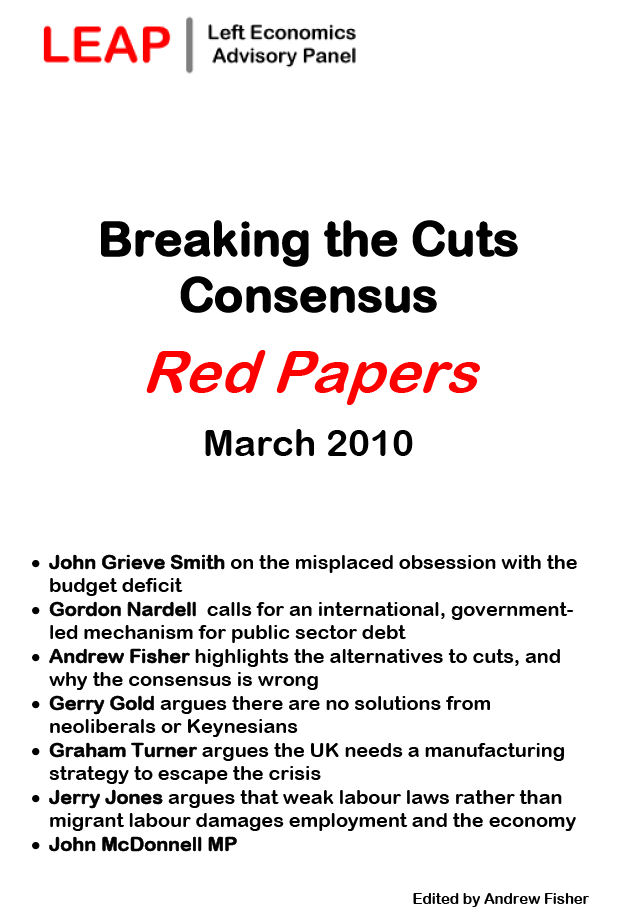
LEAP Red Papers March 2010: Breaking the Cuts Consensus


The March 2010 LEAP Red Papers: Breaking the Cuts Consensus are published today in advance on the Budget Statement on Wednesday 24th March.

In this edition of the papers, John Grieve Smith argues that the pre-election cuts consensus is driven by misplaced obsession with the budget deficit, and that such cuts would be damage the economy. The 'misplaced obsession' could be countered by an international, government-led mechanism for pricing and trading public sector debt, argues Gordon Nardell.

An alternative to the cuts consensus, based on tax justice and public ownership, is argued for by Andrew Fisher, while Gerry Gold explains why neither the solutions offered by neoliberals nor Keynesians can solve the global crisis.

Graham Turner argues that the crisis in the UK is exacerbated by the decline of manufacturing, on contrast to other countries that have had a clear manufacturing strategy, while Jerry Jones tackles another election issue – migration – arguing that trade union rights are the solution to exploitation and under-cutting.

As John McDonnell MP concludes, no party is adequately addressing these issues because none want a more democratic system

Download the papers in full.

Wednesday, 10 March 2010

Women and the recession


It's the first day of the Women's TUC conference today in Eastbourne, and to coincide, the TUC has published statistics showing that women workers would be hardest hit by public service cuts.

67% of public sector workers are women, and of part-time workers in the civil service, 87% are women. These statistics highlight the better flexibility in the public sector, which allows workers with childcare and other caring commitments, still mostly women, to work flexitime or part-time.

With all parties threatening massive public sector job cuts, it is clear that women workers would be hardest hit. Download the full TUC report.

But there's also another reason why women are more likely to be hostile to public sector and welfare cuts - they are the main service users. There are more women pensioners, more women in poverty due to unequal pay, and the disproportionate caring responsibilities they have bring them into closer contact with health and education services too.

Public sector cuts are a feminist issue!

Sunday, 13 December 2009

Everything must go? Brown’s asset sales assessed


Andrew Fisher

Just as Thatcher bagged up the family silver and flogged it at knock-down prices to her mates in the City, so Brown and Darling have scraped around for any valuable bits that Thatcher and Major inexplicably overlooked.

And so on 12th October 2009, Gordon Brown announced what Alistair Darling had already announced in the Budget in April 2009: the great New Labour sale – everything must go! – from the Royal Mint to Royal Mail, the Ordnance Survey, the Channel Tunnel Rail Link and much much more!

The flaw is that many of these government controlled assets are exactly that: assets. They generate income into the Exchequer, and so Brown is – as John McDonnell MP pointed out – “slaughtering geese that lay golden eggs, for a one-day fry-up”.

Table 1 below shows the level of revenue that some of these assets generate to the Exchequer every year. In addition the Student Loan Company received £900m in 2008/09 in student loan repayments (although these should be written off as unjust debts).

Table 1

Organisation Turnover Surplus
Ordnance Survey £117m £16m (13.7%)
Royal Mint £159m £5m (2.9%)
Tote £2,900m £156m (5.4%)
Royal Mail £9,560m £321m (3.4%)
Dartford Crossing £23m £4m (17.7%)
Urenco (1/3rd for sale) £1,130m £240m (21.2%)

Without even taking into consideration the revenue generated by some of the proposed asset sales (e.g. Channel Tunnel Rail Link, land and council house sales), we can see that these raise around £1.5bn per year for the Exchequer.

It makes no sense to sell these assets. In fact the imperative would be to create more revenue-generating assets for HM Treasury. The state has recently acquired several banks and the profitable East Coast Mainline franchise – all of which, if properly run, should generate substantial revenue to the Exchequer.

Another income generator is council housing which, as Defend Council Housing has shown, has money taken from it every year. This is why the private sector is keen to get its hands on it – and Brown is only to happy to oblige.

Brown’s £16bn asset sale announcement on 12th October included the sale of tens of thousands of council homes – which a cynic might suggest undermines his council housing credibility gained at Labour Party conference for promising to build approximately 2,000 council homes over the next few years.

As Jeremy Corbyn MP said: “To sell assets means a loss of already huge public investments and enables the purchaser to fleece the public for decades to come” – which is of course why they are ‘assets’ and why the private sector wants them.

Brown’s asset sales make no economic sense – they will damage the UK exchequer in the medium to long term and result in worse services due to the innate inefficiency of the private sector. Yes you read that right

Private sector – more efficient? No.

This asset sale further exposes to ridicule the rhetoric of private sector efficiency and dynamism. Why not sell state ‘burdens’ to these entrepreneurial alchemists to turn to profit – using their innate efficiency? Because the dynamism of the ‘profit motive’ is a myth, as this recession has so clearly demonstrated.

One private train operator was recently quoted in the trade press as saying, “I do find it slightly irritating that we don’t operate on a level playing field with [state-owned] European companies . . . you have entities supported by the state in Holland, Germany and France which do not have the same constraints on them of delivering for shareholders in the way we do. I was concerned that the Dutch could be satisfied with a very low return”. Still a return you note, but the inefficient distribution of surplus to shareholders is factored out.

In the days following the public sector takeover of the East Coast mainline rail franchise (formerly operated by National Express) it was announced that seat reservation charges would be abolished and an extra £12m invested in station improvements. The Transport Secretary Lord Adonis stated that he expected to “see real improvements in the service and better value for money”, and Elaine Holt who now manages the franchise on behalf of the state said, “over time we'll introduce further improvements to the service, the stations and the trains”.

This crisis is throwing capitalism into sharp relief – profit is wasteful, and the corporate sector has consumed more state welfare than if the whole country was on the dole. But it’s always been obvious, which would provide a better public service – a public sector operator where any surplus is reinvested into service improvements, lowering costs, and raising staff wages; or a private sector operator that must divert a proportion of that surplus to its shareholders?

A similar instance occurred with the nationalisation of Northern Rock. CBI director general Richard Lambert, said: “It is critically important that state ownership of the bank should not be allowed to distort the savings market, through access to government funds on favourable terms”. This roughly translates as a publicly-owned bank can offer better terms to savers (aka “distort the savings market” in CBI-speak).

The private sector is terrified of fair competition from the state and non-profit models of production – and this should give us the confidence to argue for and develop the alternatives.


*This article is taken from the LEAP Red Papers: The Cuts, which can be discussed in full on the LRC website