Showing posts with label Keynes. Show all posts

Saturday, 18 February 2012

Unemployment, the economy and the new slave labour

"Look after unemployment and the Budget will look after itself" - John Maynard Keynes, 1933

Unemployment rose by 48,000 in the past three months to 2.67 million, the economy managed only 0.3% growth in the past year, and Osborne is having to borrow far more than he planned - not to invest in the economy, but just to service debt.

Keynes made that statement in the 1930s when politicians were heading in completely the wrong direction under Ramsay MacDonald's national government. Reducing unemployment is the key to closing the deficit and reducing Britain's mounting debts. More people in work means more taxes coming to Treasury coffers, and less being paid out in benefits (not just the pitifully low jobseeker's allowance, but in housing benefit and other reliefs).

More people in work means more disposable income in the economy to help sustain jobs in the service and retail sectors. This will keep more people in work in those areas and would give businesses the confident to invest; creating more jobs. There's also the added bonus of extra VAT revenues too (a virtuous circle you might say).

The right will be quick to jump on the Keynesian analysis - and ask how will all these new jobs be funded? The simple answer is by borrowing. The knuckle-dragging morons of the right will then glibly quip 'oh so your solution to a debt crisis is to borrow more'. This is your chance to quip back 'yes, like George Osborne is - an extra £46bn in fact, because your stupid way doesn't work'. What would £46bn fund? Well crudely over 1.8m jobs paying £25,000 (which would in turn give back billions in tax revenue).

Instead of this Keynesian approach, Osborne is following the Thatcherite monetarist approach. Osborne also recognises that welfare costs will rise when unemployment is high, but his solution is cutting £20bn from welfare over four years. This is attacking the victims of the economic crisis.

Workfare is a particularly vile element of this 'welfare reform', in which claimants are offered, or forced onto, placements in large corporations to work near full-time hours for free. This benefits the profit margins of the companies, but does not create jobs. In fact given there are to be at least 250,000 of these placements then it is fair to assume that some job substitution will go on, and that it will have some effect in suppressing wages.

While 2.67 million people are unemployed, there are only 476,000 vacancies in the economy. The TUC has done valuable work showing that actually there are as many as 6.3 million people looking for work, by applying the US U6 model to the UK - and those just wanting to change jobs.

Are workfare placements included in the vacancies figures?

More worrying still is that some of the 476,000 vacancies, the ONS cites, might actually be unpaid work placements. Following the emergence of a Tesco ad for night shift workers on 'JSA+Expenses', LEAP asked the ONS 'do the 476,000 vacancies in the Labour Market Survey data include unpaid work placements through DWP work experience schemes?' The reply was underwhelming: 'It is unlikely to be included as businesses are asked how many people they are looking to recruit from outside their business'. 'unlikely' is not the reassurance we wanted, but the rest of the message is worse - workfare placements are recruited from outside the business as the numerous workfare ads now emerging in Jobcentres prove.

Ineffective and immoral

The DWP's own research has found that "workfare is least effective in getting people into jobs in weak labour markets where unemployment is high" (so like now then), and further adds "schemes that pay a wage can be more effective in raising employment than 'work for benefit' programmes".

For 16-24 year olds - 22.2% of whom are unemployed and who make up around 40% of all the unemployed - the Work Experience Programme offers the opportunity to experience slave labour in a modern setting. Now, some people have criticised groups for calling workfare, 'slave labour', and they're right: slave labour was often provided with food and tied housing.

Many of us point to the 1930s and Keynes because he was arguing against a political consensus of idiots who were wrecking the economy and with it millions of lives. Many of us have argued that this government is winding back the clock to the same period - ripping up the post-war welfare state. Now with the reintroduction of slave labour, it is clear the Tories and Liberals want to go back even further to the early 19th century - a time when slavery had only relatively recently been made illegal. But even then the Tories didn't argue for its restoration.

Friday, 8 April 2011

"There is an overpowering logic in putting people back to work"


Letter in today's Independent from Kelvin Hopkins MP

Stephen King's "Economic Outlook" (4 April) did at least cast doubt on Osborne's pipedream that savage cuts in public spending will usher in a private-sector supply-side economic recovery.

Price Waterhouse Coopers estimate that every job lost in the public sector will mean another job lost in the private sector, so if 450,000 jobs in the public sector are lost, we could be looking at close on a million extra unemployed some three years hence. It could actually be worse than that with powerful downward multiplier effects kicking in.

King goes on to reject the Keynesian alternative, too, suggesting that whatever governments do, we're all doomed. He should be reminded that in 1945, with gross government debt four times larger than now, Labour and subsequent Conservative governments spent their way out of debt by maintaining high levels of employment, thus maximising tax receipts and minimising the bill for benefits. The National Health Service was created, living standards rapidly rose, and inequality was reduced. More of the same now would have the same effect, so why not just do it?

The alternative is to leave millions of ordinary people wishing to consume goods and services but without the income to do so, and millions of people willing to produce those goods and services but unable to do so because they are unemployed.

There is an overpowering logic in putting those people back to work. That cannot happen unless the government takes action to create jobs, raising spending in the most labour-intensive areas such as construction and the public services. Annual deficits and Britain's gross debt would then start to fall just as they did in the quarter century after 1945.

Kelvin Hopkins MP (Lab, Luton North), House of Commons, London SW1

Sunday, 20 March 2011

Keynesian consensus equals a constructive advance


John Grieve Smith says Labour must argue for properly funded investment in the nation’s future

The two key objectives of Labour’s economic strategy should be to reduce unemployment while maintaining and improving public services. That would be in stark contrast to the coalition’s policy of cuts that will increase job losses and cause serious difficulties for education, health and other vital services. As all this becomes apparent, there should be growing support for alternative policies.

The last Labour Government was one of the international leaders in using increases in public expenditure and cuts in taxation to increase demand for goods and services in order to fight the recession. The consequent budget deficits led to extra public borrowing and hence higher interest payments on public debt. But this was money well spent in minimising the reduction in output and employment, with all the waste and personal suffering that involves.

The trouble now is the widespread hysteria about the deficits, exemplified by the Greek and Irish financial crises, as financial markets panic about governments’ ability to meet the future interest and repayment costs of their increased debt. The consequent cuts in public expenditure to boost financial market confidence will prolong, rather than reduce, high levels of unemployment. The latest Office for Budget Responsibility report suggests that unemployment will continue rising until it reaches a peak of 8 per cent next year.

As far as the United Kingdom is concerned, no one should seriously suggest that we are in danger of defaulting on our public debt. The coalition Government does not need to take precipitate action to reduce the deficit when it is likely to exacerbate the unemployment problem. Cuts in public expenditure involve a direct reduction in employment in the public sector and the firms supplying it. In addition, as people lose their jobs and spend less, companies supplying consumer goods and services will suffer – and cut their labour forces.

When we are safely out of the recession, careful action should be taken to achieve a gradual reduction in the deficit. This should not involve cuts in expenditure on public services, but increases in types of taxation which have the minimum effect on employment. Tax increases on people with lower incomes can lead to a corresponding drop in their expenditure. Tax increases on those who are better off may well lead them to dip into their savings in order to maintain their spending on consumption. Moreover, taxes on capital, such as an increase in inheritance tax, may have little or no effect on consumption. So an increase in progressive taxation is the best way to tackle the deficit, with the minimum – if any – effect on employment.

Such an approach would match the public mood of discontent with the growing inequality of incomes, as exemplified by the much-publicised high salaries and bonuses of top bankers and company directors. Britain has the fourth highest level of inequality of all the countries in the Organisation for Economic Co-operation and Development. Again, it seems a safe bet that there will be increasing concern with present policies as local services, such as schools and hospitals, begin to feel the pinch – both from cuts in current spending and delays in new investment.

The size of the public debt would be seen in better perspective if it were more widely recognised that borrowing is the normal way to finance investment in improved infrastructure such as transport, and public services such as health and education. It would help if the Government’s accounts were to distinguish debt arising from new investment and ascribe it to the sectors which are benefiting – for example, education.

Labour is in no way being irresponsible or opportunist if it takes serious issue with the coalition over the cuts. We should make it clear that a Labour government would not be prepared to accept a continuation of the present high levels of unemployment. It would make the reduction of unemployment a key objective in determining its approach to the budget deficit, public expenditure and taxation. This would signify a return to the Keynesian consensus that existed in the days of full employment before Margaret Thatcher’s reign. Such an approach would be consistent with promoting progressive taxation, rather than cuts in public services, as part of a campaign to reduce the current level of inequality and establish a fairer society.

  • John Grieve Smith is the author of There Is A Better Way: A New Economic Agenda For Labour
  • This article also appears in the current issue of Tribune

Saturday, 5 February 2011

Take care when quoting Marx

Andrew's favourable post of Hugh Radice's Red Pepper article ends with this 'Time for an old, old slogan: workers of the world unite!'

As most may know this is a revised version of the last line of the Communist Manifesto, but in that document Marx and Engels propose more than uniting as a way forward. The last paragraph of the Manifesto reads in full, and it is particularly important as the wave of popular uprisings unfold in the Middle East:

In short, the Communists everywhere support every revolutionary movement against the existing social and political order of things.

In all these movements, they bring to the front, as the leading question in each, the property question, no matter what its degree of development at the time.

Finally, they labour everywhere for the union and agreement of the democratic parties of all countries.

The Communists disdain to conceal their views and aims. They openly declare that their ends can be attained only by the forcible overthrow of all existing social conditions. Let the ruling classes tremble at a Communistic revolution. The proletarians have nothing to lose but their chains. They have a world to win.

Working Men of All Countries, Unite!


But it is important to beware when people refer to Marx or even Keynes .....


Dogma gives Marx a bad name

The merit of veteran Financial Times writer and noted economist Samuel Brittan is that he is not a dogmatist. He may not have all the answers when it comes to today’s crisis. But Brittan believes that summoning the writings or reputations of dead economists to back a policy is hopelessly wrong.

Vince Cable, Liberal Democrat business secretary in the Coalition government, claimed in the January 17 issue of the New Statesman that “Keynes would be on our side”. Two economists promptly called this “foolhardy”. Others, says Brittan, too often cite Karl Marx to justify a view.

“What a reflection all this is on the would-be scientific standing of political economy,” says Brittan who served in Labour as well as Tory governments. He himself was taught by Milton Friedman, the father figure of the monetarist theories of the 1980s implemented by Thatcher and Reagan.

There is indeed no merit in citing what Keynes or Marx (or even Friedman) said at a certain point in history if the aim is to prop up a preconception about today’s world. As Brittan says: “Can one imagine physicists trying to advance their views by showing that they were implicit in some obscure passage in Einstein or Isaac Newton?”

This is true. But any half-decent physicist will know that a modern understanding of the material world would not be possible without the advances made by earlier scientists. Their theories are incorporated into modern physics – not simply rejected as old hat.

So it should be with Marx, a revolutionary communist as well as a political economist. Turning his ideas into a tenet, a dogma to be repeated on suitable occasions, was not the responsibility of bourgeois economists like Brittan. Principal blame for this rests with the Stalinist movement, particularly the bureaucracy of the former Soviet Union. They did this to Lenin too, taking a phrase here and a quotation there to provide a rationale for every twist and turn.

Brittan himself is not averse to throwing out the baby with the bathwater, declaring that if Marx were alive today he would be 193 years old and, therefore, no one could know what he would say. This is indisputable; and the likelihood of Marx returning is not even up for discussion.

What Marx left, however, was a legacy of a philosophical method, an approach to understanding constantly changing reality. Marx himself, in the afterword to the second German edition, could do no better than cite with approval a critical review of Capital in 1872:

The one thing which is of moment to Marx, is to find the law of the phenomena with whose investigation he is concerned; and not only is that law of moment to him, which governs these phenomena, in so far as they have a definite form and mutual connexion within a given historical period. Of still greater moment to him is the law of their variation, of their development, i.e., of their transition from one form into another, from one series of connexions into a different one. This law once discovered, he investigates in detail the effects in which it manifests itself in social life.

This dialectical method enabled Marx to reveal the contradictions inherent within the system of capitalist production. The tendency of the rate of profit to fall, the continuous drive to global expansion, the inevitable formation of monopolies – these and other scientific laws were expounded by Marx. They naturally need verification through a study of today’s conditions. Rescuing Marx from the dogmatists is essential in our preparation to transcend a capitalism that is in its deepest-ever and most threatening crisis.

Paul Feldman
Communications editor

http://www.aworldtowin.net/index.html
4 February 2011


Friday, 21 January 2011

The real Keynes


Book Review by Graham Turner

Keynes Betrayed, by Geoff Tily, Palgrave Macmillan, 2010

Palgrave Macmillan have republished Geoff Tily’s “Keynes Betrayed” in paperback.

This is an important book because it contradicts so much of the perceived wisdom over Keynes’s policy prescription. And it should be stressed, the errors of understanding Keynes are committed by economists on both sides of the spectrum – right and left – as well as a good chunk of those sitting in the middle.

Keynes was far more concerned about monetary issues than fiscal policy. Unfortunately, most cursory reading of Keynes simply focuses on the General Theory, which was written in 1936. Even then, too many readers of this important book fail to appreciate the chronology of policy advice Keynes was offering in the 1930s – monetary first, fiscal second.

Indeed, Keynes made an enormous – and positive contribution – to policy long before the General Theory was published, as Geoff Tily shows commendably in this book. "Keynes's central policy priority was a permanently reduced long-term rate of interest", Tily argues. Keynes was a leading proponent of central bank long-term asset purchases – today called quantitative easing (QE). Furthermore, he was quite clear about the problem within bond markets which made QE necessary, as shown by his liquidity preference theory. Keynes also understood the importance of targeting the yield rather than merely setting a nominal purchase target for QE.


In all these respects, Keynes had a much greater understanding of the bond market – including the critical role of expectations - than today’s central bankers. The current FOMC has been content to announce an extension of its own, somewhat flawed QE, announcing last November that it would buy a further US$600bn of US Treasuries. Since then, sniping from hawks on the FOMC, a (modest) uptick in economic growth and an unseemly rush to extend tax cuts has sparked a huge sell-off in US Treasuries. And that has occurred just as the S&P/Case Shiller index for house prices is poised to break down to new bear market lows. Federal Reserve chair Ben Bernanke has been forced to admit that the economic recovery in the US is slow. It may well stall, precisely because the Fed chair, and much of the economic establishment, including New York Times commentator Paul Krugman (not to mention the departed, discredited Lawrence Summers and Chrisina Romer) simply do not ‘get Keynes’.

One economist who clearly does is Geoff Tily. His book is based on a PhD thesis, supervised by Professor Victoria Chick at the University College of London. Professor Chick is one of a handful of economists who truly comprehends the importance of monetary affairs in Keynes’s work, and encouraged Geoff to write his thesis.

Geoff provides clear evidence of the role Keynes played in driving the shift towards QE in the early 1930s, long before the General Theory was published. He also dissects the manner in which Keynes’s legacy was traduced by economists, both on the right and soft left in the post-war era, after his untimely death in 1946.

This book is rigorous, and readers will be impressed by the comprehensive manner in which Geoff takes Keynes’s critics to task. It is not the sort of book that can be read in one quick swoop. It is a demanding read, because it is so thorough. It challenges many of the misconceptions over the policies pursued during the 1930s. For these reasons, this book helps to explain why the West has botched its response to the credit crunch.

Thursday, 21 January 2010

Fiscal Irrelevance Bill

Yesterday MPs voted through the Fiscal Responsibility Bill which pledges to halve the budget deficit within four years.

Aside from the anti-Keynesian nonsense of the concept (cutting investment during a recession), and the brutal nature of the cuts envisaged by all three main parties, the most relevant aspect of the Bill is it's irrelevance.

Clauses 1 and 2 of the Bill set out targets for cutting the deficit. Clause 3 states that if an objective set by Clause 1 or 2 of the Bill is not met then the Government must come to Parliament and explain why not.

Very simple: a sensible government would report annually saying it was ignoring the objectives set under Clauses 1 and 2 as they would damage the economy, and public services. Job done. Forget about the Fiscal Irrelevance Bill. There's not even a need to repeal it.

Nevertheless, Bill or not, the political cuts consensus continues unabated, and it's good that LEAP Chair John McDonnell has tabled EDM 681 'Public Expenditure and the Deficit':

That this House notes that in his interview in the Financial Times of 19 January 2010 the Chancellor of the Exchequer has admitted to a planned policy of 17 per cent. cuts in expenditure across Government departments other than schools, health and the police force, the early withdrawal of the 50 pence tax rate and an end to the tax on bonuses; and therefore judges that this will mean that the ordinary people of the UK will be the ones who are to pay for the economic crisis, not of their making, and that many of those who, through their reckless greed caused the crisis, will walk away unscathed, receiving new bonuses and playing once again in the casino economy.

So far also signed by MPs Katy Clark, Jeremy Corbyn and David Drew - all of whom are supported in the LRC General Election Campaign.

Tuesday, 15 December 2009

The Cost of Public Sector Cuts


Richard Murphy

There’s been a lot of discussion about the need for public sector cuts. Give or take the public sector employs about 5 million people. If there were to be public sector cuts of 10% then maybe 500,000 people would lose their jobs.

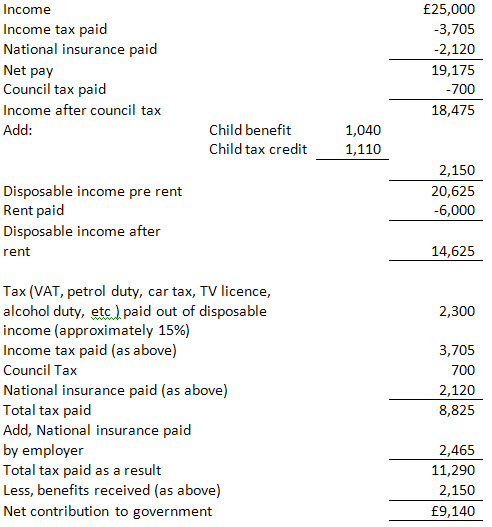
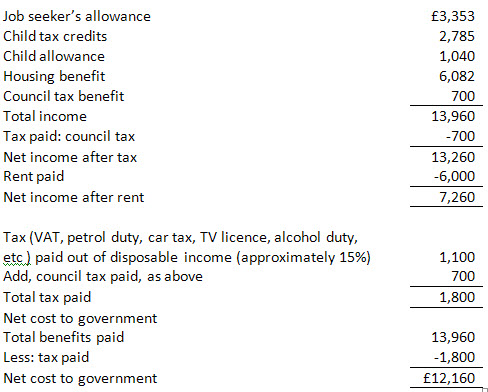
I have considered the consequence of this by doing a simple exercise. I have done a case study on the cost of a person earning £25,000 per annum who is a single parent with a child of school age, paying £500 a month in rent and £700 a year in council tax losing their job. The assumptions are slightly simplifying: benefits are harder to calculate in more complicated households. The rate of pay is slightly above mean and significantly above median UK pay. But £25,000 is a good, round number.

The total tax paid and benefits received by this person look like this:

Now assume the same person was unemployed. They would get the following benefits:


The total lost to the government if this person loses their job in the private sector is the addition of the total contribution lost plus the total cost paid. That is £21,300.

It could be argued that the cost is less in the public sector because tax deducted goes straight back to pay the employment cost. It so happens the net effect is the same. In that case the comparison with the private sector is maintained here.

The actual cost is higher though. The person in work has disposable income of about £14,625; the same person unemployed spends £7,260. That is a difference of £7,365. In other words they are twice as well off in work as out of work. But, most importantly, of that difference at least 65% will support other people’s wages plus the taxes they spend on goods and services. Assuming these other people pay taxes at about the same overall rate as the person in the above exercise (and this is likely) that means about 36% of that difference will indirectly go in tax as well. That’s about £1,700. So now the benefit of keeping the person in work is £23,000 and they are only paid £25,000. Put it another way: 92% of the cost of cutting a £25,000 a year job when we have less than full employment is paid by the state.

In that case it is abundantly clear that paying to keep people in work pays – especially and even particularly if what they do has long term benefit that saves cost into the future. That cost saving – for instance from green efficiencies – has only to be £2,000 for it to be entirely worthwhile creating a job out of government spending to keep this person in work.

And that is before any account is taken of the social costs of being in employment, which are substantial in terms of reduced crime, improved educational outcome, better health, and more besides.

Now let’s reflect on the fact that in reality the average direct cost of employing an average public sector employee is less than this. Let’s make it around £21,000 – more like median pay – and then note that 500,000 at this pay rate will supposedly save £10.5 billion in the wage cost of the government. Putting these half a million people out of work will save us about £0.8 billion. That’s misery for 500,000 people and their dependents to save just £1,600 per job lost.

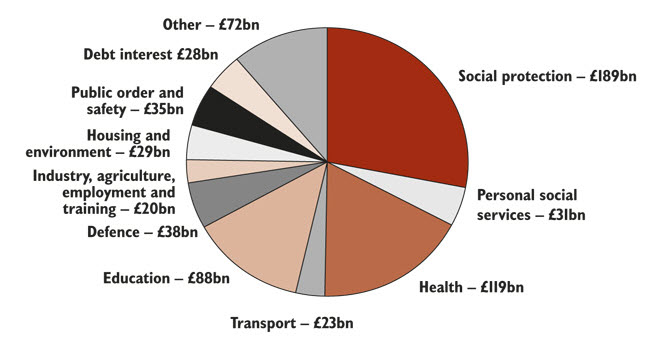
That though is not the end of it. Total government spending is £671 billion, split down like this:


So, to cut spending by 10%, £57 billion of extra cuts are required on top of sacking 500,000 people. These savings would need to be made up of:

1. Reduced benefits, which will result in reduced consumer spending, or
2. Reduced payments to private sector contractors to provide work to the government.

Either way there is reduced demand. £57 billion of reduced demand. Of which 65% approximately will go to labour. That’s £37 billion of labour cuts then. At £25,000 or so a head (approximately) that’s over 1.5 million more unemployed.

That, with the losses from the public sector adds more than 2 million to unemployment – making well over 4 million in all. Some consider this likely, I know.
But what is the effect on public spending? Maybe 92% of the cost of this cost in lost wages will fall on government either by benefits paid or lost revenue. That’s £34 billion. And that’s before we deal with the massive social and crime related costs of that level of unemployment and the collapse in our long term prospects.

So, to achieve total savings of maybe a net £4 billion in borrowing (£3 billion net from private sector cuts and about £1 billion net from public sector employee cuts) this policy would put 2 million people out of work.

Now I know all the problems of extrapolation in here, and I know that not everyone will get benefits in the way I have outlined above (but those that don’t will suffer even more extreme losses in income – compounding losses elsewhere) but frankly all analysis in this area is moving into the unknown, economically and statistically speaking. And losses to government may also be bigger than I suggest – after all out of the £57 billion of non-labour cost cuts required £20 billion will be lost profits and rents – and they could result in £6 billion of additional government tax losses, tipping the equation in the direction of any cuts in government spending creating actual cost for the government.

Which makes clear that the logic of cutting government spending now when we have no jobs for those we make unemployed makes no sense at all. It’s profoundly annoying to have to reinvent the whole Keynesian argument in this way – because that is exactly what I am doing – but needs must precisely because so many do not seem to understand this obvious fact.

Of course this situation will eventually change: private sector demand will pick up and employment with it. But right now there is no sign of that and to cut now would, I can confidently predict, produce something like the outcome I predict here. Put simply: cut spending and we’ll increase government debt. Perverse you might think – but true, and exactly what Keynes predicted.

What is more, the reverse is true. Increase spending now and the multiplier effect which compounds the impact of cuts in the above analysis goes into reverse: more jobs are created, revenue flows to government, benefit spending falls and government debt goes down with it.

The answer is simple: if we want to get out of the mess we’re in we spend. It’s the only way to reduce government debt at this stage in the economic cycle. It worked in the 30s. It will work now. Let’s do it.


*This article is taken from the LEAP Red Papers: The Cuts, which can be discussed in full on the LRC website

Tuesday, 3 November 2009

No Way to Run an Economy


I've just got back from the launch of Graham Turner's new book No Way to Run an Economy at Bookmarks, the socialist bookshop.

Thanks to getting an advanced copy I had read all but the last two pages before the launch began (I read the last two pages on the tube back to Charing Cross - like the rest of the book they were excellent).

Graham says he wrote the book - the follow up to The Credit Crunch - out of frustration at the inept handling of the economic crisis (the book is subtitled 'why the system failed and how to put it right') in the UK and US in particular - the book is scathing about the incompetence of the Obama Administration's response.

Turner highlights the misinterpretation and ignorance of Keynes that has exacerbated the current crisis, but also uses Marx to highlight the systemic failings and contradictions in modern capitalism. As Graham joked, "I've heard me be described as a Keynesian because I sometimes use Keynes to demonstrate what's wrong. I've also cited Friedman, does that make me a monetarist? I'm an economist: Marx is useful at looking at the structural problems".

The book does indeed look at the failings of central banks in the US, UK and EU - and invokes Keynes to highlight their mistakes. Likewise though the strength of this book is the more in-depth look at the structural failings and a Marxist critique of neoliberalism. In utilising these two analyses Turner demonstrates an understanding of today's globalised economy that few policymakers have grasped - and it highlights not only what a superb analyst Graham has been throughout this crisis, but how such a thorough understanding of the economy has informed that analysis.

This highly readable book is a comprehensive overview - packed into under 200 pages - of our economy and its current malaise by the most astute chronicler of this economic crisis. Buy it now - and do so from Bookmarks.

Thursday, 9 April 2009

'Creative destruction' order of the day

Despite the G20’s attempts at confidence-boosting rhetoric, the interdependent components of the global economy remain locked in a deadly embrace, wrestling with each other as they plummet to the ground.

Ever more desperate attempts to resuscitate the fantastic but failed world of credit and debt dilute the value of currencies and further worsen the health of the global corporations as demand falls for the goods they produce, sending their share prices down.

In Britain, all talk of a “recovery” later this year has disappeared and next week’s Budget is in fact a crisis measure as public finances spiral out of control. European steel production is close to collapse and a trade war with China is looming over its dumping strategy.

The Irish government is the first to admit in practice that neither additional government borrowing, nor expanding the supply of money can help its country withstand the impact of the global crisis of dwindling production and consumption. It won’t be the last.

In measures designed to forestall the looming threat of state bankruptcy, its emergency second budget looks like the flailing autotomised arms of a threatened octopus, when a limb is severed by the endangered creature.

In a so far maverick response to the shock forecast that economic activity in the Republic is forecast to shrink by 8% this year, a dramatic worsening of last year’s 3% contraction, finance minister Brian Lenihan warned of "a serious decline in national living standards: the sharpest fall on record.”

Taxes will rise, though not on corporate profits, and spending on services will be slashed. In the public sector pay will be hard hit affecting a large part of the population.

Nevertheless, with already the worst government deficit in Europe, and the entire financial sector in a state of collapse, a new Irish agency will be provided with funds to buy up the banks’ property and land-based bad debt. The catch here is that no-one knows what its real value is, nor what the price should be.

Elsewhere in Europe, rather than taking the route of printing money to add to the trillions already given or promised to the banks, Germany and France have been giving away vouchers in a new-for-old car scrapping scheme.

Demand for Germany’s €2,500 vouchers has been hugely successful. Far more people have applied than expected, and concern is rising about the public anger that will erupt when the money runs out. Angela Merkel’s surprised government has added a further €3.5bn taking the total available to €5bn.

Sales of brand new small cars have soared, but there’s a catch here too – it doesn’t seem to have increased consumption overall. The second hand market has collapsed completely and what spending there is, is transferring from other products like TVs and sofas.

As the crisis enters historically uncharted territory, governments are exhausting all the weapons they can use in their attempts to rescue the capitalist way of life. The Irish pioneers have opened the doors to a new phase.

Joseph Schumpeter, an economist high priest of capitalist business cycles, and an opponent of Keynes, described the process in his famous book, Capitalism, Socialism and Democracy, when he wrote: “This process of Creative Destruction is the essential fact about capitalism. It is what capitalism consists in and what every capitalist concern has got to live in.”

Gerry Gold
Economics editor
A World to Win
http://www.aworldtowin.net/

Friday, 17 October 2008

Time to cut the losses

In the last week, stock markets the world over have been showing the classic signs of bipolar disorder, but in the most concentrated form. Euphoric, manic, hysterical highs followed by the deepest depression. Much of it, say some of the commentators, is internally generated, the result of speculators feeding off each other’s panic.

But as everyone else knows, there are clear external causes. The soaring highs are the direct result of a renewed series of injections, by governments and central banks, of credit – the same stuff that the world’s financial system became addicted to and wholly dependent on during the “long boom”. It doesn’t help. Yesterday, the two largest Swiss banks UBS and Credit Suisse were obliged to seek new capital in a further attempt to prevent them turning into non-banks, ceasing to exist, becoming, as Monty Python had it, dead parrots. When the Swiss banks fall, there’s nowhere safe left for your money.

The stock market lows – a five-year retreat reached in the UK and back to the 1980s in Japan – are the result of an avalanche of indications that the recession is not only with us, but will last for years. Giant corporations are bankrupt, jobs falling off a cliff, house prices dropping like a stone. Even the price of oil has fallen back, as the speculators move their money elsewhere. China, which has powered the global economy, is cutting back and shutting down factories.

The Brown-led government, which has taken on the role of street-level pushers, are looking to raise the money that they are guaranteeing to the banks by issuing more debt to the investment markets. But there’s a limit to what can be raised. The rest will come from an assault on government spending, public services, the elimination of the legal guarantee for public sector pensions, and last but not least, any measures to deal with climate change – irrespective of Miliband the Younger’s pronouncement on an 80% emissions reduction by 2050.

Early signs of the brutal reality that will result came from the news that under Brown and Darling’s control, Northern Rock has been foreclosing, repossessing and evicting at double the rate of the rest of the industry, as detailed in Andrew's post on Wednesday. So much for the benefits of “nationalisation”.

Brown knows that the bankers’ bail-out won’t stop the rot, so he’s promoting a restructuring of the world’s economy, along the lines of the Bretton Woods arrangements that laid the basis for the post-war recovery and the boom years. The Financial Times says this is premature, adding:“Lest we forget, Mr Brown himself was in charge of the IMF’s ministerial steering committee for a large part of the past decade and yet signally failed to implement the ideas he is parading. During this time, it was repeatedly explained to him that every early warning system devised by the finest minds in international economics, including those at the fund, either predicts crises that never arrive or misses those that do.”

The paper of business is correct. The basis for restoring stability after a decade and a half of the Great Depression wasn’t Keynes’s proposals, but the massive destruction of surplus productive capacity and human lives during the second world war.

A much easier, less destructive way out of the mess would be to cut the losses, admit the capitalist system is bankrupt and make the transition to a new kind of economy altogether. One based on not-for-profit production, social ownership, self-management, planned production for need, distributed via an intelligent market informed by democratic processes and expressed preferences. That’s what we will be discussing tomorrow at the Stand Up for Your Rights festival. Be there!


adapted from www.aworldtowin.net

Saturday, 23 August 2008

A policy error too far

It’s good to see praise for the work of contributors to LEAP such as Andrew Fisher’s warm welcome to Graham Turner’s new book The Credit Crunch. But, in the spirit of comradely debate, here are some comments which show that Graham’s book raises as many questions as it answers.

The book correctly chastises the mainstream press for failing to address the underlying causes of the massive accumulation of debt that exploded in the sub-prime crisis of 2007 and the credit crunch that followed, and he is right to say that this is “out of fear that the contradictions and flaws with the economic philosophy they have espoused will be exposed”. Graham is right again in his critique of the neo-liberal philosophy of unrestricted free trade which has dominated the global policy agenda for the last period.

It’s also true, as Andrew points out, that Graham talks about the growing power of the corporations during the period of globalisation. But there’s hardly a mention of it in the main parts of the book, and any deeper analysis of the underlying causes of corporate growth is absent. Rather than tracing the ballooning of credit and debt as the necessary expression of, and complement to the relentless expansion of capital, as is shown in my book,
A House of Cards, Graham’s subsequent interpretation claims the whole problem is the result of policy errors by governments.

While others have traced the growth of a global network of transnational corporations which have transformed the role of national governments, and some even, like Leslie Sklair, have shown the development of a transnational capitalist class, Graham tends to take an anti-historical view, preferring to see the world as it was when Keynes lived and breathed. His is a macroeconomic world of nations competing in a system of more or less free markets. If only they’d followed the interventionist theories and advice of the economist and Lord John Maynard Keynes, governments could have kept the corporations under control and sustained a nice balance between corporate power and workers’ interests.

Graham’s account of the historical build-up to the current crisis takes in the 1920s and 1930s Great Depression, but leaps over the Second World War and the destruction of capital made necessary by the investment frenzy that led to overproduction and the 1929 crash. The creation and elimination of surplus productive capacity is an essential component determining the boom-bust trajectory of the capitalist economy and Graham sidesteps this question.

In my view, seeing the present crisis as a result of “policy errors” is itself a profound error. Policy-makers and corporate power represent a division of labour within the capitalist system as a whole. The globalisation process propelled them into each other’s arms, transformed the roles of the IMF and World Bank, institutions created at the post-second world war Bretton Woods to manage relations between nations (in which Britain was represented by Keynes, but largely sidelined by US interests), and created a process which led to global institutions like the World Trade Organisation. All now became subject to legions of corporate lobbyists serving the self-developing expansion of capital. If mistakes were made their origin actually lies in the accumulation process of capital itself, an objective process reflected in the heads of policy-makers obliged to serve its interests.

Graham’s proposal to rebalance the power relationship as a way of keeping profit levels high assumes that governments are in control, when they are patently not. It’s why he ends his book with a despairing hope. Even as domestic and commercial property prices tumble around the world, Graham’s hope is that central banks and governments can prevent the debt-induced collapse of asset prices by issuing even more credit. He calls it ’quantitative easing’. In my view, this policy is not only unrealistic but also ties us into the retention of the fundamental, exploitative relationships of capitalism as the biggest economic disaster of all times looms. That indeed would be a major policy error when a bold leap to social ownership as the solution to the crisis seems a more progressive way forward.