Showing posts with label public expenditure. Show all posts

Friday, 31 May 2013

Health tourism - the true 'cost' of foreign nationals to the NHS

A new phenomenon has emerged in recent months in the long British history of scapegoating. We've had migrants stealing our jobs, migrants taking our housing, scroungers taking benefits, migrant scroungers taking benefits (I thought they were taking our jobs?!)

Now in a new malicious and factually dubious piece of divisive scapegoating we have David Cameron and Health Secretary Jeremy 'cockney rhyming slang' Hunt accusing foreign nationals of stealing our NHS. They have a catchy phrase for it too - 'health tourism'.

However, the scaremongering immediately ran into trouble when Cameron and Hunt couldn't agree on a figure with Cameron suggesting there was between £10m and £20m that the NHS should be recouping, while Hunt suggested the NHS was losing £200m. In April a Conservative MP found through Freedom of Information requests that the figure might be £40m.

Even though Conservative Party ministers and MPs can't agree on a figure - possibly because the data isn't fully available - they have problematised foreign nationals using the NHS. And this scaremongering has worked: at a recent Benefit Justice meeting I spoke at, a contributor from the floor - after rightly bemoaning NHS cuts - went on to blame the cost an open door policy through which anyone in the world can use the NHS ... apparently.

But since we have three estimates of the gross costs of foreign nationals to the NHS, let's try to get a net figure by looking at the savings to the NHS by foreign nationals, and by British nationals using foreign health services.

Foreign nationals saving the NHS

Firstly, the NHS makes a huge saving by importing foreign nationals to run the NHS. The cost of training a doctor is estimated by the BMA to be a minimum of £269,527, up to £564,112 for consultants - the cost of which is shared between trainees and the state. According to a 2008 study by the OECD (cited in WHO research), the UK had the highest share of foreign trained doctors in Europe - with 37.5%. The same research states that the UK had 243,770 doctors in 2008, so 91,414 were foreign trained.

If the UK had borne the full cost of training those doctors that would have been £24.6 billion - and that is using the lowest end of foundation training cited by the BMA (£269,527). Given we import far more doctors than we export - and that we import more doctors than any other European country - then it's safe to say the UK is saving several billion pounds.

And that's without calculating similar costs for nurses, midwives, etc. According to research by the National Nursing Research Unit, before 2005 10,000-16,000 nurses were emigrating to the UK each year, but following the changes in 2005 the numbers decreased to 2,000-2,500 foreign nurses arriving in the UK each year*.

This is without costing in the UK lives that would be lost were these foreign nationals not there to staff our NHS. How do you think your hospital would cope with losing over one-third of its doctors? The financial, social and human cost to the UK would be immense.


The cost of UK citizens on other health services?

According to parliamentary research, in 2007/08 the average value of NHS services for retired households was £5,200 (compared with £2,800 for non-retired). Now given there are about 220,000 pensioner households living abroad that's just over £1 billion. Even if just 1% of that cost was not recouped from the UK by foreign healthcare systems, that would be over £10 million. If 5% went unrecouped that would be £51 million.

Of course these figures should be treated with a health warning: firstly, they assume health costs have stayed the same as five years ago; secondly, there are no reliable consolidated estimates for what foreign health systems fail to reclaim; and thirdly the figures exclude non-pensioner households living abroad.

Conclusion

Despite whipped up fears by the Conservatives, UKIP and their daily print editions the Mail, Sun and Express, the figures for 'health tourism' cited by the government (which range from £10 to £200m) are relatively trivial in government spending terms.

In 2012, NHS spending was £104 billion. So even at the highest end of the government's dubious estimates, health tourism accounts for just 0.19% of total NHS expenditure.

That gross figure does not take account of the savings made by the NHS by importing already trained medical staff or for UK nationals who receive unrecouped treatment abroad.


* 2002 research by the Royal College of Nursing found in just one London NHS trust nurses and midwives from the following 68 countries: Algeria, Angola, Australia,  Austria, Barbados, Belgium, Benin (Dahomey),  Brazil, Cameroon, Canada, Central African Republic, China, Congo, Denmark, Dominica, Finland, France, Gambia, Germany, Ghana, Greece, Grenada, Guyana(British Guyana), Hong Kong, Hungary, India, Ireland, Isle of Man, Italy, Ivory Coast, Jamaica & Cayman Islands, Japan, Kenya, Korea (South), Malawi, Malaysia, Malta, Mauritius & Reunion, Mauritania, Moldavia, Nepal, Netherlands, Netherlands Antilles, New Zealand, Niger, Nigeria, Norway, Philippines, Poland, Romania, Russia, Sierra Leone, Singapore, South Africa, Spain (inc Canary Islands), Sri Lanka, St Lucia, St Vincent (Grenadines), Swaziland, Sweden, Tanzania, Trinidad & Tobago, Turkey, Uganda, United Kingdom, United States of America, West Indies, Zambia, Zimbabwe

Saturday, 8 October 2011

In defence of Gordon Brown (well, partially)


Last Thursday night I spoke about the economic crisis at a meeting of St Albans Labour Party, which seems in good health: a good attendance and a lively debate followed my presentation. Below I've integrated the first half my speech with some of the excellent points made in discussion.

Labour did not overspend


Despite the claims of Cameron and Osborne (and that rather politically naive and economically illiterate note left by Liam Byrne) the last Labour government was not profligate, it did not over-spend. In fact, as this graph shows, Labour actually spent less as a proportion of GDP than either the governments of Thatcher and Major.

Labour stuck to Tory spending plans from 1997-99 meaning that public spending did not start increasing in real terms until 2000. The UK had also embarked on an unprecdented period of seemingly stable economic growth that would last until late 2008.

Labour also had two decades of underinvestment in public services to make up for. The proportion of GDP spent on education, health and pensions lagged far behind the rest of Europe. Too many pensioners and children were in poverty, and Labour set ambitious targets to reduce (and even eradicate) poverty among these groups.

Labour's aim then, to increase public spending, was correct. It was necessary to build new schools and hospitals and to employ more and improve the wages of dedicated public servants.

But it was not just this period of economic growth that allowed New Labour to spend more: they also hit the utilities with a windfall tax to (partially) compensate for the fact they were undersold by the Tories' cheap sell-offs. Introduced in the emergency budget in 1997 it raised £5.2bn. Brown also sold off about half the UK gold reserves in 1999, raising over £2bn.

The decision to sell-off that gold has been heavily criticised - the price of gold has shot up since - but the question is what was it spent on? At that point our public services were in desperate need of investment - and Labour had manifesto commitments to bring down hospital waiting lists and reduce class sizes. At the time it seemed the right priority, and most people would agree.

Labour reduced the debt


So Labour spent, as Brown himself would often say, prudently throughout its term in office. It also managed to reduce the national debt - as this graph shows.

When Labour came to power in 1997, the national debt was 42% of GDP. By 2002 it was below 30%. It increased very slowly between 2002 and 2008 to 36% (still lower than any year under Margaret Thatcher or John Major). Then, as the chart shows, the banking crisis hit and Labour left office in 2010 with the national debt at around 52% - lower than in Japan, the US, France or Germany.

Despite this George Osborne came to the Despatch Box for his emergency budget in June 2010 and told us Britain was on 'the brink of bankruptcy'. Where Brown had put a windfall tax on big business privateers, Osborne delivered an unprecedented cut in corporation tax and other business tax breaks, with welfare cuts.

But Labour did make massive mistakes

Having said that some criticism must be levelled at Gordon Brown and New Labour for the mistakes they did make. Their light-touch and continued deregulation of the banking sector meant that Britain was harder hit by the global financial crisis that many other countries. Our over-dependence on the finance sector and failure to have any strategy for manufacturing left us particularly exposed.

The Tories however cannot make any headway on this because they actually called for further deregulation of the banking sector, finance and mortgage markets. They too offered no industrial strategy.

Likewise Labour should also be criticised for their national accounts-fiddling approach to investment: PFI. This has dumped about £300bn of debt on public sector bodies for assets worth about £50bn. But, bad news again for the Tories, PFI was the brainchild of the Major government and Labour's only opposition to PFI came from rebellious backbench MPs like John McDonnell and Kelvin Hopkins.

Another colossal waste of money (though more pertinently of human life) was New Labour's wars in Afghanistan and Iraq, but again the only opposition was found on Labour's own benches. Likewise for the commitment to replace Trident.

Conclusion


Labour made huge economic mistakes - it relied too heavily on the finance sector and the growth of personal debt - but none of the Tories' attack lines that Labour spent too much or left Britain on the brink of bankruptcy are tenable.

The bank bailout was also a disaster - less the nationalisation of the banks and more the privatisation of public money. Intervention was needed and although botched it was better than the Tory frontbench which dithered between bailout support and letting banks fail (and along with them would have gone jobs, savings and much more of the UK banking system) - which in turn allowed Vince Cable to appear credible.

In opposition Labour needs to assess where it went wrong. The simple formula for 1997-2010 was 'if the Tories agree it's probably a mistake', as they were on banking regulation, PFI, wars and (eventually) the bank bailout.

Thursday, 24 March 2011

LEAP Chair John McDonnell MP speaks in Budget debate


John McDonnell (Hayes and Harlington) (Lab): I listened to the Budget debate yesterday as well as today, and I want to take up some of the points raised in it. I clearly come from a different economic school from the hon. Member for Wimbledon (Stephen Hammond)—and I probably come from a different one from his erstwhile colleague the shadow Chancellor as well!

The premise of the debate so far has been that as a result of profligate public expenditure by the last Government, we have an economic crisis on our hands. The conclusion is that we can solve the deficit largely by cutting public expenditure. My hon. Friend the Member for Bassetlaw (John Mann), who is no longer in his place, referred to various Treasury charts, and I have to say that one that was published a short while ago demonstrates that the profligate expenditure argument is simply not true.

Let us consider the recent Treasury chart about public spending under the last Government and previous Governments as a percentage of gross domestic product. It shows that public expenditure under the last Government was, in fact, less than it was at the height of Thatcherism and under John Major’s period in office. I shall circulate this chart to Members. I know this is true because for many of the years the last Labour Government were in office, I was attacking them for not spending enough and for poor expenditure. I fully agree with the criticisms made of the private finance initiative; I opposed every PFI scheme that was proposed.

If we look at the chart to find out when expenditure as a proportion of gross domestic product rose dramatically, we discover that it was, as the shadow Chancellor said, only when the economic crisis hit and we had to pump out the quantitative easing into the economy. In my view, the deficit occurred as a result of the failure to match expenditure with tax justice. We had large levels of tax evasion and avoidance and, in addition, we failed to develop a whole range of other tax bases within the economy. Genuine criticisms can be made of over-dependence on the financial sector and the failure to develop the manufacturing sector during that period.

What do we do now? It is not all about cutting expenditure. In yesterday’s debate, reference was made to the crisis of the 1930s and the lessons that can be learned from it. It is worth Members returning to J.K. Galbraith, who I believe wrote the best book on the crisis, The Great Crash 1929. What Galbraith says is that although economic structures can be put in place, what will defend us most against a repeat of the crisis is memory. We seem to forget that the cause of that crisis was the cause of this crisis—speculation by the banks and other speculators and, yes, a Government who failed to regulate. I have to say, however, that when a number of Members called for bank regulation in this House, there was an element of quietude on all sides. I remember fighting for four years, in almost a solitary capacity, to secure the passage of the City of London (Ward Elections) Bill at a time when we were pressing for regulation.

One of the lessons of the 1930s is that the one thing we should not do in a recession is cut public expenditure, because that will turn a recession into a depression. However, it is exactly what the Government seem to be doing. At present 2.5 million people are unemployed, 1 million young people are unemployed, according to recent statistics 1.7 million people are in involuntary part-time employment, and the £80 billion cuts proposed by the Government will make at least another 1.2 million people unemployed.

What I am really anxious about, however, and what we should all be anxious about, are the cuts in capital expenditure. We are told that there will be a 4% cut next year and a 6% cut in the year after that, and that local government capital expenditure is to be cut by 30%—possibly more, according to the Red Book. I believe that if that element of demand is removed from the economy, we will experience either a deflationary spiral or the worst of all worlds, stagflation: increasing inflation along with stagnation in the real economy. I do not believe that there will be a double dip. My fear is that we will become like Japan, where asset values are falling, and will scrape along the bottom of economic activity for perhaps a decade.

People ask what the alternative is. I have mentioned the lessons of the 1930s, and Keynes’s name has been bandied about many times today. It is true that Keynes concentrated on the bond market, but one of the main lessons to be learned from him is that the key issue is unemployment. I think we should be declaring, across parties, that our objective must be the return of full employment, which appears no longer to be cited as a policy objective. As has already been pointed out, the most effective way of restoring investment is through capital investment—the development of capital programmes in housing, renewable energy and transport. I ask Members to look at the green new deal and to examine the One Million Climate Jobs booklet produced by trade unions including the Public and Commercial Services Union, which sets out a capital investment programme that could get people back to work.

How would that be paid for? Let me list just a few short-term measures. I am very pleased that windfall taxes have come back into fashion, and I commend the Government for that, but I do not think that the windfall taxes on the banks go nearly far enough. The lending rates on personal loans in particular are exploitative and extortionate in the markets. I also think that if we are to consider organisations that have profiteered during the recession, we should consider the supermarkets. Commodity inflation is about 3%, but they have increased prices by 6% and above, and they have been profiteering for a number of years.

I think that a windfall tax on energy is appropriate. The current profits of British Gas average 24%, and Ofgem has reported an average profit margin of 38% per customer since last November. That is profiteering during a recession. Some economists have suggested that a windfall tax in those three areas would produce up to £10 billion to get people back to work.

Let me make clear, however, as I did under the last Government, what should happen in the longer term if we are to avoid future deficits. Yes, it is about careful expenditure and it is about having confidence in local and regional decision making, but it is also about achieving a fair and just tax system which will fund our expenditure. First, we must tackle tax evasion and avoidance. What has been done about that by past Governments and by the present Government is trivial. According to Richard Murphy and John Christensen of the Tax Justice Network, £150 billion a year is potentially available to us. Secondly, we need a financial transaction tax. We have been talking about a Robin Hood tax for too long, and we should now be implementing it. Thirdly, I think we should deal with land speculation. I believe that now is the time for land value taxation. If we tax the wealth in land, we will encourage development rather than preventing it.

On Saturday, there is to be a 'march for the alternative'. I expect at least half a million people to march in the streets against the cuts, and I want them to march for a just alternative. I believe that one of the alternatives they will expect us to implement in the House is a fair taxation system allowing investment in public services so that we can all share in that wealth.

Monday, 26 July 2010

Capitalism in the wake of the financial crisis


Stephanie Blankenburg

In June 1931, J.M. Keynes warned a Chicago audience that
“today [we are] in the middle of the greatest catastrophe – the greatest catastrophe due almost to entirely economic causes – of the modern world. I am told that the view is held in Moscow that this is the last, the culminating crisis of capitalism, and that our existing order of society will not survive it”

and around the same time, the then Governor of the Bank of England, Montagu Norman, warned his French counterpart that
“[u]nless drastic measures are taken to save it, the capitalist system throughout the civilized world will be wrecked within a year. […] I should like this prediction to be filed for the future”

In hindsight, we know that such fears underestimated capitalism’s resilience. However, the premonitions of impending catastrophe – in the form of the rise of European Fascism and World War II - were, if anything, understated.

Perhaps the most startling contrast between 1931 and 2010 is the total absence of any sense of systemic crisis of capitalism today compared to assessments, such as the above, in the wake of the Great Depression. Quite the contrary: Despite continuing fears of a “double-dip” recession in the UK, in some Euro economies and now also in the US, the ideological momentum is, for now, very starkly with the advocates of free-market global capitalism under the leadership of financial capital. What is under attack are not the perpetrators of the current crisis but the public sectors of advanced capitalist economies – that is, the livelihoods, pensions, healthcare, education, public transport, theatres and cultural centres, and more generally the social and collective infrastructure, of those who rescued their failing banking and financial sectors from collapse only a two years ago. Officially, today’s crisis is not one of capitalism, but of public deficits.

Immediate outlook and policy alternatives

It is obvious that current policy initiatives, at the international as well as national level are either woefully inadequate or blatantly counterproductive. The starkest manifestation of the latter is, of course, the austerity hysteria that has gripped the UK and EMU economies, in particular Germany.

In the US, the Dobb-Frank bill potentially paves the way for a reform of the US financial sector that tackles the core problem, namely the separation of risk bearers from risk evaluators. Its main weakness is, however, that central features of the bill still have to be put into draft regulatory reform legislation that is more than likely to be watered down through lobbying by financial institutions and moderate senators. At their most optimistic, most commentators concede that this bill is unlikely to affect the US financial industry as it stands and may only affect potential future consolidation.

At the international level, the Basle III negotiations are still ongoing, but all signs are that a future agreement will fall far short of requirements for a fundamental re-organisation of the modern financial architecture and its structural inability to evaluate risk. The latest IMF paper on “Lessons from the crisis for central banks” (PIN dated 20 July 2010) concedes that Central Bank policy frameworks have to go beyond inflation targeting in the future, but its emphasis on a continuing primary concern with price stability, and its focus on a wide-ranging but limited-in-scope range of “macroprudential” tools signals the total failure to even begin to take account of the current structural imbalances of the world economy. The only initiative at the international level that goes beyond a patchy focus on half-hearted financial reform, is the call for the creation of a “Global Economic Coordination Council” of the Final Report of the UN Commission on the International and Monetary and Financial System, published in September 2009 and largely ignored since (http://www.un.org/ga/president/63/commission/financial_commission.shtml, see in particular pp. 87,90 f).

The immediate implication is that, in the de facto absence of any international policy project to tackle the structural flaws and imbalances of the international economy, financial capital remains at liberty to destroy core state and public capacities in advanced economies. Perhaps the most important policy insight to be drawn from the current situation is that what is under way, certainly in Europe (including the UK), is a concerted programme to roll back the state much beyond the tenets of conventional neoliberal programmes of the 1980s (and 90s): Initiatives, such as the upcoming Spending Review in the UK, or the adoption, in Germany, of a law that enshrines the requirement to balance the state budget year-by-year in the Federal Constitution (from 2016), are set not only to limit state intervention into the economy, but to destroy existing public infrastructure and the very capacity of states to intervene in the future, independently of which governments may be in power.

This programme evolves against the background of increasing economic instability and a sharpening of international economic imbalances, including:

  • Major “double-dip” recession in the UK and in the US (where it is now clear that the fiscal stimulus programme of 2009 has failed to revive domestic investment (manufacturing) and consumer demand).
  • In Germany, austerity hysteria in the form of the “balanced budget law” will lead either to a long-term deflationary spiral in Germany or else to an expansion of its trade surplus/dominance of the Eurozone. In both cases, the eventual collapse of the Euro becomes a much more likely prospect that is currently still the case. Whatever the inherent flaws for the EMU – and those have been obvious for some time – a collapse of the EMU primarily means the eradication of 60 years of economic and political integration in Europe, and a likely return to nationalistic fragmentation. The only winner here is, once again, financial capital faced with a large number of infighting small states, rather than at least the potential of a unified large state.
  • A more difficult accumulation process in China, and a reinforcement of tendencies in the Asia Pacific region “to go its own way”, rather than this potential “powerhouse” of world economic growth being productively integrated in the global economy
  • Continued downward pressures on growth in other LDCs, and concomitant increases in political instability
  • Increasing political instability in particular in Southern Europe.

This may not compare to the disaster that followed 1931, but should be more than sufficient to concentrate minds. From a Left perspective, a number of closely related angles on the creation and systematic promotion of policy alternatives should be on the agenda:
  • In Europe (including the UK), the core immediate policy task will, of course, be to oppose deficit and austerity hysteria. Importantly, for such opposition to be effective, it cannot simply be based on cries of “injustice”, however justified these may be. Rather, it requires a clear analysis of why state deficits can and should be financed and to what precise purpose. This means breaking the rightwing hold on hegemony over the deficit debate pro-actively and aggressively, not through defensive skirmishes about what not to cut, but through an all-round defence of the state as a forum for the political negotiation of collective interests. Perhaps ironically, the economic argument for an extended role of the state in crisis-ridden capitalist economies is easily put. There is contention about detail, but clear overall theoretical as well as empirical support for more rather than less state. What matters will be putting these (all to often still academic) arguments into clear political language, and to focus on re-conquering the very idea of the state as a collective political arena.
  • National opposition to austerity programmes must, from the start, be linked to wider argument about contemporary capitalism at the international level: Neoliberalism has, for now, successfully neutralised national policy debate about the state (and deficits) by taking international capital mobility as a given: Any reform proposal that defends public spending at the national level but ignores the fact that such initiatives will only be successful in the presence of an international reform to govern (financial) capital mobility and to co-ordinate expansionary fiscal/monetary policy moves, will fail. Left counter-initiatives need not immediately have complete politically and economically feasible recipes of how to curb international capital mobility. For a start, it will suffice simply to attack neoliberalism on its weak flank: Its lack of an international equivalent to Adam Smith’s national “system of liberty” on which its advocacy of free markets is still based.
  • In the medium run, a core concept to focus on for the development of policy alternatives will have to be that of economic democracy in core capitalist economies: Neoliberalism has not only successfully suppressed national economic policy over the role of the state. It also has managed to sell its anti-state stance as the epitome of political democracy (see, e.g. Camerons’s “Big Society” of volunteers). What neoliberalism, or any legitimising capitalist scheme before it, has never managed, is to defend or legitimise the total absence of economic democracy from capitalist societies, other than through the (now stalled) rise of mass consumption. But markets function like undemocratic voting systems: The individual vote is weighed by the amount of money the market participant can spend/ has access to. Your money is your voice. Focusing on the lacunae that is economic democracy in capitalist societies would to-date mean not only to revive trade unionism, but also to introduce the concept of active participation to debates about what the mass demand that drives capitalism should look like, i.e. the formulation of new forms and structures of demand and the type of markets we want to create and expand, on the basis of progressive income distribution: Demand for an expansion of social infrastructure, environmental protection, extended community services, participatory institutions, demand also for redistribution towards other, developing, economies. If the first point above is clearly enough argued, it will be obvious that the problem is not one of the availability of resources (finance), but of democratic decision-making about their use, and about the risks entailed in putting these resources to differing uses.
All of this is stuff for debate, of course. But unless we want commentators and analysts in 2087 to look back to 2010 to try and understand how the seeds of disaster were sown, we better get on with it fast.

* This is an edited version of the paper Dr Blankenburg delivered at the July LEAP meeting.

Thursday, 1 April 2010

An X Factor spin to the election battle

Jeremy Corbyn MP, writing in the Morning Star

Monday night's Channel 4 debate between Alistair Darling, Vincent Cable and George Osborne was portrayed as an X Factor competition with the threesome all allowed to give their own broadly similar analysis to the situation facing this country.

An instant opinion poll after the event awarded a 36 per cent victory to Professor of Hindsight Cable with Darling and Osborne tying for second place on 32 per cent.

Rather surprising this, in view of Osborne's peculiar decision to announce that the Conservative government would remove the National Insurance increase and would thus offer up £5.6 billion of "efficiency savings."

Apparently the Tories think they are marching into power on the slogan of efficiency savings, but I would recommend that every public worker be seriously concerned about this because it sounds to me and many more like cuts by another name.

Where all three agreed was that there has to be a repayment of the £167bn deficit and the question was more on the timetable for repayment rather than the principles behind it or of the sort of economy that we should have in the future.

The Tories, as we well know, are a party representing the interests of the very rich and the purpose of Labour ought to be to represent the organised working class and radical people of this country.

For all his analysis of the way the banking crisis came about, Cable essentially offers broadly market solutions to the problem and claims the Lib Dems are neither representatives of the Tory rich or militant "trade unions." Interestingly, the Lib Dems equate a similarity of power and interest between the incredibly rich backers of the Tory Party and trade unions who represent people in work.

This would suggest a complete lack of understanding of the role or rights of trade unions in our society.

The three big industrial disputes at the present time - the BA cabin staff strike, the civil servants' dispute over severance pay arrangements, and the rail workers' defence of signal and safety workers' jobs and conditions.

Even if successful none of these disputes will make any member of any union better off, but they will save jobs and protect conditions.

And all of these actions are defensive. If anyone has any doubts as to what happens when the bankers are allowed to impose a solution on the economic crisis, they only have to look at the latest twists and turns in Greece.

The once highly popular PASOK government in Athens is seeking to obey the diktats of the world's bankers and the European Bank, thus creating more unemployment and a deeper recession.

In turn this will further increase the jobless rate in one of Europe's poorer countries.

The alliance of the European leaders enforcing these measures on Greece and now on Portugal are the result of the creation of an independent central bank dedicated to "market stability," not social justice.

The Morning Star reported the publication for discussion of the People's Agenda by the Labour Representation Committee, which boldly poses the question in whose interests our economy has to be run.

The pamphlet stresses that despite the increases in pensions, welfare benefits and child allowances the low taxation rate among the richest means that inequality in Britain is probably the highest in Europe.

In its proposals for an incoming government, the point is strongly made that contracting out of public services, marketising education and league tables for schools have forced public services to focus more on cost-cutting than quality.

The pamphlet quite rightly calls for a massive house-building programme and while the government's recognition of the role of council housing in the past two years is welcome - as is the change in local authority finance - a massive problem of those living in overcrowded accommodation remains.

This results in underachieving children and many who have no chance of council housing being forced to live in very expensive private rented accommodation.

It is time to control this absurd market and prevent the exploitation of the vulnerable through extortionate rents.

The People's Agenda also makes demands for a decent minimum wage, the repeal of anti-trade union laws and the public ownership of crucial industries.

After the election the incoming government will inherit an unprecedented opportunity in the public ownership of most of the banking system.

This should be brought under public control and not left in the hands of a holding company whose sole function is to dispose of the shares at the first opportunity.

Labour was founded by the trade unions and socialists in Britain at the start of the 20th century and its very survival depends on the support of that same coalition.

To win the election, this coalition must be mobilised. Afterwards, the crisis of free market and bankers' Britain must be dealt with by ending the obscenity of inequality and replacing it with the goal of equal opportunities and social justice.

Monday, 8 March 2010

Cuts? There is an Alternative

LEAP participated in another lively and positive Convention Of The Left meeting in Manchester on Saturday 27th February, which continued its refreshingly pluralistic, comradely and non-sectarian atmosphere.

One of the major tasks for the left in the coming period is solidarity with those in struggle. But another urgent task is, as the Convention Of The Left meeting was titled, Making It Public.

We will no doubt be fighting defensively for much of the near future, but there is also a responsibility on the left to break the consensus for cuts and argue publicly and forcefully for the alternatives.

Coming out of Saturday's meeting, the Left Economics Advisory Panel and Convention Of The Left have drafted a flyer for public distribution on why the cuts consensus is wrong and what the alternatives are. It's important we make the argument for a socialist alternative and give people hope.

Download the flyer - Keeping It Public

See also the LEAP letter in the Morning Star on 4th March, which followed Rob Griffiths' article the previous day, The Truth Behind the Cuts Orgy.

Friday, 19 February 2010

Cut now or cut later? 80 economists have it wrong!


The letters in today's Financial Times from a combined sixty economists are a welcome rebuke to the nonsense from 20 mates of David Cameron's (aka leading economists writing in the Murdoch press).

Today's letters point out some very salient facts that correct the Times letter. The letter headed by Lord Layard is spot on when it says:

"immediate cuts - even supposing they are practicable - would not produce an offsetting increase in private sector demand, and could easily reduce it."

and

"Britain's level of government debt is not out of control"


Likewise the letter headed by Lord Skidelsky and signed by David Blanchflower (among others) is correct and quite amusing in pointing out:

"In urging a faster pace of deficit reduction to reassure the financial markets, the signatories of the Sunday Times letter implicitly accept as binding the views of the same financial markets whose mistakes precipitated the crisis in the first place!"


The problem though is that both letters back cuts* - they simply argue about timing. The solution to this crisis would be to collect the taxes that are currently going uncollected, evaded and avoided - as much as £120bn a year. Then bring the banks into public ownership and invest their profits in public services.

Update 22/02: TUC now calling for petition to Darling and Osborne against 'premature cuts' in new press release. This is supported by the Fabians and others.

*let's be clear some cuts would be welcome: Trident, ID cards, military spending (including getting our troops out of Afghanistan)

Thursday, 21 January 2010

Fiscal Irrelevance Bill

Yesterday MPs voted through the Fiscal Responsibility Bill which pledges to halve the budget deficit within four years.

Aside from the anti-Keynesian nonsense of the concept (cutting investment during a recession), and the brutal nature of the cuts envisaged by all three main parties, the most relevant aspect of the Bill is it's irrelevance.

Clauses 1 and 2 of the Bill set out targets for cutting the deficit. Clause 3 states that if an objective set by Clause 1 or 2 of the Bill is not met then the Government must come to Parliament and explain why not.

Very simple: a sensible government would report annually saying it was ignoring the objectives set under Clauses 1 and 2 as they would damage the economy, and public services. Job done. Forget about the Fiscal Irrelevance Bill. There's not even a need to repeal it.

Nevertheless, Bill or not, the political cuts consensus continues unabated, and it's good that LEAP Chair John McDonnell has tabled EDM 681 'Public Expenditure and the Deficit':

That this House notes that in his interview in the Financial Times of 19 January 2010 the Chancellor of the Exchequer has admitted to a planned policy of 17 per cent. cuts in expenditure across Government departments other than schools, health and the police force, the early withdrawal of the 50 pence tax rate and an end to the tax on bonuses; and therefore judges that this will mean that the ordinary people of the UK will be the ones who are to pay for the economic crisis, not of their making, and that many of those who, through their reckless greed caused the crisis, will walk away unscathed, receiving new bonuses and playing once again in the casino economy.

So far also signed by MPs Katy Clark, Jeremy Corbyn and David Drew - all of whom are supported in the LRC General Election Campaign.

Tuesday, 15 December 2009

The Cost of Public Sector Cuts


Richard Murphy

There’s been a lot of discussion about the need for public sector cuts. Give or take the public sector employs about 5 million people. If there were to be public sector cuts of 10% then maybe 500,000 people would lose their jobs.

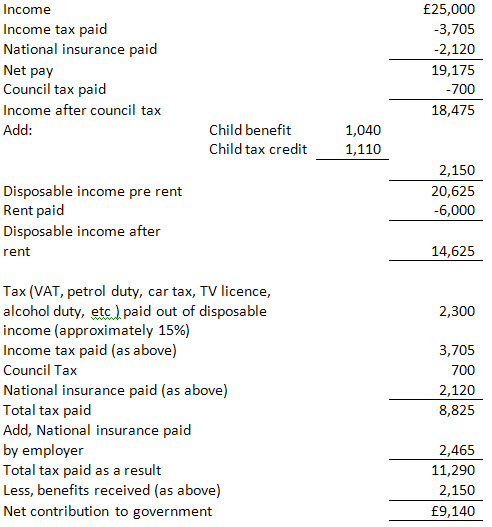
I have considered the consequence of this by doing a simple exercise. I have done a case study on the cost of a person earning £25,000 per annum who is a single parent with a child of school age, paying £500 a month in rent and £700 a year in council tax losing their job. The assumptions are slightly simplifying: benefits are harder to calculate in more complicated households. The rate of pay is slightly above mean and significantly above median UK pay. But £25,000 is a good, round number.

The total tax paid and benefits received by this person look like this:

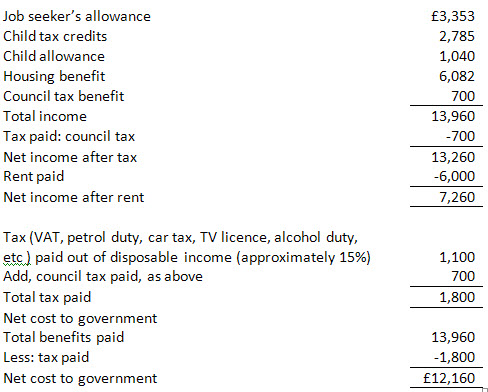
Now assume the same person was unemployed. They would get the following benefits:


The total lost to the government if this person loses their job in the private sector is the addition of the total contribution lost plus the total cost paid. That is £21,300.

It could be argued that the cost is less in the public sector because tax deducted goes straight back to pay the employment cost. It so happens the net effect is the same. In that case the comparison with the private sector is maintained here.

The actual cost is higher though. The person in work has disposable income of about £14,625; the same person unemployed spends £7,260. That is a difference of £7,365. In other words they are twice as well off in work as out of work. But, most importantly, of that difference at least 65% will support other people’s wages plus the taxes they spend on goods and services. Assuming these other people pay taxes at about the same overall rate as the person in the above exercise (and this is likely) that means about 36% of that difference will indirectly go in tax as well. That’s about £1,700. So now the benefit of keeping the person in work is £23,000 and they are only paid £25,000. Put it another way: 92% of the cost of cutting a £25,000 a year job when we have less than full employment is paid by the state.

In that case it is abundantly clear that paying to keep people in work pays – especially and even particularly if what they do has long term benefit that saves cost into the future. That cost saving – for instance from green efficiencies – has only to be £2,000 for it to be entirely worthwhile creating a job out of government spending to keep this person in work.

And that is before any account is taken of the social costs of being in employment, which are substantial in terms of reduced crime, improved educational outcome, better health, and more besides.

Now let’s reflect on the fact that in reality the average direct cost of employing an average public sector employee is less than this. Let’s make it around £21,000 – more like median pay – and then note that 500,000 at this pay rate will supposedly save £10.5 billion in the wage cost of the government. Putting these half a million people out of work will save us about £0.8 billion. That’s misery for 500,000 people and their dependents to save just £1,600 per job lost.

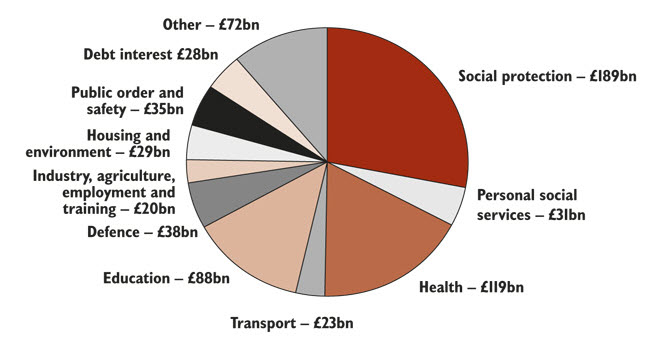
That though is not the end of it. Total government spending is £671 billion, split down like this:


So, to cut spending by 10%, £57 billion of extra cuts are required on top of sacking 500,000 people. These savings would need to be made up of:

1. Reduced benefits, which will result in reduced consumer spending, or
2. Reduced payments to private sector contractors to provide work to the government.

Either way there is reduced demand. £57 billion of reduced demand. Of which 65% approximately will go to labour. That’s £37 billion of labour cuts then. At £25,000 or so a head (approximately) that’s over 1.5 million more unemployed.

That, with the losses from the public sector adds more than 2 million to unemployment – making well over 4 million in all. Some consider this likely, I know.
But what is the effect on public spending? Maybe 92% of the cost of this cost in lost wages will fall on government either by benefits paid or lost revenue. That’s £34 billion. And that’s before we deal with the massive social and crime related costs of that level of unemployment and the collapse in our long term prospects.

So, to achieve total savings of maybe a net £4 billion in borrowing (£3 billion net from private sector cuts and about £1 billion net from public sector employee cuts) this policy would put 2 million people out of work.

Now I know all the problems of extrapolation in here, and I know that not everyone will get benefits in the way I have outlined above (but those that don’t will suffer even more extreme losses in income – compounding losses elsewhere) but frankly all analysis in this area is moving into the unknown, economically and statistically speaking. And losses to government may also be bigger than I suggest – after all out of the £57 billion of non-labour cost cuts required £20 billion will be lost profits and rents – and they could result in £6 billion of additional government tax losses, tipping the equation in the direction of any cuts in government spending creating actual cost for the government.

Which makes clear that the logic of cutting government spending now when we have no jobs for those we make unemployed makes no sense at all. It’s profoundly annoying to have to reinvent the whole Keynesian argument in this way – because that is exactly what I am doing – but needs must precisely because so many do not seem to understand this obvious fact.

Of course this situation will eventually change: private sector demand will pick up and employment with it. But right now there is no sign of that and to cut now would, I can confidently predict, produce something like the outcome I predict here. Put simply: cut spending and we’ll increase government debt. Perverse you might think – but true, and exactly what Keynes predicted.

What is more, the reverse is true. Increase spending now and the multiplier effect which compounds the impact of cuts in the above analysis goes into reverse: more jobs are created, revenue flows to government, benefit spending falls and government debt goes down with it.

The answer is simple: if we want to get out of the mess we’re in we spend. It’s the only way to reduce government debt at this stage in the economic cycle. It worked in the 30s. It will work now. Let’s do it.


*This article is taken from the LEAP Red Papers: The Cuts, which can be discussed in full on the LRC website

Friday, 20 November 2009

Attention! Deficit disorder


John McDonnell MP

From today's Morning Star

This week the Treasury confirmed that the government budget deficit had reached record levels of £11.4 billion last month.

This bombshell means the experts have had to revise their estimate of what the annual deficit could pan out to be. A whopping £190bn is their calculation.

Add to this collapsing tax receipts as the recession bites and the costs of having over 2.5 million people unemployed, and you're left with a major economic headache.

The big three parties are all in firm agreement that reducing and eliminating the deficit are central priorities for the coming period, whoever is in office.

The only difference between them is the timescale they have in mind.

In the Queen's speech this week Labour introduced proposals for a Fiscal Responsibility Bill, which would commit it to cutting the deficit by 50 per cent in four years, while Vince Cable and Nick Clegg of the Lib Dems are calling for Gordon Brown to launch into "savage cuts."

As part of his strategy to position the Conservatives as the party of economic responsibility, David Cameron is playing hardball. He's suggested that a Tory government would eliminate the whole deficit in one Parliament.

Cameron's recent speeches referring to the iniquities of big government are crude attempts to lay down some semblance of justification for plans to cut public spending and reduce public borrowing.

His big-government theme is reminiscent of the Thatcherite arguments of the 1970s and '80s, when the government pushed policies to "get government off people's backs."

A return to economic growth could reduce the deficit, but even if the current recession is coming to an end, few would predict spectacular growth over the next few years.

The Organisation for Economic Co-operation and Development is predicting no more than 1 to 2 per cent growth up to 2011.

There is residual anxiety that the shaky US property market could still tip the British economy back into recession at any stage during this period.

The only alternative available to reduce the deficit is to secure more tax revenues.

But neither Labour nor the Tories are willing to increase taxes or take any serious measures to tackle the large-scale tax evasion and avoidance which are sapping our public finances to the tune of £150bn a year, according to the Tax Justice Network.

This political consensus across the main parties holds out the prospect of public service cutbacks on a scale not seen in this country since the '30s.

According to the Budget figures for 2009, the government's total managed annual expenditure is £671bn.

Even if we allowed for the predicted 1 per cent growth in the economy over the coming years, any government aiming to wipe off £190bn debt within one period of office would have to launch a programme of cuts of £30-35bn per year for the five years of that Parliament.

This would mean cutting 25 per cent of all government expenditure.

People need to be made aware of what a 25 per cent cut in public services would look like.

Crudely, 25 per cent cuts could mean the axing of over:

7,000 GPs
4,000 NHS dentists
400 NHS hospitals
750 secondary schools
100,000 teachers
10,000 firefighters.

The Tories have made it clear that they want to cut the welfare benefits bill, particularly the dole and pensions.

Cuts on the scale required to make any real impact on the deficit would require a cut in unemployment benefit, already the lowest in Europe, to £48 per week and raising the state retirement age to 69 immediately.

This is what we are now facing as a result of an economic recession created by bankers, speculators, profiteers and their supporters in government.

All the main political parties have decided that we will pay for this crisis, not the the institutions or individuals that caused it.

Having used our money to stabilise the financial system, the government has stood back and allowed the speculators to return to business as usual. Bankers are in line to receive £6bn in bonuses this Christmas.

But even if the main political parties are not willing to consider an alternative to this insanity, many people are.

Ordinary people are still fuming at the bankers with their bonuses and the politicians with their expenses, who colluded to bring about this crisis and who are now colluding to ensure it is us not them that pay for it.

The role of the People's Charter is to fill the vacuum left by the bankrupt strategy of these political parties.

By setting out a straightforward analysis of the crisis, the charter provides an alternative view of causes of the unemployment and the threat to our public services that we are facing.

By setting out a common-sense set of basic policies, the charter offers a way of developing an alternative strategy to take the economy out of recession in a way that could transform the future of our society.

Already endorsed by trade unions, the TUC and enthusiastically supported by the Labour Representation Committee at its annual conference last week, the charter is beginning to catch the wind at a time when an alternative to the sterile consensus of the main political parties is desperately needed.

The charter could be the benchmark by which people will decide how they cast their votes in the coming election.

John McDonnell MP is Chair of the Labour Representation Committee.

Saturday, 26 September 2009

Breaking the consensus on cuts

At the Labour Party conference, LEAP and the LRC will be handing out a flyer-briefing 'Cutting our way to defeat? There is an alternative'. Read more about this and download the flyer from the LRC website.

On Sunday, as Labour Party conference (well, rally) kicks off, so does the Jobs, Education, Peace demo supported by PCS, NUT, UCU, NUJ, Stop the War, Right to Work and Unite Against Fascism. Mark Serwotka, PCS General Secretary, will tell the rally:

"The main political parties have forged a damaging consensus on public sector cuts when it was the greed of the City that caused the financial crisis."

Quite right. The demo is also on the front page of today's Morning Star under the heading 'Lobby Labour to save our public services'.

Sunday, 20 September 2009

The Credit Crunch – Who Pays?


Graham Turner

The sharp rally in stock markets since March has put a spring in the step of bankers. But unemployment continues to grind higher and the spectre of a full frontal assault on public sector workers looms. The question of who pays for the credit crunch now dominates the headlines.

In essence, all three major political parties believe that public sector workers should bear the price for a huge rise in the government's borrowing. The economy may have been stabilised, but the hit to the public purse has been unprecedented outside of war.

On current projections, the Chancellor may have been too optimistic when he rocked the House of Commons in April, announcing a projected deficit of £175 billion or 12.4% of GDP for the current financial year. The latest data for August show the moving annual total has already risen to £127.3bn. The public sector finances for July were particularly dire.

The best approach to evaluating the data is to consider the annual change in £ terms. July showed a rise in the deficit of £13.0 billion compared with a year earlier. The previous record decline was set in January this year, but that showed a comparatively modest increase in the deficit of £8.5bn on an annual basis.

The deterioration in July was significant because this is seasonally an important month for tax revenues. If the 15.8% y/y drop in tax revenues is repeated in January next year – another big month for the government coffers, the Treasury may be forced to revise its forecast for the deficit higher, to 13.0% or 14.0% of GDP.

With Gordon Brown's reputation for prudence in tatters, the door is wide open for the Conservatives – and the Liberals should they join in a coalition government – to launch savage cuts on public services far beyond those seen under Thatcher, or following the IMF bailout of 1976.

The public sector deficit is unquestionably out of control. But the right wing media and its political allies have been very successful in convincing the wider electorate that public spending is the culprit.

An objective assessment of the data suggests otherwise. During the first five months of the current financial year, tax receipts have fallen by an average of 11.4% y/y (in £ terms). That is significantly worse than the 6.5% y/y decline expected by the Treasury for the full year, set out in the April budget.

By contrast government spending is rising by less than expected. So far, its has climbed by an average of 5.3% y/y (again, in £ terms) compared with a Treasury forecast of 7.7% y/y for the full year.

And it is hard to equate this increase in spending with the media image of waste and profligacy in the public sector. In real terms, it represents a rise of 3.3% y/y, a remarkably low increase given the inevitable pressures on social security payments, in response to rising unemployment.

Indeed, it is quite possible that the ratio of public spending to GDP will be less than the 43.1% projected by the Treasury, and may only be a touch above the 42.3% recorded under Thatcher, during the early 1980s' recession.

Furthermore, it is worth comparing the Tory years from 1979 onwards, with the record under New Labour. The ratio of public spending to GDP has been exactly the same - 37.1%, even with the Treasury's forecast for a rise to 43.1% included.

Much of the onslaught on public sector workers reflects a belief among the right wing press that the UK has become a high tax country. Again, the hard evidence suggests otherwise. Between 1979 and 1997, the ratio of tax revenues to GDP averaged 40.2%. Since then, it has averaged 37.5%.

Unequivocally, the Tories are the party of high taxes. Indeed, the Treasury’s projected tax revenues for this year - just 35.1% of GDP - will be lower than under any year between 1979 and 1997. Furthermore, if the data for the first five months is any guide, the final figure could be around 33.4%. The credit crunch will have indeed turned the UK into a low tax economy.

But we should not expect the public sector deficit to fall quickly even if the economy were to recover. The collapse of corporation tax receipts in particular is not a one-off or a temporary response to the credit crunch. The ability of banks and companies to roll forward their losses implies there may be a structural gap in tax revenues that persists for many years.

US investment bank Merrill Lynch provided a rare insight into this problem in August last year, before it was subsumed by Bank of America in the panic that followed the collapse of Lehman Brothers. In a regulatory filing last year, it admitted that $29bn of losses sustained on subprime mortgages in the US were being routed through its London office. According to the Financial Times, the bank was therefore "unlikely to pay corporation tax for 60 years" - even if it returned to profit levels reached at the height of the boom.

It is clear from any objective assessment of the data that new sources of tax revenue need to be found to fill the gaping hole in the public sector accounts spawned by the credit crunch. Higher income taxes are not the only answer. Companies need to be taxed if they want to do business in the UK. They can try and relocate their headquarters to Ireland, Switzerland or the Cayman Islands. But they cannot physically remove their entire operations. So they need to be taxed on the level of business or turnover. Companies need access to the UK market to sell their goods, and they should not be allowed to operate here if they are not prepared to pay their way. Economically and morally, it is wrong for public sector workers to pick up the tab for a crisis they did not create.

* Graham Turner's new book No Way To Run An Economy, published by Pluto Press is available from Bookmarks Book Shop, price £12.99

Wednesday, 22 July 2009

Public sector debt hits nearly £800bn

Figures out earlier this week showed that public sector borrowing has now soared to £798.8bn, equivalent to a record 56.6% of GDP.

The perverse and increasingly dishonest debate between the three main parties is how about how to cut out-of-control public spending - with public sector pensions, student grants, welfare, the fire service, Royal Mail, and a whole host of other useful items being bandied about without any consideration of why they exist now.

However, public spending in the year to June rose only by 0.9 per cent in real terms. Public spending is not out of control. We are in debt because of the bank bailout, and because of falling tax receipts.

If cuts are needed, then we should be happy to identify them: Trident and ID cards would be a good start. The 'Our Taxes, Our Lives' campaign is making exactly that point.

There's also a good article from Wednesday's Morning Star, 'Public spending is not to blame'.

Monday, 13 July 2009

'Our Taxes, our Lives'


Come to the Campaign Launch of 'Our Taxes, our Lives' . . . . . . a major new campaign on public expenditure and cuts

'Our Taxes, our Lives'
Campaign Launch
Thatcher Room, Portcullis House, Westminster
Tuesday 14th July 2009
6:30pm – 8:30pm
Hosted by John McDonnell MP

Speakers:
Tony Benn
John Christensen
Tax Justice Network
Mark Serwotka
General Secretary, Public and Commercial Services Union
Tony Dolphin
Senior Economist, IPPR
Kate Hudson
Chair, CND
Ann Feltham
Campaign against the Arms Trade

"Spending decisions are financial but they are also moral; they are about values, identifying what and who, really matters"