Yesterday MPs voted through the Fiscal Responsibility Bill which pledges to halve the budget deficit within four years.
Aside from the anti-Keynesian nonsense of the concept (cutting investment during a recession), and the brutal nature of the cuts envisaged by all three main parties, the most relevant aspect of the Bill is it's irrelevance.
Clauses 1 and 2 of the Bill set out targets for cutting the deficit. Clause 3 states that if an objective set by Clause 1 or 2 of the Bill is not met then the Government must come to Parliament and explain why not.
Very simple: a sensible government would report annually saying it was ignoring the objectives set under Clauses 1 and 2 as they would damage the economy, and public services. Job done. Forget about the Fiscal Irrelevance Bill. There's not even a need to repeal it.
Nevertheless, Bill or not, the political cuts consensus continues unabated, and it's good that LEAP Chair John McDonnell has tabled EDM 681 'Public Expenditure and the Deficit':
That this House notes that in his interview in the Financial Times of 19 January 2010 the Chancellor of the Exchequer has admitted to a planned policy of 17 per cent. cuts in expenditure across Government departments other than schools, health and the police force, the early withdrawal of the 50 pence tax rate and an end to the tax on bonuses; and therefore judges that this will mean that the ordinary people of the UK will be the ones who are to pay for the economic crisis, not of their making, and that many of those who, through their reckless greed caused the crisis, will walk away unscathed, receiving new bonuses and playing once again in the casino economy.
So far also signed by MPs Katy Clark, Jeremy Corbyn and David Drew - all of whom are supported in the LRC General Election Campaign.
Showing posts with label Fiscal Responsibility Bill. Show all posts
Showing posts with label Fiscal Responsibility Bill. Show all posts
Thursday, 21 January 2010

Sunday, 17 January 2010
Obama and the banks
President Obama's announcement last week that he would demand the US public's money back from the banks was telling. It told us that with a vital election coming up Obama knows when to bow to popular opinion.
In immediately rejecting it ("The Americans are doing something different" said Darling) it told us that New Labour are less concerned about public opinion - something the public reflects back to them in opinion polls regularly.
Obama went further saying the US bank bailout was "distasteful, but necessary". He also described bankers' bonuses as "obscene" and referred to the banks as "the very firms who owe their continued existence to the American people" - almost LEAP-esque . . . almost.
Gordon Brown told an audience in London yesterday, "We believe we will probably make a profit from what we have done in helping out the banks. Our aim is that no member of the public has to pay for the rescuing."
Really? So why is he pressing ahead with the Fiscal Responsibility Bill to halve the UK deficit in four years if we're just waiting for a windfall? Under Brown's Bill every member of the public will pay with worse services. Universities are already paying thanks to New Labour's cuts.
In immediately rejecting it ("The Americans are doing something different" said Darling) it told us that New Labour are less concerned about public opinion - something the public reflects back to them in opinion polls regularly.
Obama went further saying the US bank bailout was "distasteful, but necessary". He also described bankers' bonuses as "obscene" and referred to the banks as "the very firms who owe their continued existence to the American people" - almost LEAP-esque . . . almost.
Gordon Brown told an audience in London yesterday, "We believe we will probably make a profit from what we have done in helping out the banks. Our aim is that no member of the public has to pay for the rescuing."
Really? So why is he pressing ahead with the Fiscal Responsibility Bill to halve the UK deficit in four years if we're just waiting for a windfall? Under Brown's Bill every member of the public will pay with worse services. Universities are already paying thanks to New Labour's cuts.
Wednesday, 16 December 2009
It Doesn’t Have to be Cuts, There are plenty of Alternatives
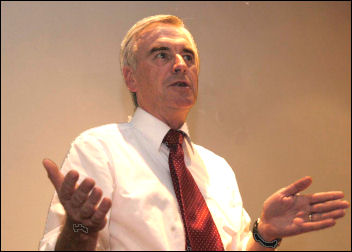
John McDonnell
The backdrop to the Pre-Budget statement is the potential for the Government's annual deficit, previously estimated at £175 billion, to be on course to balloon up to £190 billion. All three main political parties are committed to reducing and eventually eliminating the deficit. Labour’s new Fiscal Responsibility Bill commits the Government to cutting the deficit by 50% in four years, while Cameron is proposing to eliminate the whole deficit in one Parliament. Clegg and Cable are calling from the sidelines for a detailed programme of “savage cuts.”
Despite threats to bankers’ bonuses and on-and-off calls for a Tobin Tax, none of the main political parties is willing to look at a serious increase in the tax take – either by increasing redistributive taxes or tackling large scale tax evasion and avoidance. Only the Chancellor and the most deluded elements of the Bank of England’s Monetary Policy Committee (MPC) believe that significant economic growth will materialise in the next two years to lift tax revenues and ease the deficit. The OECD is predicting no more than 1% to 2% growth up to 2011 – and David Blanchflower, former MPC member, is cautioning about the potential of a double dip recession.
The result is a consensus across all the main parties that demands a cutback in public spending not seen in this country since the 1930s.
To achieve a cut of £190 billion, even if the so-called ‘smart government’ savings were achievable, a Government would have to cut £30-35bn per year for the five years of that Parliament. This would require a 25% cut in public services. On this scale, the Government would need to make cuts that would include over 7,000 GPs, over 4,000 NHS dentists, over 400 NHS hospitals, over 750 secondary schools, over 100,000 teachers and over 10,000 firefighters. Welfare benefits and pensions would inevitably come under attack, and to secure this level of savings would mean cutting unemployment benefit to £45 per week and for the pension age to increase to 69.
If New Labour refuses to break the cross-party consensus on who is to pay for the economic crisis, we are facing the prospect of a sufficient number of Labour supporters staying at home at the General Election to allow the Tories to slip back into office or at best a hung Parliament based upon a cross party economic deal around public expenditure cuts.
The only hope of mobilising our supporters and Labour retaining office with a workable majority is a demonstrable, radical change in political direction by the Government, carried over into its election manifesto. An alternative programme to set out on a new course would include:
• large scale public service investment;
• ending privatisation;
• rebalancing our economy by creating and protecting jobs with investment in manufacturing;
• increasing the minimum wage, state benefits and pensions;
• building and refurbishing the affordable homes we need to overcome our housing crisis;
• making a real commitment to tackling climate change by adopting the green new deal programme for renewable energy and transport;
• securing a peace dividend by withdrawing from Iraq and Afghanistan and scrapping Trident and ID cards;
• confronting the corporate tax evasion scandals and tax injustices and the waste of public resources on Trident and ID cards.
Even at this late stage, adopting a programme like this – and unashamedly promoting it to the electorate – could save a Labour Government, and the economy, but time is rapidly running out.
*This article is taken from the LEAP Red Papers: The Cuts, which can be discussed in full on the LRC website
Subscribe to:
Posts (Atom)