Showing posts with label public ownership. Show all posts

Saturday, 22 March 2014

An economy as if people mattered


Andrew Fisher's speech for People's Budget at the Southampton People's Assembly

After a minute's applause for both Tony Benn and Bob Crow, these are the notes from which I made my speech (with a few ad libs!)at the Southampton People's Assembly on 20 March, responding to the Budget and arguing for an economy as if people mattered:

Well I hope you’re grateful.

Two years ago the Chancellor was taxing your pasties – that is what you people eat isn’t it?

And taxing your caravans – that is how you people holiday?

But now look:

You’re getting tax cuts on beer and bingo (or working class culture as the Chancellor calls it). See, tax cuts aren’t just for big business and millionaires, they’re for you – the little people – too!

Budget 2014

So aside from the Tories'  lame efforts to persuade us they're on our side, what were the main things we learned in the Budget?
  • No end to austerity: because it’s ideological - by 2018 public spending will be lower than at any time since 1948 - the year in which the NHS was founded. "Rolling back the state", but going further than Thatcher ever managed. And if anything austerity is being ratcheted up. Public spending has risen by less than inflation (so a real terms cut), but his estimate for 2015-18 is for cuts to public spending in absolute terms 
  • ISAs – who can save £15,000? Someone working full-time on the minimum wage doesn't even earn £15,000 a year.
  • And what's underpinning Osborne's forecast for more growth? The assumption is more household debt - which will rise to the levels that precipitated the crisis. There's also some utterly delusional figures for business investment rising between 8-10% year-on-year for the next three years.
  • An array of green taxes were scrapped or capped in the Budget, making more of a mockery of the Coalition's "greenest government ever" rhetoric.
What the Budget didn’t address
  • Pay – it did nothing for people's wages and falling living standards. As Bob Crow said: 
  • The Housing crisis – nothing in there that will build the homes our country needs, nothing to tackle rising homelessness or the rising costs of paying the rent. We are back to a pre-war situation where more of us are dependent on private landlords, with not enough council housing and fewer able to afford a mortgage.
  • Jobs or industrial strategy – far from being a budget for 'doers', following his 'march of the makers' budget, OBR projections show UK exports falling in future years. This is a government - to be fair, like those before them for the last 35 years - without a serious labour market or industrial strategy. The recovery in unemployment is due to low wage, insecure jobs.
  • And the energy crisis – nothing to tackle the fuel poverty which disproportionately affects the poorest pensioners; and nothing to address the UK's woeful investment in renewable energy, in which we lag behind the rest  of Europe.
What sort of economy we want

While Osborne rattles on about his modest and delayed economic growth, and the 24 hour news tells us every hour how the FTSE is doing, what would an economy look like as if people mattered?

Five questions, I think would matter to most people:
  1. Are we reducing poverty and inequality?
  2. Is unemployment falling?
  3. Are people's living standards rising?
  4. Is the tax gap - the £120bn of avoided, evaded and uncollected tax - reducing?
  5. Is the economy stable and environmentally sustainable?
If we want that economy, an economy that acts in our interests, then we need greater economy democracy. Tony Benn said:

And you can see how that happened, we built the NHS, the welfare state, council housing, comprehensive education, and brought the utilities under public control. And sadly we can see how that has been reversed through privatisation - anti-democratically transferring power back from the ballot to the wallet, from the polling station to the marketplace.

For me anything too important to fail should be in public ownership - if we want an economy where people matter. And we need economic rights, individually and collectively. The right to a minimum income, protection from being made redundant - why on Earth are profitable companies allowed to make people redundant - taking away people's jobs to give bigger bonuses to directors or higher dividends to shareholders?

And trade union rights restored, so that we can protect our jobs, pay, pensions and fight for better working conditions.

I hope that's a good basis for discussion. Thank you.

Tuesday, 1 October 2013

Why - and how - Labour should pledge to renationalise Royal Mail


Yesterday, Labour's shadow Business Secretary Chuka Umunna - tipped as a possible future leader by some - announced that Labour would keep Royal Mail in private ownership if, as is likely, the Tory-led government pushes through privatisation before 2015.

Writing for the Huffington Post, Umunna argued:
"I have been very clear that we are not in a position to pledge to renationalise the Royal Mail if we get into government in 2015. I do not know how much Royal Mail shares will be trading at in May 2015, so I do not know how much it would cost to renationalise. No credible future Business Secretary would therefore make such a pledge"
What struck me was how woefully unaware Umunna seems of Britain's long history of nationalisations. But, first some good news to be read into Umunna's otherwise depressing statement: if Labour won't nationalise because of cost, then rail renationalisation is on the cards - since the franchises can be brought back under public control as they expire, cost-free. Come on Maria Eagle, you can do it!

But I digress. Labour has of course already said it will stick to the Tory spending plans that it criticises as being flawed, and therefore Mr Umunna is unable to make spending commitments, unless funded by some other cut (like Trident perhaps?).

But still, governments have rarely used current expenditure accounts for nationalisations. Even the colossal shovelling of public money at the banking system in 2008/09 was done through an arcane stand-alone Bank of England fund.

The largest swathe of nationalisations occurred under Clement Attlee's 1945 government, and included coal, steel, electricity, gas, electricity, railways, road haulage - alongside a massive expansion of publically-owned social security, public health, education and housing.

Now you might say, 'that's all well and good, but Labour will come to office in 2015 with a very different inheritance. Didn't you hear Liam Byrne? There's no money left!'. To which the reply is 'I never listen to Liam Byrne. Why on earth would anyone? But I see your point, Attlee only took office after six years of war, with the country's infrastructure and labour force decimated, and with a national debt nearly four times what it is today. But I just think maybe today's Labour could manage one relatively small renationalisation...'

Attlee's government also reduced the national debt during its term in office. 'But how?' you ask, 'when they must have spent billions on all those nationalisations'. Attlee's government largely exchanged shares for Treasury bonds - sustainable low cost funding of the purchase of assets that often generated revenue in return (Royal Mail made a profit of £430m last year) or were steered in the public interest to underpin economic growth and to meet social need ('meet social need' aka 'predistribution'). Another question Mr Umunna should be asking is why would any government wanting to reduce the debt, sell off a steady income stream?

But of course saying now that if the Tories privatise Royal Mail, Labour will renationalise will drive away the vultures circling over Royal Mail. Who would pay for shares now, knowing they'll be exchanged in less than 18 months. Labour committing itself now to renationalisation in 2015 could scupper the move entirely.

All is not lost if Labour waits. The inevitable result of Labour committing itself to renationalisation next year would be to reduce the share price of a privatised Royal Mail. Look at the impact of Ed Miliband's modest price freeze announcement for energy companies. This would make even a cash buyback considerably cheaper.

The Attlee government did something very simple, it told the electorate what it would do - boldly - and it won a landslide. Until it finally announced some policies at its conference last week, today's Labour was barely ahead in the polls, against a deeply unpopular government. It went from being level to four points ahead before, to 8 to 11 points ahead after the announcement to freeze energy prices and repeal the bedroom tax.

There's a lesson there. One is that, if Labour wants to look 'credible' it shouldn't oppose privatisation only until it happens. That's rather like being a vegetarian between meals.

UPDATE (05/10/13): It is now estimated that Royal Mail will be valued at around £3 billion for the sell-off. Chuka Umunna has described this as "on the cheap", stating that two of Royal Mail's sites in London are alone worth £1.5 billion - and that these sites are at risk of being sold off once the shares are sold to private investors.
Such asset-stripping is common in privatisation - and occurred following the privatisations of the railways and of the water boards. If such asset-stripping occurs, then Labour should renationalise in 2015 by compensating shareholders on the basis of the valuation of the company at time of privatisation, minus the value of any assets sold off. If they can privatise on the cheap, we can renationalise on the cheap!

Tuesday, 24 September 2013

John McDonnell MP's verdict on Ed Miliband's conference speech


Since Ed Miliband became leader, the strategy of the left has been to make issues safe for him by building support within and outside the party issue by issue. Only when it's safe is he confident about moving on an issue. Today's speech demonstrated that we are setting the agenda but there's so much further to go. A major housebuilding programme is needed, but it needs to be public housing alongside rent controls to stop landlords profiteering from housing benefits.

Challenging the scapegoating of unemployed and disabled people needs to be made a reality by scrapping the rigged capability tests associated with Atos and abolishing workfare. Time limited price controls won't end the rip-offs. A clear commitment to end privatisation is needed, especially in the NHS, and to bring rail, water and energy back into public ownership plus, if it goes ahead, Royal Mail. 

To tackle low pay, we need to make the minimum wage a living wage by right, re-establish trade union rights and restore a commitment to full employment. People already suspect this is a recovery for the rich and ongoing recession for the rest. This is exactly the time when people want more radical action. Make today's speech a beginning.

Tuesday, 6 August 2013

Lloyds bosses to speed up privatisation with 70% payout


by Luke James

Bosses of bailed-out Lloyds bank revealed today they will hand a massive 70 per cent of profits to shareholders in a bid to speed up privatisation plans.

Chief executive Antonio Horta-Osorio issued the invitation to asset-strip the part-publicly owned bank because private investors have so far only shown modest interest.

The government owns 40 per cent of Lloyds, acquired when it saved the bank from collapse in 2008 with £17 billion of public money.

Ministers are desperate to flog the stake - and so cut the public out of dividend payments - because of their privatisation obsession and have offered Mr Horta-Osorio a £2 million bonus to deliver the sale.

His plans to give away a staggering 70 per cent of profits by 2016 would mean that Lloyds pays higher dividends to shareholders than any other bank.

Leading left-wing economist Andrew Fisher said it was a "slap in the face for the British public, who bailed out banks like Lloyds.

"It makes it clear that what many of us have said all along is true - we nationalised the debts, while the profits are privatised," said the Left Economics Advisory Panel co-ordinator.

"Lloyds's grotesque dividend and executive pay bonanza comes at the expense of its customers, the taxpayer and its own staff - at a time when over 3,000 job cuts have been announced."

This article first appeared in the Morning Star

Tuesday, 5 March 2013

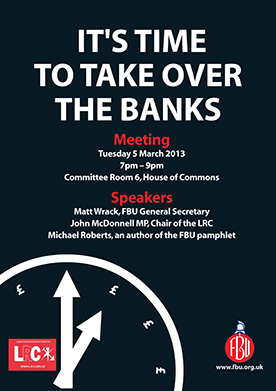
It's time to take over the banks!

Get along to an excellent meeting tonight at 7pm in Westminster to discuss the public ownership of the banks.

At TUC Congress last year, unions voted in favour of an FBU motion calling for the public ownership of the banks. At the meeting tonight, to be held in Committee Room 6 in the House of Commons, FBU general secretary Matt Wrack will discuss the campaign alongside LRC and LEAP chair John McDonnell MP.

The meeting will also hear from Michael Roberts who, alongside Mick Brooks, wrote the excellent FBU pamphlet 'It's time to take over the banks' (pdf).

The pamphlet makes the case for a publicly owned finance industry that provides a public service, giving financial support to industry and working people. Taking over the banks will enable planning, investment and the creation of millions of jobs. A publicly owned and democratically accountable banking system is essential to developing such a programme.

The meeting is open to all and free to attend, but allow 10-15 minutes to get through parliamentary security.

In a Comment is Free piece yesterday, PCS general secretary Mark Serwotka also made the public ownership of the banks one of his 10 steps to kickstart the UK economy. So far, the article has an 89% approval rating!

Monday, 12 December 2011

'Poor decisions' led to £45bn RBS collapse, says feeble FSA report


Morning Star
Monday 12 December 2011
by Rory MacKinnon, Corporate Affairs Reporter

Financial watchdog chief Lord Turner stated the bleeding obvious today in a 452-page report on Royal Bank of Scotland's failure which said "poor decisions" were to blame.

Political economists rained down ire on the Financial Services Authority chairman's "pathetic" findings after a year-long investigation into the 2009 collapse.

Lord Turner pinpointed "multiple poor decisions" by directors which ultimately ended up with the bank needing a £45 billion bailout from taxpayers to fend off closure.

Failures included aggressive expansion with "inadequate due diligence," such as the 2007 takeover of Dutch high street bank ABN Amro, and dangerously low levels of capital permitted under "light-touch" regulation.

He said that the bank had suffered from an over-reliance on high-risk, short-term funding and had made substantial losses in credit trading which were underestimated by both the bank itself and regulators.

The FSA chief also blamed the "systemic crisis" the world over.

But Lord Turner only briefly touched on "underlying deficiencies in RBS management" that made it "prone to make poor decisions."

And he justified the failure of the FSA to spot the spiralling crisis as a side effect of it working "against a backdrop of political pressures for a 'light touch' regulatory regime."

Left-wing commentators were left unimpressed.

University of Wolverhampton Professor Roger Seifert dismissed the report as "pathetic."

Regulators' own lack of skill and technical expertise "was never the issue - it was a complete lack of political will," he said.

"It was not a minor failure or lack of skills and technical expertise.

"It was a failure at the heart of the liberal government."

Left Economics Advisory Panel's Andrew Fisher said the findings underlined the need for the government to take the banking system into taxpayer hands.

"The failure of RBS was due to a regime sanctioned by successive governments that instituted banks as the dynamic driving force of the economy rather than as safe depositories," he said.

"The banks and wider finance sector manage our money, our mortgages, our pensions.

"Their existence is essential for our day-to-day lives, our homes and our futures.

"This is a systematic failure to which the only sustainable solution is public ownership and control."

And Tax Justice Network economist Richard Murphy said: "Regulating better a structure that is inherently flawed will never give us the right answer.

"Reforming the system as whole is the only way forward now - and this is the elephant that dared not trumpet in this report."

Wednesday, 2 November 2011

The millions should control the billions


Mark Serwotka, PCS General Secretary, argues that banks should be publicly owned

To know where we should go on bank reform, we have to understand where we have been. The banking crisis that swept the globe in 2008 was not a crisis of the banks alone, but a crisis of government: the failure of successive governments in the UK and globally to have any oversight of the banks. It was negligent.

Many of us as parents know what would happen if we were negligent: if you let a toddler dictate what they wanted to eat, the diet of jelly, ice cream and cakes would probably leave them obese or in a diabetic coma, while the sugar-induced highs and crashes would bring trauma to the household. Never mind the nanny state, the government has been a bad parent to the toddling banks. It has allowed them unsupervised access to the biscuit barrel. The banks are now even more like toddlers, unable to stand without government support.

We should be clear: the banks are indeed too important to fail. Millions of working people depend on banking for their savings, their pensions, their mortgages and for the daily management of their finances. The assets traded and gambled around the globe are people’s life savings, their security in retirement and their family homes. The current situation is even more precarious than in 2008. Several banks and governments teeter on the brink of collapse. A Greek default could result in a domino effect. While the UK was in a financially secure enough position to offer bail-outs in 2008, it is doubtful if today that would be politically acceptable or economically affordable.

Any rational observer would concede that anything vital to our society demands close oversight. The shocking thing about the banking collapse in 2008 was how the regulators were unaware of, and did not understand, many of the intricate schemes and processes operated in the banking system. It is time the public interest became a factor in our banking system. Given the importance of banking – not as an end in itself but because of what it facilitates – and because of its vulnerability, it is essential that the rebuilding of the system is done in the public interest.

My trades union has a clear policy: the banks should be publicly owned. Some might say this is ideological. I would say it is logical. Banks are so vital that they have to be underwritten by the public – just like public transport and utilities such as gas, electricity and water. If British Gas or Thames Water went bust, the government could no more shrug its shoulders and say “that’s the market” than it could when the UK banking system teetered on the brink in 2008-09. But there are several other reasons why the banks should be publicly owned.

First, a bank underpinned by the state could lend at lower rates and offer savers higher rates. When Northern Rock was nationalised, Sir Richard Lambert, then CBI director general, told the Treasury Committee: “It is critically important that state ownership of the bank should not be allowed to distort the savings market, through access to government funds on favourable terms”. In other words, offering the public (and businesses) a better deal would “distort the market”. Just as private finance initiatives have proved incredibly wasteful, the inherent stability of the state makes it the natural home for secure banking.

Second, we are suffering from a crisis of investment. Banks are cautious about lending yet there is no end of investment opportunities from much-needed housing to redressing the UK’s woeful underinvestment in renewable energy infrastructure. Investment is essential to creating jobs, cutting the welfare bill and increasing our tax revenues – closing the deficit. At the moment we have the worst of all worlds: a government irresponsibly cutting capital spending and private banks that are unwilling to lend. Too much of the money banks have gained through quantitative easing has been speculated with or invested overseas.

Third, we should act in the public interest. While my union members are demonised in the rightwing tabloids as feather-bedded pen pushers with gold-plated pensions (the average member is on £22,850 and will get an £80 per week pension), the fat cats are rewarded with obscene bonuses and huge salaries. We could direct investment to where it is socially useful, ensure savings are encouraged and get a better grip on the housing market and mortgage finance.

The question is one of democracy: it is the wages, pensions and mortgages of millions that create the wealth banks have squandered. It is time those millions controlled their billions.

Sunday, 16 October 2011

Miliband offers only hot air on energy

The report by Ofgem last week showed the profit margin for energy companies has risen to £125 per customer per year. It expressed concern at the rampant profiteering by energy companies. This is important - let's remember that every winter an extra 20-30,000 pensioners die due to cold-related illnesses. With prices having risen by 10-20% this will be a life or death issue for tens of thousands this winter.

The Ofgem report did not surprise us; in March 2011 we published our report 'Restoring the Public' and noted:
The unusually cold winters in the past two years, and large margins, have led to bumper profits for energy suppliers such as British Gas, whose profits rose by 24% in 2010. The regulator Ofgem has found that energy companies increased their net profit margin per customer by 38% last November, and is currently reviewing energy prices. However the case for a windfall levy now is not in conflict with future recommended reforms to regulation.

At that time we advocated a windfall tax on these excessive profits. It's clear though that seven months later, the energy companies remain unconstrained by regulation. Ofgem deliberately does not have the teeth to prevent excessive profiteering.

In retrospect our call for a one-off windfall tax, combined with the review of regulation, underestimated the problem. Let's face it: no review of regulation under the current government is likely to constrain business to benefit consumers.

Ed Miliband writing in the Sunday Mirror, continues his 'moral capitalism' theme from his Labour Party conference speech, stating "there is nothing to stop those power companies giving up those profits".

But there is! The very reason the companies profiteer is because their purpose is to maximise profits for their shareholders. Ed's plea is as asinine as Vince Cable repeatedly imploring the banks to lend more. The lesson is companies (as they are designed to do) will act in their own interest, not the public interest (unless the two happen to coincide - rare).

If Ed Miliband wants cheaper energy prices exhortations are not enough. Neither would be his other plan: "more competition". More companies will act exactly the same as the big five already do - because they will also want to maximise profits.

The only permanent solution is public ownership. If something is 'too important to fail' as the banks and energy companies are then they have to be run in the public interest - that means control.

If Ed Miliband is going to inspire voters to return to Labour he needs something that will electrify the electorate. His current gas is just hot air.

Thursday, 7 July 2011

You can't control what you don't own

If there's one lesson of the banking crisis and bailouts of 2007-09, it's that 'you can't control what you don't own'.

Today the government implores the banks to lend more to businesses and to constrain executive bonuses, but to little avail. Perhaps the irony is that we do still own large stakes in several banks. Indeed if it were not for the various guarantee schemes that underpinned UK banking, we would have ended up owning most of them as they fell like dominoes. However, the ownership model devised was arms-length, temporary, and was in reality the privatisation of public money rather than the nationalisation of private assets (or liabilities).

The New Labour government had introduced the market further into areas such as welfare, education and health, had part-privatised the London Underground, and more of the civil service than the governments of Thatcher and Major combined. But here it was facing the possibility that its golden child - the finance sector - was about to collapse.

In 2007, what struck LEAP was the lack of debate about public ownership. What really sent the message home clearly for me was this press release from Unite, the union that represents Northern Rock staff, from 20 November 2007. It sets out a six point 'Charter for Northern Rock' the sixth point is "To retain Northern Rock as a UK listed company".

I don't use this example to in anyway demean Unite, but simply to highlight how little issues of ownership and control were being discussed and debated in the labour movement.


Today, Southern Cross - which owns 753 care homes across the UK - remains on the verge of collapse. The 2011 GMB Congress asked 'If private equity and the private sector are places fit for the care of our elderly, our most vulnerable and our most dependant?' Indeed.

A new debate is starting up about media ownership in the wake of the News of the World hacking scandal. With energy and supermarket prices both rising above inflation to enable gratuitous profiteering, the demand for public ownership should be made.

Earlier this week it was also revealed that Virgin Trains received £40 million in public subsidy, and paid out nearly £35 million in dividends. The case for rail re-nationalisation is overwhelming.

It therefore seems an opportune time to publish free online for the first time LEAP's 2008 publication Building the new common sense: Social ownership for the 21st century (you can buy a hard copy here).

The pamphlet looks at different forms of public ownership from the Morrisonian post-war model to workers' co-operatives.

Download chapter by chapter

Saturday, 19 March 2011

The future of the Northern Rock: questions for the re-mutualisers


There's a new campaign being led by Labour MP Chuka Umunna to remutualise Northern Rock, with a letter supporting the proposal published in the Guardian and an EDM tabled in Parliament.

The proposal has cross-party support with two Conservative MPs co-signing the Guardian letter, along with a Liberal Democrat and even Unite General Secretary Len McCluskey.

As I argued in October 2008, there should be "a return for the public" for the huge loan bailout and subsequent nationalisation of Northern Rock.

I have to say I'm currently only lukewarm about the campaign. I'm instinctively sympathetic - my savings and current account are both with a mutual - but I'm just not clear on how re-mutualising Northern Rock would work, and if it would be fair to taxpayers who after all are the ones responsible for its continued existence.

Sadly, neither the letter, EDM nor campaign page answer these concerns - it just tells me mutuals are more accountable, democratic, and that it would be popular, none of which I would dispute.

The questions I have for the campaign are therefore:
  • What is the benefit for the taxpayer? The taxpayer collectively saved Northern Rock so why should only current customers benefit?
  • Why not just keep Northern Rock in public ownership and use future profits to fund public services?
  • Shouldn't former employees benefit too? Over 2000 have lost their jobs since 2008 - yet it was their taxes that paid to 'save' it as much as anyone else's. And would this be a building society model or would staff have a governance role too? If so, what?
For the time being my opinion remains that Northern Rock be publicly owned and publicly controlled. It's already the former, but we should be campaigning for the latter - it seems fairer than re-mutualisation.

Monday, 4 October 2010

Are the banks about to fail again?

Last month the Irish government bailed out the banks again, forcing their budget deficit to balloon to an astonishing 32%. It was all too familiar, the banks have once again been bailed out with public money, yet remain in private control and with very little regulation or oversight. There was even the Irish Finance Minister, Brian Lenihan, popping up to say the biggest bank, Anglo Irish, was too big to fail.

People of course said that about Lehman Brothers, but it failed and the world did not implode. What has vanished though is many Irish jobs, welfare rights and public services - all apparently necessary to avoid a crisis. Instead the collapsing demand in the economy caused credit rating agencies to downgrade Ireland back in July.

And so to the UK, and today the New Economics Foundation (NEF) has published a report Where did our money go? Building a banking system fit for purpose, which warns "[UK] Banks set to demand fresh bail-out in 2011" and cites increased borrowing by them.

It also highlights the a "shocking" lack of information on how banks had used the bail-out money. Like Ireland a lack of ownership and control accompanied the bailout - criticised with great foresight by LEAP Chair John McDonnell at the time - and now we may be on the brink of further collapse.

Referring to the NEF report, LEAP's Graham Turner, from GFC Economics, said "the Bank of England also warned in its June Financial Stability Review that there will be a huge increase in refinancing requirements for UK banks in 2011. This remains a systemic threat."

Like Ireland again, the UK is about to embark on unprecedented mass public spending cuts - which would sap demand from the economy, and could possibly simply be the precursor to funding another bailout for the bankers.

If the UK banks do suffer a second round of collapse, then it is time to nationalise the assets as well as the losses and control the sector for public good not shareholder and speculator gain.

There's an excellent piece in today's Morning Star on this, Banks on the brink yet again - well worth a read.

Thursday, 5 August 2010

Lloyds racks up £1.6bn profits from cuts

From today's Morning Star

Louise Nousratpour

Taxpayer-backed Lloyds Banking Group has boasted of a "significant milestone" when it announced half-year profits of £1.6 billion.

The result came as a marked turnaround on the £4bn of losses seen a year ago and was better than expected by most analysts in the City.

Lloyds, which is 41 per cent owned by the public, claimed that sharply lower bad debts had helped its recovery, with losses on loan defaults more than halving in the first six months of 2010.

However Left Economics Advisory Panel Andrew Fisher refuted the banks version of events.

"The profit is not due to successful operation, but due to private equity-style asset-stripping with 16,000 jobs cuts, pensions cut and branches sold off to Santander," he said.

Mr Fisher added sarcastically that the taxpayer should be pleased with the profit because "with a 41 per cent stake we should be welcoming over £650 million into the public coffers. That figure would more than pay for the Health in Pregnancy grant that was abolished in the last Budget."

Finance union Unite said that the profits had only been possible because of staff who had worked "tirelessly in extremely difficult circumstances."

National officer Cath Speight said: "Since the formation of the bank there have been over 16,000 jobs lost and those who hold the key to the success of the bank continue to face insecurity and uncertainty about their futures because of the sale of bank branches.

"Employees have also suffered as Lloyds severely curtailed their future pension benefits."

Lloyd's profits contributed to a combined haul of more than £11bn from the four major high street banks.

HSBC reported a bumper £7bn half-year profit on Monday.

Monday, 2 August 2010

HSBC bank big-wigs brag of super-profits

From today's Morning Star

Louise Nousratpour

Banking giant HSBC has boasted that it had more than doubled half-year profits to £7.2 billion - prompting demands for a windfall tax and the nationalisation of the banking system.

The British-based group's super-profits roared 121 per cent ahead in the first six months of this year as bad debts plunged to their lowest level since the financial crisis.

In Britain, where HSBC cut 4,600 jobs last year, profits totalled £1.3 billion, an increase of 26 per cent. The bank has also set aside £6.2bn in staff pay, bonuses and benefits for the first half of the year - up 7 per cent on a year earlier.

Left campaigners said that the recent super-profits announced by the corporate sector confirmed that we are not "all in this together," as Prime Minister David Cameron keeps telling the nation, with big business flourishing while Chancellor George Osborne "robs ordinary people of £6bn in austerity measures."

Left Economics Advisory Panel co-ordinator Andrew Fisher said: "The eye-watering figures from HSBC reinforce the fact that the corporate sector has had a good recession.

"We are seeing the same phenomenon whether it's BT, British Gas or the banks - corporate profitability restored to or above pre-recession levels, while the recession they barely felt is used as an excuse to cut jobs, suppress wages and raise prices."

Mr Fisher warned that a "stark class warfare" was being waged by the Con-Dem government and "its corporate pals who were given £25bn in tax breaks in the last Budget.

"The reality is that the government still holds over £850bn in bank assets.

"There is no need for a single job to be cut or for a penny to be taken away from a single public service."

Communist Party of Britain general secretary Rob Griffiths renewed the labour movement's demand for a windfall tax on all super profits and for the banking sector to be brought in-house to plug the deficit and fund public services.

"Banks were kept afloat because the government and the Bank of England pumped £1.3 trillion into Britain's financial system, yet the working class are being forced to pay the cost of the crisis while the fat cats grow fatter on their ill-gotten gains," he added.

Britain's other major banks are due to report their results later this week. Part-nationalised Lloyds is forecast to report £800 million in profits, while the 83 per cent state-owned Royal Bank of Scotland (RBS) is expected to post interim profits of around £200 million.

Labour leadership frontrunners David and Ed Miliband have both called for the recently introduced banking levy to be doubled.

David Miliband told a south London party meeting on Sunday that the tax, expected to raise £2bn a year from banks, was "incredibly small."

Saturday, 8 May 2010

More on the Great Rail Rip-off

Following on from our post of 4th May about threatened rail cuts, news now emerges of franchises redesignating peak times to increase - by up to 4 times - rail fares.

In our January 2009 report for the RMT union, we identified the following threats from the rail companies:

1. Either attempting to renegotiate franchise agreements, which could
include:
a. Reducing premium payments or requesting extra subsidies
b. Cutting services on less profitable routes

2. Cutting staff numbers to reduce overhead costs, which would increase
unemployment and could lead to worse services and less passenger
safety

3. Raising rail fares, which could drive passengers from the rail into
private transport

We have now seen all three in this recession. On point 3, the BBC reports that "Virgin decided to extend ticket restrictions for more than an hour a day", so many services are now peak. One example is that last year, taking the 0915 from London Euston to Manchester, returning at 0855 the next day, would have cost £66. Now that Virgin has extended its peak hours, the same ticket costs £262. It's a similar story at South West Trains - owned by homophobe Brian Souter.


Virgin remember is owned by tax exile Richard Branson who takes tax subsidy but avoids tax. Virgin is so named not because of its owner's sex appeal but because it is based in the Virgin Isles.

Afraid of more franchises defaulting, it appears the Office of Rail Regulation inside the Department for Transport is doing nothing and allowing passengers to be fleeced.

However on the East Coast mainline, which was taken over by the government last year, five trains a week have been reassigned the other way, from peak to off-peak.

The answer is simple: renationalise the railways!

Tuesday, 27 April 2010

Lloyds announces returns to profit

by Louise Nousratpour
Morning Star

Part-nationalised Lloyds Banking Group has announced that it was back in profit, with the government's shares now reported to be worth £2 billion more than the Treasury paid for them.

Lloyds, which is 41 per cent owned by the taxpayer, said "positive trends" in its business and wider economy helped it return to profit in the first quarter.

The group did not provide a profit figure, but news that it clawed out of the red marks a significant turnaround on the £6.3 billion losses reported for 2009 after the HBOS takeover and credit crunch left Lloyds with £24bn in bad debts.

The Guardian claimed that the taxpayer stood to gain a total paper profit of £10bn following surprise increases in share prices at Lloyds and the Royal Bank of Scotland, which is 84 per cent state-owned.

Left Economics Advisory Panel co-ordinator Andrew Fisher said that Lloyd's profit announcement had made the case for nationalising the lucrative banking system and using the gains to plug the massive deficit rather than slashing public services.

Speaking while on the campaign trail for west London Labour MP John McDonnell, he said: "If we had properly nationalised these bailed-out banks in the first place, any profits would have gone straight into the Exchequer rather than remain as paper profit."

Lloyds has come under fire for offering huge bonuses to chief executive Eric Daniels.

He stands to reap a potential £6.2 million in salary and options for 2010 if the bank meets a series of targets.

Tuesday, 16 February 2010

Robin Hood Tax - a critical perspective

From Raphie de Santos of the SSP, reproduced from Facebook:

"I think the tax has a lot of problems at a lot of levels. First, it needs international agreement – most of these transactions are also off market – on unofficial over the counter (OTC) markets which are currently unsupervised. Far from curtailing banks from speculation it would push banks from a low margin execution business for pension and insurance funds where the margins are thin (we would end up paying through increased fees on running our pension/insurance funds) to trading for the Bank’s own account (speculative proprietary trading with high returns).

Brown and co know all this and that it will never be implemented. He is using it as a bit of Bank bashing ahead of the election. The real way would be to tax the banks investment banking profits and hit the high earners with a 100% tax above £100,000.

Of course really taking over the banks and using their tens of thousands of billions of pounds of assets for social use and closing down all their speculative businesses and turning their lending into social rents is the real way ahead. The Robin Hood Tax campaign is becoming a substitute for real action and something Brown and co can hide behind."

For those who haven't seen it here's the launch video, more details on the Robin Hood Tax campaign website.