Showing posts with label Mark Serwotka. Show all posts

Wednesday, 15 May 2013

Are Tax Dodgers the Real Scroungers?‏

Looks like an excellent event organised by Sussex LRC, a week today as part of the Brighton Festival Fringe.

Are Tax Dodgers the Real Scroungers?‏

Wednesday 22 May

7pm

Community Base, 113 Queens Road, Brighton, BN1 3XG

Speakers: Richard Murphy (Tax Justice Network), Mark Serwotka (PCS), Katy Clark MP


Sadly, it seems tickets are sold out - though contact sussexlrc@hotmail.co.uk in case of late returns. But we'll try to get a report and even video from the meeting, if possible.

In the meantime, you'll have to make do with this Class blogpost 'Who are the real scroungers?' - which should be a good teaser for the meeting.

But even more clearly - are tax dodgers the real scroungers? Look at this graphic and make up your own mind ...


Friday, 26 April 2013

MPs expose tax firms' 'inside track' on loopholes

MPs and unions today fiercely criticised an "unhealthily cosy relationship" between the Treasury and big accountancy firms that enables wealthy people and companies to avoid paying tax.

The public accounts committee said that it was "very concerned" at the way the "big four" accountancy firms - Deloitte, Ernst & Young, KPMG and PwC - were able to exploit loopholes in the tax laws.

It noted that staff were regularly seconded from these accountancy firms to advise the Treasury on technical issues when drafting legislation, only to return to advise clients on how to use those laws to avoid tax.

This "insider knowledge" on changes to Britain's tax laws enables them to identify loopholes in legislation quickly, the committee said.

Committee chairwoman Margaret Hodge said the practice represented a "ridiculous conflict of interest" which should be banned.

"The large accountancy firms are in a powerful position in the tax world and have an unhealthily cosy relationship with government," she said.

She warned that HM Revenue & Customs was engaged in a "battle it cannot win" in seeking to stem the losses to the exchequer from tax avoidance.

It had far fewer resources than the big four firms which employ almost 9,000 staff and earn over £2 billion a year from their tax work in Britain.

Left Economics Advisory Panel co-ordinator Andrew Fisher called for an end to the "revolving door between HM Treasury and the tax avoidance industry.

"At a time when cuts are forcing millions into poverty and thousands into homelessness, the continued existence of the tax avoidance industry should shame any civilised nation.

"Trade unions like PCS and Unite and campaigners like the Tax Justice Network and UK Uncut should feel proud that they have forced this injustice into the public glare."

PCS general secretary Mark Serwotka said: "This cosy network around the Treasury and the big accountancy firms helps wealthy individuals and companies to deprive our exchequer of tens of billions of pounds a year.

"This then helps the government to peddle the myth that there's no money for our public services."

This article first appeared in the Morning Star

Tuesday, 5 March 2013

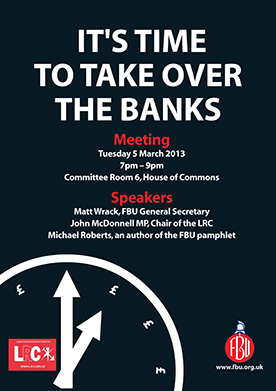
It's time to take over the banks!

Get along to an excellent meeting tonight at 7pm in Westminster to discuss the public ownership of the banks.

At TUC Congress last year, unions voted in favour of an FBU motion calling for the public ownership of the banks. At the meeting tonight, to be held in Committee Room 6 in the House of Commons, FBU general secretary Matt Wrack will discuss the campaign alongside LRC and LEAP chair John McDonnell MP.

The meeting will also hear from Michael Roberts who, alongside Mick Brooks, wrote the excellent FBU pamphlet 'It's time to take over the banks' (pdf).

The pamphlet makes the case for a publicly owned finance industry that provides a public service, giving financial support to industry and working people. Taking over the banks will enable planning, investment and the creation of millions of jobs. A publicly owned and democratically accountable banking system is essential to developing such a programme.

The meeting is open to all and free to attend, but allow 10-15 minutes to get through parliamentary security.

In a Comment is Free piece yesterday, PCS general secretary Mark Serwotka also made the public ownership of the banks one of his 10 steps to kickstart the UK economy. So far, the article has an 89% approval rating!

Tuesday, 12 February 2013

Britain needs a pay rise

The PCS union today launched a new report 'Britain needs a pay rise' looking at the effect of falling wages on the UK economy.

The report shows that UK workers (public and private sector) are collectively losing £50 billion a year since austerity pay policies were introduced from 2008.

As today's inflation figures show RPI inflation at 3.3%, this looks set to continue and worsen - as the average pay settlement has been 1.5% over the last year.

The report notes that since the onset of recession in 2008 the real value of wages has fallen by 7% (£50 billion a year). During the same period there has been a real terms drop in consumer demand of 5%.

This is not a coincidence - freezing or capping wages sucks demand out of the economy. It also forces more workers on to tax credits, housing benefit and other welfare payments costing the government more.

For public sector workers in general, and civil servants in particular, there are lots more facts specific to them in the report - including comparators with the private sector. In the public sector, where all increases are capped at 1% this year (for many for the second year after a two year pay freeze), pay policy will cut £7 billion a year until 2015 (at least).

Whatever sector you work in, the report highlights the necessity for workers' wages to improve for any recovery to take hold.

Launching the report today, PCS general secretary Mark Serwotka said:
"Almost everyone can now see that austerity is not working. The chancellor George Osborne is borrowing more for failure, we are on the verge of a triple dip recession, food banks are on the rise and pay day loan sharks are preying on the vulnerable.

"We believe the government's pay policy, built on the lie that hardworking civil servants are paid too much, is having a seriously damaging effect on the whole economy.

"Instead of burying their heads in the sand and hoping for the best, ministers can and should act now to put money into people's pockets and back into our economy."

Read the report

Friday, 17 February 2012

Ditch austerity and try another route

Two letters from The Guardian on 17/02/12:


As the Greek public order minister says his people "can't take any more", it's timely that Simon Jenkins (Austerity fails, yet we're too shy to think outside the box, 15 February) says the failure to take economic management beyond the diktats of austerity has become the great intellectual treason of today.

It is not just in Greece that austerity is failing but in the UK, too. George Osborne's emergency budget was supposed to bring Britain back from the brink but has, instead, pushed us closer to the precipice. Where he predicted growth of 2.3% last year, we got 0.3% – less than in the US, Germany, France, and even Italy where their leader's economic incompetence got him deposed.

This failure to generate growth – which Osborne pledged to create by cutting the public sector, which he said had been "crowding out" the private sector – means his government is borrowing billions more than planned, necessitating further cuts. Unemployment is the highest for a generation, with youth unemployment the highest ever on record.

The alternative required is the exact opposite of austerity; it is investing for growth, creating jobs to get people working again, and raising wages and benefits to create demand. We have distributed over 250,000 copies of our "There is an alternative" pamphlet, explaining how this would work. Even the modest stimulus in the US has meant falling unemployment and higher growth. Mr Osborne should at least aspire to that, rather than following Greece into a death spiral.

Mark Serwotka
General secretary, Public and Commercial Services Union


• Simon Jenkins rightly wails that "thousands of citizens across Europe are having their lives ruined ... because a financial elite, once burned, is too shy to think out of its box". Fair enough, but maybe part of the problem is that the Guardian, like most of the media elite, is itself too shy to publish outside the box. With the unemployment trajectory on course this week for 3 million by the end of the year, it is remarkable that the renowned policy analyst Peter Taylor-Gooby was not even mentioned when he recently published his research study linking the potential for civil disorder and riots to the legitimacy of the austerity measures taken by western governments over two decades and suggesting that without change further unrest will follow.

Similarly, when tackling the economic deficit Greg Philo offers a radical proposal of a wealth tax of 20% on the assets of the richest 10%, but his work never gets beyond the Guardian's website. There's a comforting staleness in reading the same old establishment faces in the Guardian and watching them on Question Time or the Politics Show. Exceptions apart, to have a Guardian journalist decry others for a lack of radical thinking when the paper has been a fervent advocate of the timidity of British politics is a bit rich.

John McDonnell MP
Hayes and Harlington

Wednesday, 2 November 2011

The millions should control the billions


Mark Serwotka, PCS General Secretary, argues that banks should be publicly owned

To know where we should go on bank reform, we have to understand where we have been. The banking crisis that swept the globe in 2008 was not a crisis of the banks alone, but a crisis of government: the failure of successive governments in the UK and globally to have any oversight of the banks. It was negligent.

Many of us as parents know what would happen if we were negligent: if you let a toddler dictate what they wanted to eat, the diet of jelly, ice cream and cakes would probably leave them obese or in a diabetic coma, while the sugar-induced highs and crashes would bring trauma to the household. Never mind the nanny state, the government has been a bad parent to the toddling banks. It has allowed them unsupervised access to the biscuit barrel. The banks are now even more like toddlers, unable to stand without government support.

We should be clear: the banks are indeed too important to fail. Millions of working people depend on banking for their savings, their pensions, their mortgages and for the daily management of their finances. The assets traded and gambled around the globe are people’s life savings, their security in retirement and their family homes. The current situation is even more precarious than in 2008. Several banks and governments teeter on the brink of collapse. A Greek default could result in a domino effect. While the UK was in a financially secure enough position to offer bail-outs in 2008, it is doubtful if today that would be politically acceptable or economically affordable.

Any rational observer would concede that anything vital to our society demands close oversight. The shocking thing about the banking collapse in 2008 was how the regulators were unaware of, and did not understand, many of the intricate schemes and processes operated in the banking system. It is time the public interest became a factor in our banking system. Given the importance of banking – not as an end in itself but because of what it facilitates – and because of its vulnerability, it is essential that the rebuilding of the system is done in the public interest.

My trades union has a clear policy: the banks should be publicly owned. Some might say this is ideological. I would say it is logical. Banks are so vital that they have to be underwritten by the public – just like public transport and utilities such as gas, electricity and water. If British Gas or Thames Water went bust, the government could no more shrug its shoulders and say “that’s the market” than it could when the UK banking system teetered on the brink in 2008-09. But there are several other reasons why the banks should be publicly owned.

First, a bank underpinned by the state could lend at lower rates and offer savers higher rates. When Northern Rock was nationalised, Sir Richard Lambert, then CBI director general, told the Treasury Committee: “It is critically important that state ownership of the bank should not be allowed to distort the savings market, through access to government funds on favourable terms”. In other words, offering the public (and businesses) a better deal would “distort the market”. Just as private finance initiatives have proved incredibly wasteful, the inherent stability of the state makes it the natural home for secure banking.

Second, we are suffering from a crisis of investment. Banks are cautious about lending yet there is no end of investment opportunities from much-needed housing to redressing the UK’s woeful underinvestment in renewable energy infrastructure. Investment is essential to creating jobs, cutting the welfare bill and increasing our tax revenues – closing the deficit. At the moment we have the worst of all worlds: a government irresponsibly cutting capital spending and private banks that are unwilling to lend. Too much of the money banks have gained through quantitative easing has been speculated with or invested overseas.

Third, we should act in the public interest. While my union members are demonised in the rightwing tabloids as feather-bedded pen pushers with gold-plated pensions (the average member is on £22,850 and will get an £80 per week pension), the fat cats are rewarded with obscene bonuses and huge salaries. We could direct investment to where it is socially useful, ensure savings are encouraged and get a better grip on the housing market and mortgage finance.

The question is one of democracy: it is the wages, pensions and mortgages of millions that create the wealth banks have squandered. It is time those millions controlled their billions.

Thursday, 7 July 2011

Public sector pensions: unaffordable? untenable?


Is there anyone who hasn't listened to Cabinet Office Minister Francis Maude's mauling on the Today programme last week? (it really heats up at about 8 minutes in)

As well as being evasive about what was up for negotiation, it was clear that either Maude hadn't read the Hutton report or was willfully trying to misrepresent it by saying pensions were getting more costly, and that Hutton had said public sector pensions were 'untenable'.

Later in the day, other Ministers took to the airwaves and suggested that the Hutton report's projected falling costs was based on certain assumed changes that the unions were opposing, including the change in the inflation measure for indexation from RPI to CPI.

It's therefore worth looking at the National Audit Office report, published in December 2010 (in between Hutton's interim and final reports) and does not take into account the indexation change, nor does it make any assumptions in the size of the workforce. It shows reforms agreed between the unions and the then Labour government in 2007-08 "reduces costs to taxpayers by 14 per cent".

It also says, "long-term costs are projected to stabilise around their current levels as a proportion of GDP". So even without these disputed areas (which the government obviously aims to force through) the costs are still not rising, but stable.

The 07-08 agreement is also "transferring from taxpayers to employees additional costs arising if pensioners live longer", which means savings are being provided by public service employees in form of increased contributions or reduced future pension.

The 07-08 deal raised the pension age to 65 for new starters, introduced a career average scheme into the civil service pension scheme, and introduced 'cap and share' arrangements so that unexpected rises would be borne by employees. Labour Cabinet minister at the time, Alan Johnson MP, said it was a "fair and reasonable" deal.

And so to the Labour Party and Ed Miliband, who was very clear (some might say repetitive) in his opposition to the strikes. However, in a briefing to Labour MPs 'PLP brief: Strikes and public sector pensions- 28 June 2011, From the Leader of the Opposition' Ed sets out Labour's position more fully (over 7 pages) yet no more clearly.

In it he says (p.1) "we support serious and long term reform of public sector pensions" and says "John Hutton's report should provide the starting point". But despite repetitively saying that "negotiations are ongoing", the document does acknowledge:
  • "Even before John Hutton's final report was published, the government slapped a 3% surcharge on pension payments for millions of public sector workers" (now 3.2% according to Danny Alexander's speech to IPPR on 17 June); and
  • "Lord Huton argued that public sector pensions in the UK are affordable in the long run"
  • "[The government is] switching the indexation of public sector pensions to CPI from RPI"
The above seems to counter Ed Miliband's line that negotiations are ongoing, and even the document hints at this by saying "If the government wants, they could have proper discussions. If that happens, there's no need for these strikes". This strongly implies proper discussions are not happening, undermining Ed's insistence that it's wrong to strike when negotiations are ongoing. Even Francis Maude was virtually forced into a confession of the sham nature of the talks under scrutiny from Evan Davis and Mark Serwotka (Radio 4 Today).

Unions met with the government again this week (for the first time since 30 June), but little movement seems to have been achieved, according to this Reuters report.

It is important that both the media and the Labour opposition begins to cut through the spin and misrepresentations and hold the government to account on this issue. It is even more bizarre for the Labour Party since, by tacitly supporting further changes, they are saying their own 2007-08 deal was ineffective, despite the National Audit Office proving the contrary.

Monday, 14 September 2009

LEAP publishes Inflation report at TUC

LEAP has today published a major new research report on inflation.

Inflation Report 2009: why inflation is a class issue (free download) shows how in the past year inflation has disproportionately hit the poorest hardest.

The report, commissioned by the Trade Union Co-ordinating Group (TUCG) of eight trade unions, also argues that trades unions must fight for above inflation pay increases, especially for the lowest paid workers who have been hit hardest by inflation - as it is essential goods (which cost the poorest a higher proportion of their expenditure) that have had the highest rate of inflation in the last year.

The paper also proposes a new inflation measure: 'Essential Inflation', based on the inflation rate for the essential items that people are unable to cut back on.

Bob Crow, RMT General Secretary, said:

"It is clear from this important piece of research that the working class have taken by far and away the biggest hit in this recession.

"While pundits talk about falls in inflation, out there in the real world it's a day to day struggle for people to make ends meet as the cost of essentials continues to rise.

"Meanwhile, it's bonus time again in the casinos of the City of London. Those who got us into this mess have come out smiling while the workers who really make the economy tick have been hammered.

"RMT fights day after day against exactly this kind of injustice."


John McDonnell MP, TUCG Parliamentary Convenor, said:

"This paper demonstrates who has been hardest hit by the recession - and it's the lowest paid.

"This evidence will now shape trade unions' strategy in coming pay negotiations. Trade unions cannot be expected to stand back and allow the living standards of their members to be eroded when they've witnessed the return of the bankers' bonus culture."


Mark Serwotka, PCS General Secretary, said:

"Low paid workers in both the private and public sector are bearing the brunt of the recession. Hundreds of thousands of civil and public servants have experienced pay freezes leading to their pay being cut in real terms.

"PCS members who keep this country running know the true cost of inflation with 40% of staff who are helping people deal with recession getting no pay rise at all last year. This report lays bare the fact that it is the poorest in society who are hit by essential inflation."


The report's conclusions are:
  • In current pay negotiations, where pay freezes are being proposed across organisations (e.g. British Airways) it is important to understand that a pay freeze is a real terms cut of nearly 2% in living standards for the poor, but a real terms increase for the richest. Unions are therefore correct to argue that low paid workers should not be treated the same in pay negotiations as senior management grades (even ignoring arguments about reducing existing pay differentials).

  • It also means that unions representing the lowest paid workers should be calling for pay increases of at least 2% just to maintain living standards.

  • Government must ensure that in areas it regulates – many of which are covered in the Essential Inflation measure – that rises are kept down so as not to disproportionately affect the poorest.

  • The Government must also ask the Low Pay Commission to reconsider its recommendations that the National Minimum Wage (NMW) rates rise by only 1.1% in October 2009 – less than the rate of inflation for the second consecutive year. This would represent a decline in relative living standards for low paid workers, if there pay is increased only in line with the NMW uprating. Likewise upratings to social security benefits and the basic state pension this year must also be more generous.

Wednesday, 22 April 2009

Budget 2009: Analysis

John McDonnell MP, LEAP Chair, warns of a package of cuts buried in the Budget and "trivial" concessions.

Graham Turner, author of The Credit Crunch, gives his take on the Budget.

Mark Serwotka warns that public services will suffer.

Richard Murphy on how the Budget fails the environment.

Jeremy Corbyn MP, writing in the Morning Star, in advance of the Budget.

Monday, 20 April 2009

Bailouts for the banks, Cuts for the public sector

With pre-Budget leaks suggesting £15bn of public sector cuts to be announced in Wednesday's Budget, PCS has put out the statement below:

MEDIA RELEASE
Date: 20 April 2009
For immediate use

SPENDING CUTS WILL DAMAGE SERVICES SAYS CIVIL SERVICE UNION

The Public and Commercial Services Union (PCS) warned that further spending cuts will damage services and jeopardise the delivery of government policies as it responded to today’s budget speculation that the government will cut spending by £15 billion.

The Chancellor has already announced £5 billion of so called ‘efficiency savings’ across civil service departments with speculation mounting that he will announce a further £10 billion of cuts in Wednesday’s budget.

Civil and public services have already been hit by spending cuts in real terms and ‘efficiency savings’ which have lead to over 80,000 job loses and hundreds of office closures.

Key areas such a tax, jobcentres and justice have all been affected. 25,000 jobs are to go and 200 offices to close in Her Majesty’s Revenue and Customs (HMRC) by 2011. 500 jobcentres and benefit offices have closed over the last 5 years hampering the government’s ability to respond to recession and the justice system is in danger of delays and backlogs as the Ministry of Justice faces a year on year cut to its budget in real terms.

Commenting, Mark Serwotka, PCS general secretary, said: “Further so called efficiency savings should not be at the expense of jobs and services. The government should be targeting the billions of taxpayer’s money wasted on the army of consultants. We have already seen the impact of cutting services to the bone in areas such as Jobcentres, whose tireless work has been hampered by a history of job cuts and office closures. Further spending cuts will jeopardise the delivery of frontline services which people are increasingly relying on as the recession deepens.”

Later today, when he addresses the Scottish Trades Union Congress in Perth, he is expected to add: “Politicians and commentators on the right are using emotive words such as ‘apartheid’ to sow division between hard working people in the public and private sector. Not only is it divisive, it is wrong. Low paid workers, wherever they work, are in this together, the victims of the excesses of the City and casino capitalism.

“The reality for thousands of civil and public servants across the UK, delivering services such as benefits, helping people back into work, tax credits and justice, has been job cuts, pay freezes and pay cuts in real terms. The reality for the communities they serve has been office closures and the deterioration of services.

“As the recession bites deeper and more and more people become reliant on public services, the government should halt office closures and job cuts in civil and public services. In this week’s budget the government should be talking about creating jobs across the economy and increasing the support for people hit by the recession. The government also needs to recognise the pressure that Jobcentres are under by committing extra resources and by reopening some of the 500 hundred they have closed over the last five years.”

ENDS

Monday, 13 October 2008

Bank Bailout should not be at the expense of Public Services!


Speaking at a meeting in the House of Commons on the financial crisis this evening, Mark Serwotka, general secretary of the Public and Commercial Services Union (PCS), will warn that the bailout for banks shouldn’t come at the expense of public services, the public who rely on them, or the hardworking people who deliver them.

Speaking at this evening’s, Left Economics Advisory Panel (LEAP) emergency rally, he will say:


"The thought of New Labour nationalising banks would have seemed absurd even a few weeks ago. Now up to £500 billion is being made available to prop up the banking system in these unstable economic times.

"We should look at the conditions attached to the massive injection of taxpayer’s money into the banking system. There should be controls on top pay, and restrictions on repossessions, with future profits from the banks going to the public purse. The trend of offshoring to avoid taxation must be brought to a rapid halt too.

"The arguments for more free markets, less regulation, and more privatisation have now been found wanting and hollow. No one trusts the smooth tongued financiers anymore. Although, amazingly, New Labour still seems keen to bring them into government roles, such as David Freud, formerly at merchant banker UBS Warburg, now advising the DWP on welfare reform.

"The money provided by the state is mostly for institutions. The protection for savers will help only a minority of working people: 60% of households with income of less than £500 per week have no more than £1500 saved and half of them have nothing. If you consider lone parents, 88% have no more than £1500 put away.

"The commitment of so much cash to banks will inevitably mean pressure on other areas including welfare, jobs and pay."

"This year nearly half of those working for the Department for Work and Pensions, who help people back into work and who deliver pensions and benefits, will get no pay rise at all this year and just 1% next year.

"The government pay freeze will not only exacerbate poverty, it will hold down saving and retail spending.

"And James Purnell’s planned attacks on lone parents, long term unemployed and those with disabilities, contained in the welfare reform green paper, cannot hope to help them into work when thousands are losing their jobs. They will simply make them poorer too.

"It’s not only the banks that need refinancing. It is time to recognise that those at the base of society will be the ones that have to pull us out of crisis. When PCS members take up the fight for better pay, they are part of a struggle for a better society, which is not subject to disasters caused by the unregulated greed of the City."

The Left Economics Advisory Panel (Leap) emergency rally, ‘Who pays for the credit crunch?’ starts at 7.30pm in Committee Room 10, the House of Commons. Chaired by John McDonnell MP, speakers include: Brian Caton (POA) - Jeremy Dear (NUJ), Kelvin Hopkins MP, Prem Sikka (Prof. of Accountancy, University of Essex).