The hung parliament that has resulted from Britain’s inconclusive general election is certain to lead to a prolonged period of political instability slap bang in the middle of the gravest economic and financial crisis since the 1930s.
Now the horse-trading begins – behind the voters’ backs – to put together a government that is unlikely to see the year out. The Tories, New Labour and the Lib Dems don’t have much time, as the markets made clear while the last votes were being counted.
Sterling fell on the foreign exchange markets, while the cost of borrowing to fund the huge budget deficit rose as dealers in British bonds began to take evasive action. Shares on the FTSE 250 – which more closely reflects the British economy – fell by over 270 points. “They have got until the markets open on Monday to sort this out,” one dealer said.
Paralysis at Westminster comes amidst turmoil coursing through global markets in the wake of Greece’s bail-out by the International Monetary Fund and other eurozone countries. Few think the £100 billion rescue package will be sufficient and the resistance by Greek workers has further unnerved the markets.
“The election is shaping up to create the worst possible outcome at the worst possible time,” warned David Morrison, strategist at GFT. “Investors’ nerves are already jangling and this added uncertainty will undermine UK equities further. The sell-off in gilts [bonds] and sterling is a clear indication of how unimpressed the City is by the lack of a clear winner.”
If the City was unimpressed, so too were the electorate. Their refusal to give any party a clear mandate could be seen to express a fear that such an outcome would make massive cuts in services and living standards more certain. While the turnout was up slightly on 2005, in many inner-city areas it was below 60%. More than one in three registered voters did not participate, despite intense pressure to do so.
Clearly the TV debates did nothing to enable voters to distinguish one party from another, apart from the style of the respective leaders. Many undecided voters failed to work out a choice in time while thousands of those who made up their minds late in the day found themselves locked out because polling stations were understaffed.
All the major parties have now pledged to act “in the national interest”, which is tantamount to saying that the markets must be mollified by a cross-party agreement to make the cuts they hinted at but shied away from spelling out in any detail during the election campaign. Ruling in the people’s interest is not an option for any of them.
One thing is clear. New Labour spent 13 years in office promoting a market capitalist economy that ultimately crashed and in doing so created the political space for the hated Tories to make a comeback from the dead. In 1997, New Labour got 43% of the vote and more than 12 million votes. Now they are down to a 29% share and 8 million votes.
A majority New Labour government is now no longer a practical possibility in British politics. Any pact with the Lib Dems would simply confirm a new political alignment that is not so much “progressive” as anti-socialist, anti-trade union and pro-business.
The election result shows that the Parliamentary system is in melt-down, one that reflects the real chaos in global economics and finance. An anti-people regime without any mandate will set about clobbering the electorate very shortly. On that basis, we have an absolute right to oppose and reject whatever government and policies emerges this weekend. More than that, we should set out creating the framework for a real democracy in the shape of a network of People’s Assemblies. The old system is broken and can’t be fixed.
Paul Feldman
Communications editor
7 May 2010
www.aworldtowin.net
Showing posts with label General Election 2010. Show all posts
Showing posts with label General Election 2010. Show all posts
Saturday, 8 May 2010

Tuesday, 4 May 2010
More rail cuts ahead
In January 2009 LEAP published RMT-commissioned research on the UK rail system.

We said that our findings raised "serious questions about the viability of the Department for Transport's (DfT) franchise model in a period of recession."
We elaborated that, we expected rail companies to attempt "to renegotiate franchise agreements, which could include ... cutting services on less profitable routes".
Today, the Daily Telegraph reports that proposals to give rail operators an incentive to cut unprofitable routes was drawn up not by rail operators, but by the DfT in January.
Of course the ludicrous franchising system means that operators receive subsidies to operate these routes, and with no party guaranteeing transport funding it is of course the DfT who would initially benefit by not having to pay the subsidies. However, the rail companies would also benefit, since they could lease less rolling stock and roster fewer staff as they would be running fewer services.
But what about the government's other policies (i.e. apart from cutting the deficit)?

In our January 2009 report, we identified the following government policies that would be threatened by rail cuts:
1. Modal shift from road to rail to reduce carbon emissions;
2. Social exclusion – increased rail fares will drive poorer farepayers with no alternative private transport options from the railways;
3. Increasing employment towards a target of 80%;
4. Improving passenger safety at rail stations and reducing staff assaults
All of which will be sacrificed if DfT plans go ahead it seems.

We said that our findings raised "serious questions about the viability of the Department for Transport's (DfT) franchise model in a period of recession."
We elaborated that, we expected rail companies to attempt "to renegotiate franchise agreements, which could include ... cutting services on less profitable routes".
Today, the Daily Telegraph reports that proposals to give rail operators an incentive to cut unprofitable routes was drawn up not by rail operators, but by the DfT in January.
Of course the ludicrous franchising system means that operators receive subsidies to operate these routes, and with no party guaranteeing transport funding it is of course the DfT who would initially benefit by not having to pay the subsidies. However, the rail companies would also benefit, since they could lease less rolling stock and roster fewer staff as they would be running fewer services.
But what about the government's other policies (i.e. apart from cutting the deficit)?

In our January 2009 report, we identified the following government policies that would be threatened by rail cuts:
1. Modal shift from road to rail to reduce carbon emissions;
2. Social exclusion – increased rail fares will drive poorer farepayers with no alternative private transport options from the railways;
3. Increasing employment towards a target of 80%;
4. Improving passenger safety at rail stations and reducing staff assaults
All of which will be sacrificed if DfT plans go ahead it seems.
Tuesday, 13 April 2010
Tory manifesto: Keep them out of government!
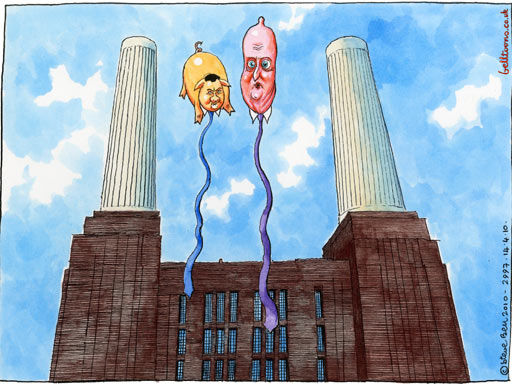
The Tories unveiled their manifesto yesterday. Peel away the 'back of the envelope' people power puff, and what remains? The same Tory policies we'd all expected:
Redistribution of wealth . . . to the rich:
- Raising the inheritance tax threshold to £1m will cost the Exchequer hundreds of millions in lost revenue from relatively wealthy people. It is a regressive tax cut that benefits only a wealthy few
- Likewise cutting the proposed rise in national insurance, described as ("Labour plans to raise the Employees’ National Insurance Contributions (NICs) for everyone earning over £20,000 by 1 per cent") neatly obscures the fact that there is also a 1% increase for employers, which the Tories will also cut. While, due to the ceiling at around £35,000, NI is a regressive tax - cutting employers' contributions is redistributing wealth to business
- The manifesto also promises "we will cut the headline rate of corporation tax to 25p". Bear in mind when John Major left office after 18 years of Tory rule it was 33%, and Labour has cut that to 28%. This is a massive redistribution of wealth to big business
- Raising the stamp duty threshold to £250,000 is a tax cut for those buying their own home, but the manifesto says nothing about the 1.8 million families on council house waiting lists
They also promise to cut the bulk of the deficit over a Parliament (i.e. going further than Labour). So, like Labour, it's cuts, cuts, cuts - but with some more redistribution to the rich and powerful sprinkled on top.
Labour Manifesto: A future fair for all?

Lord Mandelson promised it would be a "pro-business" manifesto, and described it yesterday as a "Blair-plus" manifesto. It certainly looked that way with promises to cut £6 billion of regulation on business by 2015 and keep business taxes "competitive".
Considering New Labour has already cut corporation tax from 33% to 28%, which over 13 years has cost the Exchequer £50 billion in lost revenue, it makes it galling that business is bleating about an extra 1% of national insurance.
The Manifesto refers to "the recession created by the financial crisis" but it seems to be mainly public sector workers who will be paying for it. The manifesto refers to "tough choices" (i.e. cuts) on public services, and commits to £15bn efficiency savings (i.e. cuts) in 2010-11, and a further £11bn by 2012-13.
There will also be a 1% cap on public sector pay in 2011-12 and 2012-13. Bearing in mind inflation is currently 3.5%, public sector workers are being promised a real terms pay cut for another two years.
The manifesto also promises a £20 billion programme of asset sales (i.e. privatisation) by 2020.
There will also be more outsourcing in the running of services, with "greater support for third-sector organisations in competing for public-sector contracts" and "if the local school is underperforming it will be taken over" (hinting at more City Academies).
There is of course the same rhetoric about protecting frontline services, but the "tougher than Thatcher" cuts that Darling talked about, and the scale of cuts to halve the deficit, are still hidden it seems . . .
There were however some good things in the manifesto: the National Minimum Wage will rise at least in line with average earnings in the future, which is very welcome given that the last 3 years it has risen below inflation.
Also the Government will implement the living wage (£7.60 per hour) across all government departments - which will be good news for National Gallery workers who have recently been on strike.
The manifesto also promises to keep the Royal Mail in the public sector, re-link pensions to earnings, and double paternity leave to four weeks.
The only mention of the tax gap comes under section on 'global future': "Further action will be taken to strengthen developing countries’ tax systems, reduce tax evasion, improve reporting, and crack down on tax havens."
Tax evasion, avoidance and non-collection costs over £120bn here in UK – now that really could tackle the deficit and be 'fair for all'
Tuesday, 6 April 2010
Know Your Enemy
With the General Election to be called for 6th May, the dividing lines are becoming increasingly clear.
Business is clearly backing the Tories to deliver the attacks it wants. The traditional Tory allies are backing their people again, with an attack on the moderate increase in National Insurance over the bank hoiday weekend. It was the usual suspects: the BCC, CBI and a ragtag of non-dom, billionaire executives who avoid tax as if as of right, and then complain about the tax burden.
Just as the Sun decided it would back the Tories, when they were leagues ahead in the opinion polls, big business likes to back winners.
As LEAP has pointed out, New Labour has embraced the neoliberal economic orthodoxy in its 13 years. Even now, it is not talking about making the rich pay.
However, Labour has increased the top rate of tax to 50% and is proposing to raise NI (a progressive tax). The fact that the Tories are unashamedly lining up with the bosses against even these moderate measures - and with the Murdoch press - has not served them well in the latest opinion poll in today's Guardian, with their lead reduced to just 4 points.
Does this show that Tory support for big business is damaging them (down to 37%)? If so, it should tell New Labour that being Labour might be popular. If Labour is to win it needs a decisive break and to start putting people before its rapidly deserting wealthy friends.
Thursday, 1 April 2010
An X Factor spin to the election battle
Jeremy Corbyn MP, writing in the Morning Star
Monday night's Channel 4 debate between Alistair Darling, Vincent Cable and George Osborne was portrayed as an X Factor competition with the threesome all allowed to give their own broadly similar analysis to the situation facing this country.
An instant opinion poll after the event awarded a 36 per cent victory to Professor of Hindsight Cable with Darling and Osborne tying for second place on 32 per cent.
Rather surprising this, in view of Osborne's peculiar decision to announce that the Conservative government would remove the National Insurance increase and would thus offer up £5.6 billion of "efficiency savings."
Apparently the Tories think they are marching into power on the slogan of efficiency savings, but I would recommend that every public worker be seriously concerned about this because it sounds to me and many more like cuts by another name.
Where all three agreed was that there has to be a repayment of the £167bn deficit and the question was more on the timetable for repayment rather than the principles behind it or of the sort of economy that we should have in the future.
The Tories, as we well know, are a party representing the interests of the very rich and the purpose of Labour ought to be to represent the organised working class and radical people of this country.
For all his analysis of the way the banking crisis came about, Cable essentially offers broadly market solutions to the problem and claims the Lib Dems are neither representatives of the Tory rich or militant "trade unions." Interestingly, the Lib Dems equate a similarity of power and interest between the incredibly rich backers of the Tory Party and trade unions who represent people in work.
This would suggest a complete lack of understanding of the role or rights of trade unions in our society.
The three big industrial disputes at the present time - the BA cabin staff strike, the civil servants' dispute over severance pay arrangements, and the rail workers' defence of signal and safety workers' jobs and conditions.
Even if successful none of these disputes will make any member of any union better off, but they will save jobs and protect conditions.
And all of these actions are defensive. If anyone has any doubts as to what happens when the bankers are allowed to impose a solution on the economic crisis, they only have to look at the latest twists and turns in Greece.
The once highly popular PASOK government in Athens is seeking to obey the diktats of the world's bankers and the European Bank, thus creating more unemployment and a deeper recession.
In turn this will further increase the jobless rate in one of Europe's poorer countries.
The alliance of the European leaders enforcing these measures on Greece and now on Portugal are the result of the creation of an independent central bank dedicated to "market stability," not social justice.
The Morning Star reported the publication for discussion of the People's Agenda by the Labour Representation Committee, which boldly poses the question in whose interests our economy has to be run.
The pamphlet stresses that despite the increases in pensions, welfare benefits and child allowances the low taxation rate among the richest means that inequality in Britain is probably the highest in Europe.
In its proposals for an incoming government, the point is strongly made that contracting out of public services, marketising education and league tables for schools have forced public services to focus more on cost-cutting than quality.
The pamphlet quite rightly calls for a massive house-building programme and while the government's recognition of the role of council housing in the past two years is welcome - as is the change in local authority finance - a massive problem of those living in overcrowded accommodation remains.
This results in underachieving children and many who have no chance of council housing being forced to live in very expensive private rented accommodation.
It is time to control this absurd market and prevent the exploitation of the vulnerable through extortionate rents.
The People's Agenda also makes demands for a decent minimum wage, the repeal of anti-trade union laws and the public ownership of crucial industries.
After the election the incoming government will inherit an unprecedented opportunity in the public ownership of most of the banking system.
This should be brought under public control and not left in the hands of a holding company whose sole function is to dispose of the shares at the first opportunity.
Labour was founded by the trade unions and socialists in Britain at the start of the 20th century and its very survival depends on the support of that same coalition.
To win the election, this coalition must be mobilised. Afterwards, the crisis of free market and bankers' Britain must be dealt with by ending the obscenity of inequality and replacing it with the goal of equal opportunities and social justice.
Monday night's Channel 4 debate between Alistair Darling, Vincent Cable and George Osborne was portrayed as an X Factor competition with the threesome all allowed to give their own broadly similar analysis to the situation facing this country.
An instant opinion poll after the event awarded a 36 per cent victory to Professor of Hindsight Cable with Darling and Osborne tying for second place on 32 per cent.
Rather surprising this, in view of Osborne's peculiar decision to announce that the Conservative government would remove the National Insurance increase and would thus offer up £5.6 billion of "efficiency savings."
Apparently the Tories think they are marching into power on the slogan of efficiency savings, but I would recommend that every public worker be seriously concerned about this because it sounds to me and many more like cuts by another name.
Where all three agreed was that there has to be a repayment of the £167bn deficit and the question was more on the timetable for repayment rather than the principles behind it or of the sort of economy that we should have in the future.
The Tories, as we well know, are a party representing the interests of the very rich and the purpose of Labour ought to be to represent the organised working class and radical people of this country.
For all his analysis of the way the banking crisis came about, Cable essentially offers broadly market solutions to the problem and claims the Lib Dems are neither representatives of the Tory rich or militant "trade unions." Interestingly, the Lib Dems equate a similarity of power and interest between the incredibly rich backers of the Tory Party and trade unions who represent people in work.
This would suggest a complete lack of understanding of the role or rights of trade unions in our society.
The three big industrial disputes at the present time - the BA cabin staff strike, the civil servants' dispute over severance pay arrangements, and the rail workers' defence of signal and safety workers' jobs and conditions.
Even if successful none of these disputes will make any member of any union better off, but they will save jobs and protect conditions.
And all of these actions are defensive. If anyone has any doubts as to what happens when the bankers are allowed to impose a solution on the economic crisis, they only have to look at the latest twists and turns in Greece.
The once highly popular PASOK government in Athens is seeking to obey the diktats of the world's bankers and the European Bank, thus creating more unemployment and a deeper recession.
In turn this will further increase the jobless rate in one of Europe's poorer countries.
The alliance of the European leaders enforcing these measures on Greece and now on Portugal are the result of the creation of an independent central bank dedicated to "market stability," not social justice.
The Morning Star reported the publication for discussion of the People's Agenda by the Labour Representation Committee, which boldly poses the question in whose interests our economy has to be run.
The pamphlet stresses that despite the increases in pensions, welfare benefits and child allowances the low taxation rate among the richest means that inequality in Britain is probably the highest in Europe.
In its proposals for an incoming government, the point is strongly made that contracting out of public services, marketising education and league tables for schools have forced public services to focus more on cost-cutting than quality.
The pamphlet quite rightly calls for a massive house-building programme and while the government's recognition of the role of council housing in the past two years is welcome - as is the change in local authority finance - a massive problem of those living in overcrowded accommodation remains.
This results in underachieving children and many who have no chance of council housing being forced to live in very expensive private rented accommodation.
It is time to control this absurd market and prevent the exploitation of the vulnerable through extortionate rents.
The People's Agenda also makes demands for a decent minimum wage, the repeal of anti-trade union laws and the public ownership of crucial industries.
After the election the incoming government will inherit an unprecedented opportunity in the public ownership of most of the banking system.
This should be brought under public control and not left in the hands of a holding company whose sole function is to dispose of the shares at the first opportunity.
Labour was founded by the trade unions and socialists in Britain at the start of the 20th century and its very survival depends on the support of that same coalition.
To win the election, this coalition must be mobilised. Afterwards, the crisis of free market and bankers' Britain must be dealt with by ending the obscenity of inequality and replacing it with the goal of equal opportunities and social justice.
Saturday, 27 March 2010
The Budget-that-never-happened exposed

When the showpiece of a Budget is that there'll be a supertax on cider, then one of two things must be true: the world is happy place since the only economic discrepancy relates to fizzy alco-apples or (and I'd suggest this is the case) there is so much wrong that the Chancellor is hiding something.
A BBC interview with Alistair Darling barely 24 hours after the Budget showed that Darling was indeed feeding us milk and honey (but not cider) until after the election.
In a Budget speech long on party political patter, but short on economic strategy, Darling attempted to setup dividing lines between Labour and the Tories. Why then collapse the next day and say actually, 'we're going to be the same'. In fact, we'll introduce cuts that "will be deeper and tougher" than those introduced by Thatcher.
As today's Morning Star report 'Darling comes clean over cuts'. The battle lines are drawn - you can vote Labour for tough and deep cuts, Lib Dems for savage cuts or Tory for early cuts. Cuts, cuts, cuts (has a consonant been omitted? - Ed)
Subscribe to:
Posts (Atom)