Showing posts with label Pre-Budget Report. Show all posts

Wednesday, 16 December 2009

It Doesn’t Have to be Cuts, There are plenty of Alternatives


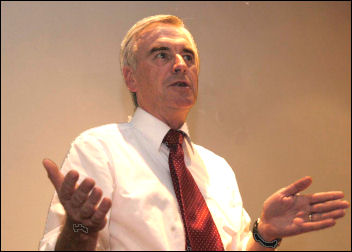
John McDonnell

The backdrop to the Pre-Budget statement is the potential for the Government's annual deficit, previously estimated at £175 billion, to be on course to balloon up to £190 billion. All three main political parties are committed to reducing and eventually eliminating the deficit. Labour’s new Fiscal Responsibility Bill commits the Government to cutting the deficit by 50% in four years, while Cameron is proposing to eliminate the whole deficit in one Parliament. Clegg and Cable are calling from the sidelines for a detailed programme of “savage cuts.”

Despite threats to bankers’ bonuses and on-and-off calls for a Tobin Tax, none of the main political parties is willing to look at a serious increase in the tax take – either by increasing redistributive taxes or tackling large scale tax evasion and avoidance. Only the Chancellor and the most deluded elements of the Bank of England’s Monetary Policy Committee (MPC) believe that significant economic growth will materialise in the next two years to lift tax revenues and ease the deficit. The OECD is predicting no more than 1% to 2% growth up to 2011 – and David Blanchflower, former MPC member, is cautioning about the potential of a double dip recession.

The result is a consensus across all the main parties that demands a cutback in public spending not seen in this country since the 1930s.

To achieve a cut of £190 billion, even if the so-called ‘smart government’ savings were achievable, a Government would have to cut £30-35bn per year for the five years of that Parliament. This would require a 25% cut in public services. On this scale, the Government would need to make cuts that would include over 7,000 GPs, over 4,000 NHS dentists, over 400 NHS hospitals, over 750 secondary schools, over 100,000 teachers and over 10,000 firefighters. Welfare benefits and pensions would inevitably come under attack, and to secure this level of savings would mean cutting unemployment benefit to £45 per week and for the pension age to increase to 69.

If New Labour refuses to break the cross-party consensus on who is to pay for the economic crisis, we are facing the prospect of a sufficient number of Labour supporters staying at home at the General Election to allow the Tories to slip back into office or at best a hung Parliament based upon a cross party economic deal around public expenditure cuts.

The only hope of mobilising our supporters and Labour retaining office with a workable majority is a demonstrable, radical change in political direction by the Government, carried over into its election manifesto. An alternative programme to set out on a new course would include:

• large scale public service investment;
• ending privatisation;
• rebalancing our economy by creating and protecting jobs with investment in manufacturing;
• increasing the minimum wage, state benefits and pensions;
• building and refurbishing the affordable homes we need to overcome our housing crisis;
• making a real commitment to tackling climate change by adopting the green new deal programme for renewable energy and transport;
• securing a peace dividend by withdrawing from Iraq and Afghanistan and scrapping Trident and ID cards;
• confronting the corporate tax evasion scandals and tax injustices and the waste of public resources on Trident and ID cards.

Even at this late stage, adopting a programme like this – and unashamedly promoting it to the electorate – could save a Labour Government, and the economy, but time is rapidly running out.


*This article is taken from the LEAP Red Papers: The Cuts, which can be discussed in full on the LRC website

Tuesday, 8 December 2009

Cross-Party consensus on cuts will doom UK to more recession

Ahead of Wednesday's (9th December 2009) Pre-Budget Report, LEAP has published its latest Red Papers: The Cuts. The papers provide an alternative to the cross-party consensus on public sector cuts and show the damage that could be wrought by the cuts agenda.

John McDonnell, LEAP Chair, said:

"The effect of the scale of cuts being suggested in the Pre-Budget Report, and by opposition parties, would mean horrific cuts in vital services and more unemployment. They offer no solution to the economic crisis, just cutbacks in public spending not seen since the 1930s.

"Yet none of the main political parties is willing to look at a serious increase in the tax take – either by increasing redistributive taxes or tackling large scale tax evasion and avoidance."


Andrew Fisher, LEAP Co-ordinator, said:

"The finance sector that brought the global economy to its knees in 2008 and 2009 will be written out of the story in 2010 as a new consensus solidifies among the Westminster elite that the real crisis is public sector debt.

"This is an economically illiterate consensus which will only serve to entrench recession and wreak misery on millions as people lose their jobs and public services are cut. Any solution must tackle the causes of this crisis, and the public sector did not cause it."


Download the LEAP Red Papers: The Cuts

LEAP is a collective of left economists that publishes pamphlets and reports, organises conferences and blogs regularly on economic issues from a left-wing perspective. The attached ‘Red Papers: The Cuts’ published today contain contributions from Graham Turner, Gerry Gold, Jerry Jones, Andrew Fisher, Richard Murphy, Dave Wetzel and John McDonnell MP.

Tuesday, 25 November 2008

This slump will overwhelm Brown


Graham Turner

The tax cuts unveiled by chancellor Alistair Darling on Monday were cheered by the Labour Party faithful. But one only has to cast a glance at the recent shocking turn of events in the US to see why these tax cuts will fail to rescue the economy.

The US Federal Reserve has slashed interest rates to around 0.5 percent. It can hardly go any lower. Yet the slide in the US housing market shows every sign of accelerating. Banks are losing so much money that they will not cut the cost of mortgages.

The most prescient indicator for the US housing market is a monthly survey by the National Association of Home Builders. Its November report shows housing demand falling faster than ever.

The weekly report from the Mortgage Bankers Association, another US organisation, reinforces the point. It shows that demand for mortgage loans has also tumbled since last month's stock market collapse.

The October crash on Wall Street was a belated response to downturn in the US housing market that started three years ago. But now the slide in share prices has in turn undermined confidence in the housing market.

It's a vicious circle that the Federal Reserve seems powerless to stop it. And it means that the losses on mortgage-backed bonds — losses that precipitated the failure of Bear Stearns and Lehman Brothers — are now multiplying.

These losses have now come close to bringing down Citigroup, one of the US's largest retail banking groups. The US administration had to step in with a $300 billion bailout to save it.

The biggest falls in these mortgage bonds are now being seen in the “triple A” sector of the market—supposedly the safest possible form of debt. This crisis has moved far beyond its roots in the subprime mortgage market and is migrating up the chain.

As unemployment rises, more homeowners are falling behind on their mortgage payments. Repossessions are already running at over three times the peak of the last housing recession in the early 1990s.

Corporate borrowing costs have also soared. Many companies are unable to borrow except at penal rates. This is making it difficult for them refinance their already onerous debt burdens.

General Motors now has to pay interest rates of over 50 percent to refinance existing loans and may soon collapse. One of the most vital cogs in the capital markets has utterly broken down.

Ben Bernanke, the hopelessly inadequate chief of the Federal Reserve, claimed last week that the liquidity crisis had eased. And the Libor rate — the rate that banks lend to each other at — has indeed fallen.

The problem is that ordinary companies cannot borrow at Libor rates. Many of them finance their balance sheets through the corporate bond market. And the collapse in stocks and mortgage bonds means that investors are too frightened to lend.

That is why corporate bond yields — which measure the borrowing costs for corporations—have risen. And as existing loans come up for renewal, companies will default—unless they can somehow slash costs.

That means job losses. And we should now be very worried. Monthly job losses in the US may reach 700,000 next year. That compares with to a September loss of 240,000. The current post-war record monthly loss is 602,000 jobs, set in December 1974.

The US unemployment rate could surpass the 1982 high of 10.8 percent by the end of next year. And it will carry on climbing, possibly reaching 15 percent or more by 2010.

The resulting social upheaval will pose a grave challenge for Barack Obama's incoming administration. But the paucity of his economic strategy should concern us too.

Obama's current plan is heavily influenced by Lawrence Summers, the former US treasury secretary. It amounts to little more than a rehash of the post-war "Keynesian" consensus that failed to resuscitate Japan's economy in the 1990s.

Increases in public spending or tax giveaways will not solve the core problem, which is how to stop borrowers from defaulting.

In 1932 the Federal Reserve drove interest rates down aggressively, which helped turn the tide. Corporate borrowing costs fell. It was still
not enough — but it was more proactive than the botched policies of today.

By the time the Obama camp realises the error of its ways, even the more radical policies of the 1930s may well be insufficient. Interest rate controls, unparalleled intervention and a state of emergency may eventually be the belated response to stem the slide into depression.

A deep and prolonged contraction in the US will hurt the rest of the world. Britain's top heavy financial sector will be hit even harder. The FTSE 100 stock index may slump to levels not seen since the early 1990s, tumbling 2,000 points.

Financial institutions will be forced to shed even more workers. The impact on consumer demand will be immense, leading to more layoffs across the manufacturing and service sectors. And that will utterly overwhelm the short term benefits of this week's tax cuts.

Graham Turner, Author of "The Credit Crunch", published by Pluto Press and available from Bookmarks for £12.99

Monday, 24 November 2008

Verdict on the Pre-Budget Report

The Chancellor today delivered his much awaited Pre-Budget Report, designed to act as a fiscal stimulus to mitigate against the looming recession. You can download the full Pre-Budget Report.

The key points of the Pre-Budget Statement were:
  • reducing temporarily the VAT rate to 15% with effect from 1 December 2008 to 31 December 2009;
  • introducing a new additional higher rate of income tax of 45% for those with incomes above £150,000 from April 2011;
  • increasing the employee, employer and self-employed rates of national insurance contributions by 0.5 per cent from April 2011;
  • increasing alcohol and tobacco duties, to offset the effects of the temporary reduction in VAT, maintaining these increases after December 2009 to support fiscal consolidation; and following a fall in pump prices of over 20 pence per litre from their summer peaks, a two pence per litre increase in fuel duty from 1 December 2008;
  • an additional £5 billion value for money target for 2010-11 and setting assumptions for spending growth from 2011-12 onwards;
  • making permanent the £600 increase in the income tax personal allowance announced in May 2008 with a further increase of £130;
  • bringing forward April's increase in Child Benefit to January, increases of the Child Tax Credit and a payment of £60 to all pensioners equivalent to bringing forward the April increase in the basic state pension;
The cut in VAT has been estimated to cost £12.5bn - yet, as Richard Murphy points out, very little of this is likely to be passed on to consumers, and even if it was it would make little impact as a stimulus to greater consumer spending. However, it will hit the Exchequer, and so an extra £5bn is being cut from public services. Understandably, the PCS union is concerned that further jobs will go - harming the delivery of public services. Mark Serwotka said, "the government needs to reverse its job cuts programme across civil and public services to safeguard their delivery. For example the government should be looking at tackling the £21.5 billion worth of uncollected tax and £25 billion lost through tax evasion, by putting more resources into HMRC to claw back the billions in lost revenue, which could be ploughed into public services and stimulate the economy."

As PCS points out each tax compliance staff member has a tax yield of £640,000 after employment costs. Why does the Government keep reducing staffing at HMRC when £21.5bn goes uncollected and £25bn avoided? If the Government serious about clamping down on tax abuse, we should look forward to the Crown Dependency Review. Richard Murphy is optimistic and maybe the pressure from Obama has finally made the Government act.

The new 45p tax rate is welcome, but as John McDonnell said is "hardly revolutionary" and "not enough". Why not 50% on £100,000? However, taken with plans to increase National Insurance and removing personal allowances for high earners, it looks like the Government is keen to fight the next election on making the case for tax rises!

However, the urgent question is will the fiscal stimulus work? This is doubtful. Despite some minor redistributive moves, the package is nowhere near enough to tackle this recession. Compare the scale with the bailout of the banks (when £50bn was handed over), how much is this package? £20bn, and £12.5bn of it is wasted in VAT cuts.

As John McDonnell concludes, "This is an expensive package which is not particularly well-directed, and is unlikely to have sufficient impact. It certainly will not recession-proof those hardest hit."

However, as McDonnell adds, "The Tories' response is woeful - they have no answers. Their plan to 'let the recesssion to run its course' would be a disaster."

Our job is to keep the pressure up on the Government to ensure they do not row back from these moderately redistributive steps, and that the Crown Dependency Review results in a clampdown on tax havens. Then there are the welfare cuts to campaign against, council housing (still off the agenda) to campaign for (get to the DCH conference tomorrow if you can), and bank nationalisation too . . .

Darling’s higher rate tax plan long overdue . . . but not enough

The Government will today announce the introduction of a new 45p top rate of tax on incomes over £150,000 - but not coming into effect until after the next General Election.

John McDonnell, LEAP Chair, said:

"The introduction of a higher rate of tax for high earners is long overdue but the Government's proposals are hardly a revolution, and delaying them until after the next election is pointless. The higher rate should be the start of creating a fair tax reform agenda, redistributing wealth from the super rich in order to take the low paid out of taxation altogether.

"The Government should also move immediately to tackle the large scale tax avoidance by the corporate sector, introducing legislation to outlaw tax havens, mirroring the
Obama bill in Congress. The public revulsion over City bonuses and bank executive salaries has opened the way for radical tax reform. Government must seize the moment."


Listen to John's reaction from BBC Radio 4 Westminster Hour

Read Prem Sikka's article 'Rebalancing the Books' on Guardian Comment is Free

Update: Excellent piece by Richard Murphy on why VAT cuts won't work.

Update 2: John McDonnell on Comment is Free says "This is no time for fearful half measures"