Showing posts with label executive pay. Show all posts

Tuesday, 18 March 2014

Democratise companies to rein in excessive banker bonuses


Prem Sikka

In times of austerity, one of few things that seems to be booming is the trade in wheelbarrows. At least, company directors at major corporations will need them to collect vast amounts of remuneration they continue to award themselves, with the help of ineffective remuneration committees.

The financial dealers on Wall Street have collected about US$26.7 billion in bonus payments, the equivalent of a year’s pay for the 1.1m workers on the minimum wage. The UK is not far behind. Bonuses in the City of London have increased by 49% compared to 2012, a higher figure than for Wall Street.

The chief executive of the crisis-ridden Cooperative Bank, Euan Sutherland, was to receive a remuneration package of £3.5 million, but has since resigned. The state-owned Royal Bank of Scotland declared a loss of about £8 billion, but has given 11 directors a bonus package worth about £18.25m between them. At Barclays and Lloyds Bank, the chief executives could be collecting more than £7m each. Of course, wheelbarrows come in handy at other corporate boardrooms too. Despite the costs arising from the Deepwater Horizon disaster, the pay packet of the BP chief executive has tripled to US$8.7m (£5.2m).

The corporate boardrooms are addicted to bonuses, but are the bonuses justified? The claims for bonuses and excessive rewards presuppose that executives exert superhuman efforts to generate wealth. The anatomy of corporate decisions does not really support that. When a new executive arrives at an organisation, for some time s/he is likely to be managing and living off products, services and strategies already in place. So the claims of distinctive contribution are hard to sustain.

Now suppose an executive decides to launch a new product or a project; this will always take some time to develop, plan and launch. The same applies if the mission is to rescue an ailing business. The success or failure of the new projects will not be known for many months or years. Meanwhile, the company will probably incur upfront costs, with no guarantee that the outlays will be recouped. Even after the initial celebrations, the product/service may turn out to be a failure and become a costly burden, as evidenced by payment protection insurance and other financial scandals.

Even if new ventures are successful, the success will depend on the involvement of other employees. It is hard to relate the success of anything to the efforts of few superstar executives. If the success cannot easily be related to the input of one person then the idea of performance-related pay becomes highly problematic. This suggests that higher rewards are claimed simply because some individuals or groups have sufficient power and control to give themselves disproportionate rewards.

So the question then is how to control the institutionalised fat-cattery. The UK government’s preferred solution is to empower shareholders by giving them a binding vote on executive remuneration. Such a step assumes that shareholders are owners of companies and bear most of the risks, and will somehow act in the interests of broader society. The evidence for this is not persuasive.

Shareholders in UK banks have average shareholding duration of about three months. Their position is no different from that of a speculator or a trader seeking short-term gains. They don’t have strong incentives to constrain directors. The UK Parliamentary Commission on Banking Standards looked at the operations of HBOS and concluded that shareholders did not exert “the effective pressure that might have acted as a constraint upon the flawed strategy of the bank”.

The commission also noted that “shareholders failed to control risk-taking in banks, and indeed were criticising some for excessive conservatism”. Shareholders often profit from harmful practices without any personal responsibility. A company can be mandated to sell harmful products, for example, cigarettes. Shareholders can share the resulting profits, but are not personally liable for because they are shielded by the doctrine of limited liability. Thus shareholder irresponsibility is written into the system and they don’t have strong incentives to consider the social good.

Besides, shareholders don’t provide most of the risk capital either. At major UK banks, shareholders only provide between 4.22% and 7.24% of total capital. The rest is provided by savers and creditors. Therefore, it is hard to make a good case for shareholder supremacy.

The proper approach is to empower the public. In the case of banks; employees, savers and borrowers are a good proxy for the public at large. They should appoint directors and vote on their remuneration. Elsewhere, employees, consumers and suppliers could be mobilised to invigilate directors as they all have a long-term interest in the welfare of the company. In a democratised company, directors are unlikely to get high remuneration without paying attention to the interests of employees and other stakeholders.

Thursday, 19 January 2012

‘Empowering’ shareholders won’t revolutionise corporate culture


Prem Sikka
Executive remuneration is out of control in the United Kingdom. The final report by the High Pay Commission concluded that “there is rarely a link between directors’ incentives and the way a company performs. In the past 10 years, the average annual bonus for FTSE 350 directors went up by 187% and the average year-end share price declined by 71%”. The average pay levels of workers rose only by 10% during the same period.

The Cameron Government is now promising to clamp down on executive pay. Details will be announced later in the year, but the key idea is to empower shareholders. The British government could follow the Australian two-strikes law, which ensures that a 25% vote against executives' remuneration packages at two consecutive annual general meetings triggers a compulsory re-election of the board. However, laws developed in particular social and economic contexts can rarely be exported.

The UK government assumes shareholders are the owners and main risk-bearers of companies. This is not the case. Most shareholders are traders and speculators and have little long-term interest in invigilating companies.

The average duration of share holding in UK-listed companies has fallen from about five years in the mid-1960s and about two years in the 1980s to about 7.5 months at the end of 2007. The average shareholding periods for banks has fallen from about three years in 1998 to about three months in 2008. This does not suggest any long-term commitment to companies or corporate issues.

Since the 1980s, governments have privatised state-owned industries and given shares to UK citizens at knockdown prices. Governments have given tax incentives to individuals to buy shares in companies. None of this has expanded share ownership.

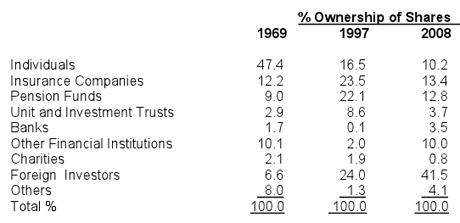
The table below shows the structure of shareholding in the UK listed companies.

The biggest change is the massive reduction is share ownership by individuals and the increase in foreign ownership by rich oligarchs, sheikhs, sovereign funds, hedge funds, offshore funds and private equity investors. Even 100 years ago, foreign companies were listed on the London Stock Exchange and UK and foreign individuals could hold shares in them. But with the increased mobility of money, their numbers have expanded.

There is little evidence to show they are interested in corporate governance issues. If foreign investors choose not to vote on executive remuneration packages, the UK government is hardly in a position to impose sanctions.

Individuals also indirectly hold shares through insurance companies, pensions funds and banks, but in these cases they do not have the right to appoint directors or mandate managers of these organisations to vote on AGM resolutions. Besides, corporate pay levels elsewhere form the benchmark for remuneration of mangers of financial institutions. Their incentives for curbing executive pay are low.

At the moment, the outcome of AGM resolutions is advisory rather than binding on directors. Even if that was changed and shareholders mustered some courage to shackle directors, they can easily be defeated because directors and their representatives are permitted to cast thousands of delegated proxy votes.

Voting rights should be given to other risk-bearers too and to those with a long-term interest in companies. Banks provide an interesting example. The leverage ratio of many banks shows that shareholders do not bear the main risks or provide most of the risk capital.

A bank with 10 billion pounds of equity and 100 billion pounds of assets in its balance sheet is said to have a leverage ratio of 10:1. In other words, for every 10 pounds of investment by shareholders, it borrowed 90 pounds.

In 2007, Barclays Bank had a leverage of around 39:1; Royal Bank of Scotland 31.2:1; HSBC 21.3:1; Lloyd’s TSB 31:1, Lehman Brothers 31:1 and Bear Stearns 33:1. Most of the long-term finance to banks is provided by savers and lenders.

Therefore, they should have the right to vote on executive remuneration, as well as for appointing directors. Employees have a long-term interest in the wellbeing of companies as their jobs and pensions depend on them. They are in a strong position to know whether the bosses deserve high rewards and should the right to vote too.

As UK politics is drifting to the right, democratisation of corporations is unlikely. Shareholder empowerment is unlikely to solve the problem of excessive executive pay.

This article first appeared on The Conversation website

Tuesday, 6 December 2011

Nick Clegg's plan for shareholders to tackle fat-cat pay won't work


Today's shareholders are often foreign, functioning more like traders than owners – why would social justice bother them?

Prem Sikka

The deputy prime minister, Nick Clegg, and the business secretary, Vince Cable, are on a charm offensive. People facing wage freezes are being told that the government will crack down on runaway executive remuneration. A key mechanism is to encourage shareholders to take a more active role, whatever that might mean, because in the words of Clegg, "they own the companies, after all". The evidence shows that such claims are flawed.

In the last 30 years there have been massive changes in shareholding patterns. Shareholders are now traders in shares rather than owners. They have little long-term interest in a company and little inclination to invigilate them in the public interest. The table below is compiled from various surveys published by the Office for National Statistics and shows the pattern of share ownership in UK-listed companies:

Despite the giveaway of shares in privatisations and tax incentives to buy shares, for example through ISAs, direct share ownership by individuals has declined dramatically. The foreign ownership of UK companies has increased and 41.6% is held abroad by oligarchs, sheikhs, sovereign funds and foreign entities. A major change not captured by the above data is that the average duration of share holdings has fallen from around five years in the mid-1960s to around two years in the 1980s, and by the end of 2007 it declined to around 7.5 months. I know of financial institutions who now churn their portfolio every three months to pick winners, and that trend is already consolidated in banks. In October 2011, Andrew Haldane, a member of the Bank of England financial policy committee noted that "average shareholding periods for US and UK banks fell from around three years in 1998 to around three months by 2008. Banking became, quite literally, quarterly capitalism".

So the government is planning to tackle fat-cat pay by empowering shareholders. That did not happen even when a vast majority of the shares were held in the UK and for a longer duration. It certainly is not going to happen when shareholders have a short-term interest and primarily function as traders and speculators, rather than as owners. It is difficult to see why oligarchs, sheikhs and other foreign owners would be bothered by high levels of executive remuneration as their main concern is the returns on their investment rather than any sense of social justice in the UK. Individuals may have indirect ownership through insurance companies and pension funds, but they do not elect directors and cannot mandate these entities to vote in any particular way. In any case, directors of these entities have incentives to maintain high executive remuneration because it provides the benchmark for their own rewards.

Even if some shareholders could muster a resolution at the annual general meeting (AGM) to oppose fat cat pay, their chances of success are slim: directors are permitted to cast thousands of votes to defeat any unwelcome resolution. Even if a resolution is passed it is only advisory rather than binding on directors. In Clegg's world, shareholders are not only the owners but also the main risk-bearers. This is not quite so either: the banking crash has vividly demonstrated that risks are borne by savers and taxpayers. Shareholders have the benefit of limited liability but taxpayers have virtually written a blank cheque. At many other entities, shareholders only provide a minority of the finance capital and thus do not bear all the risks. In any case, their liability is limited. Employees also bear a heavy cost because their jobs and pensions depend on corporate wellbeing.

To curb fat-cat pay, the government needs to empower those with the long-term interests in a company. This requires not only putting employee representatives on remuneration committees, as Clegg is hinting, but putting them on company boards and changing the way the UK companies are governed. The debate about democratisation of major corporations is long overdue.

*This article first appeared at Guardian Comment is Free

Friday, 3 June 2011

Madhouse economics with lunatics in charge


Where has all the wealth of this country actually gone?
by Prem Sikka
Friday, June 3rd, 2011

Britain’s economic landscape is blighted by economic misery and social exclusion. Nearly 2.5 million people are officially unemployed and 1.5 million are working part-time but would like a full-time job. Youth unemployment is heading towards the one million mark and graduate unemployment is around 20 per cent. Approximately 13.2 million people, including 2.8 million children and 1.8 million pensioners, are living in poverty. Britain’s state pension, as a percentage of average earnings, is the lowest in western Europe. Some 15 per cent of high street shops are empty and the Government’s austerity measures are set to deepen the misery. This is the stark reality of the world’s sixth largest economy and the third largest in Europe. So where does all the wealth go? The answer to this question is crucial because it has a bearing on the possibilities of building a sustainable economy and society.

This country’s gross domestic product has grown from the 1976 figure of £621.22 billion to a current estimate of £1,318.31 billion, but has not been accompanied by equitable share for working people. In 1976, salaries and wages paid to workers accounted for 65.1 per cent of GDP. Following mass privatisations, the demise of skilled jobs in the manufacturing sector and the weakening of trade unions, this declined to 52.6 per cent of GDP in 1996. Following the introduction of the national minimum wage and expansion of the public sector, workers’ share rose. It is now in decline again and stands at 54.8 per cent of GDP. The indications are that, at some companies, the workers’ share of value added is running at less than 50 per cent. Many are facing wage freezes and loss of pension rights. The Government is reviewing employment laws which will inevitably further shrink workers’ share. Of the 200,000 new jobs created in the last year, only 3 per cent are full-time and many do not give employees statutory rights to pension, sick pay or holidays.

All this tells only a partial story, because corporate executives have taken the largest slice of the shrinking share. A recent report by the High Pay Commission shows that, between 1997 and 2008 when Labour was in power, income for the top 0.1 per cent of the population grew by 64.2 per cent, while that of an average earner increased by just 7.2 per cent. A typical FTSE 100 executive receives a pay package of £3.7 million – nearly 145 times more than the average worker.

These trends have resulted in 50 per cent of the population owning less than 1 per cent of the national wealth. The Sunday Times 2011 Rich List shows that the 1,000 richest people in the country have amassed wealth of £395.8 billion, an increase of £60.2 billion since 2010. With wealth of £4.2 billion, Sir Philip Green is listed as the 13th richest person. Many of his employees still receive the minimum wage.

The state has not collected a higher share of the GDP in taxes to enable it to redistribute wealth. In 1976-77, taxation took 43 per cent of GDP. By 1995-96, the tax take declined to 37.2 per cent of the GDP, rising to 38.6 per cent in 2007-08 and back to 37.2 per cent in 2010-11. This decline is one of the reasons behind the brutal public expenditure cuts and loss of welfare rights. The state, or the public share, of taxes has declined even though more people are in work, there are more billionaires than ever before and the corporate sector enjoyed, before the recession, record rates of profitability.

Corporations have been the biggest beneficiaries of government policies, as successive governments have shifted taxes away from capital to labour, consumption and savings. Hikes in VAT and National Insurance contributions are a reminder of this major shift in policy. Income tax personal allowances have not kept pace with inflation and more individuals have become liable to higher rates of income tax at middle earnings. For example, the freezing of personal allowances in the 2011 Budget may result in another 750,000 people paying the 40 per cent higher rate of income tax.

Successive governments have been engaged in a race to the bottom and have appeased the corporate lobby by reducing corporate taxes. In 1982, the rate was 52 per cent of taxable profits. By 2007, it declined to 30 per cent. It is set to be further reduced to 23 per cent by 2014 and corporations are demanding even lower taxes.

The supporters of corporations will point to the fact that, in 1979, corporation tax receipts of £4.6 billion accounted for 5.4 per cent of total tax revenues. Last year, they rose to £38.5 billion and accounted for 7 per cent of the total tax revenues. However, this does not tell us the amounts that they should be paying, as corporations and wealthy elites have become very adept at shifting incomes and profits by using opaque structures and schemes to avoid taxes. For example, Boots, the high street chemist, now has its headquarters in Switzerland to enable it to avoid British taxes. Google dominates the internet and its revenues from this county have soared to £6.35 billion over six years, but the company is estimated to have paid only £8 million in corporate tax.

The United Kingdom is the home of a destructive global tax avoidance industry, headed by major accountancy firms: KPMG, PricewaterhouseCoopers, Deloitte & Touche and Ernst & Young. Various economic models suggest that, due to organised tax avoidance, we may be losing around £100 billion tax revenues each year. Inevitably, this has reduced the tax take, increased the national debt and threatened hard-won welfare rights.

The claim is that reducing corporate taxes somehow stimulates investment and creates jobs. Such a thesis is very simplistic and ignores the availability of skilled labour, education, training, infrastructure and disposable income of ordinary people. A recent study by the Canadian Centre for Policy Alternatives concluded that: “As a means of stimulating growth, employment and even private business spending, the historical evidence suggests that business tax cuts are both economically ineffective and distributionally regressive.”

The reduction in workers’ share and the state’s share of GDP means that more is available to corporations and their shareholders in dividends. This does not mean that their resources necessarily stimulate the UK economy. According to a government study, individuals in Britain own around 10 per cent of the shares listed on the London Stock Exchange. Investors from outside this country own 42 per cent of the shares listed on the London Stock Exchange and a variety of insurance companies, pension funds, unit trusts and investment trusts. Banks own the other 48 per cent. This means that a vast amount of dividends flow out of Britain and are not subject to UK tax.

A few years ago, Sir Philip Green’s business empire paid a dividend of £1.3 billion. Of this, £1.2 billion was paid to his wife who was resident in Monaco and thus escaped a tax of around £285 million, which would have been payable if she resided in the UK. Many private finance initiative companies use tax havens to avoid taxes on payments made to them by British taxpayers.

The current distribution of income and wealth will not facilitate a sustainable economic recovery. Ordinary people spend money on everyday things such as food, transport and clothing and thus generate a greater multiplier effect compared to the concentration of wealth in relatively fewer hands. Yet the UK trend has been in the wrong direction. There is no evidence to support the contention that feeding fat cats somehow percolates wealth downwards. The obsession with reducing corporate taxes has not been matched by any boom in private sector investment and jobs.

Too many people already make ends meet by borrowing and that was one of the factors behind the banking crisis. Yet the Government has learned nothing from that. Rather than redistributing wealth or pursuing progressive taxation policies, it expects ordinary people to take on even more borrowing to stimulate demand. Personal household debt is already £1.62 trillion, bigger than Britain’s GDP and the largest per capita in Europe. The Government expects it to reach £2.13 trillion by 2015. These are the economics of a madhouse. There is so sign of any sustained attack on organised tax avoidance or broadening of the tax base by considering financial transactions tax, mansion tax, wealth tax, monopolies or land value tax.

Prem Sikka is professor of accounting at the University of Essex

This article first appeared in Tribune magazine

Tuesday, 15 March 2011

Just what is fair pay?


The report of Will Hutton's Fair Pay Review was published today (download from HM Treasury website). To call it a 'damp squib' would be to oversell it. The long touted 20:1 ratio between high and low earners in public sector organisations was abandoned as "illogical". Instead the main proposal is that pay differentials are published and 10% of the earnings of top public sector chiefs be subject to performance-related targets.

Nevertheless the whole debate about pay does raise some interesting questions, about how much people earn, what is fair and how we can judge it.

The Prime Minister and Local Government Minister Eric Pickles have highlighted public sector chiefs, especially in local councils, earning more than the Prime Minister. Peter Wilby writing for Public Finance describes their "campaign against public sector pay" as "pernicious, small-minded and innumerate" pointing out that cuts in council bosses' pay would go nowhere in ameliorating the funding cuts.

Wilby also point out that a council chief executive on c.£200,000 per year compares well with the equivalent in the private sector. Indeed the PCS union highlights executive pay in the outsourcing companies that have taken advantage of privatisation:

Capita: Chief executive, Paul Pindar - £1,618,218
G4S: Chief executive, Nicholas Buckles - £1,656,251
Hewlett Packard: Chief executive, Mark Hurd - $23,863,744 (£14,842,760 at exchange rate on 14 March 2011)
Serco: Chief executive, Christopher Hyman - £1,578,662

These bosses were the subject of an excellent Dispatches programme on Channel 4 last night.

It's also worth pointing out that private sector bosses have one outcome to hit: profit. Public sector bosses have a whole range of outcomes against which their performance is measured with financial management just one among many. For NHS bosses there will be a range of health outcomes, community engagement, and equalities targets - to mention just a few.

But the questions about elite of high earners in the public sector distract from the very real problems of low pay in the sector. For example the average civil servant earns £22,850 per year, and there are thousands on little more than the national minimum wage.

The questions of comparison are also more stark. It's easy to justify a £200,000 council chiefs salary in comparison with a corporate chief exceuitive managing a similar budget on seven times as much pay. However in what way is that same council chief executive worth 19 cleaners on the national minimum wage (and many are) or 8 police officers or 10 nurses? Is a GP worth 3.5 nurses? Is a FTSE 100 CEO worth 16 GPs?

The reality is in a capitalist society there is no link between earnings and social value (even if we could define such a concept). We therefore should make two things necessary: 1) that no one is paid a wage that excludes them from the rest of society; and 2) that we have a redistributive tax system that compensates for the market failure in wages.

Of course this excludes discussion of the millions not in work (pensioners, the unemployed, students, the ill or disabled, children). Just consider, Jobseeker's Allowance pays £3,403.40 this year and the basic state pension £5,077.80.

Will Hutton has failed to address the limited remit he was given, but the wider issues his study raises must be the subject of ongoing campaigning against poverty pay and poverty benefits.

Monday, 14 February 2011

Keep the corporate fat cats in check

In the week the bonus bonanza began again, Austin Mitchell MP and Prem Sikka argue that workplace democracy is the only way to curb executive excess


The Tories are now embarked on a process dear to their hearts by squeezing the poor, slashing benefits and public services and punishing the people for the crimes of the banks. Their Liberal Democrat co-conspirators are busily trying to persuade themselves that targeting women, children and the poor is somehow “fair”. Neither seems to notice the extent to which companies and those who run them are back in the greed game.

The Government preaches wage and pension cuts for public servants and demands that no one should be paid more than the Prime Minister. Yet no one has the guts to demand the same sacrifices of the private sector, even though private sector excesses are far more damaging to social cohesion.

A recent survey by Income Data Services shows that directors of FTSE 100 companies have seen their pay rise by 55 per cent to an annual average of £4.9 million each. FTSE 100 directors received average bonuses of £701,512 – more than many people collect during their entire working lives. This is an increase of 34 per cent on the previous year. Average wages for the same period rose by 3.6 per cent.

Bankers have brought the economy to its knees, but still get their executive bonuses. Barclays Bank is paying more than £2 billion in bonuses. Goldman Sachs is paying around £8.068 billion in executive pay and bonuses. The state-funded Royal Bank of Scotland has announced a third quarter pre-tax loss of £1.4 million, but will pay out £2 billion in bonuses. The gamblers – investment bankers – will receive an average bonus of £110,000. The new boss of the state-funded Lloyds Banking group is to collect an estimated package of £8.3 million. Lehman Brothers is in bankruptcy but still wants to pay out £20 million in bonuses.

All this constitutes a major scandal. Labour did all too little to check the antics of the fat cats and the resulting social inequalities. The corporate lobby has effectively bought political parties and calls to control it lead to claims that executive pay is the outcome of market forces and set by remuneration committees consisting of independent directors.

The fat cats claim to work long hours to create wealth and feel they deserve more for that. However, wealth creation is a co-operative effort involving the investment of finance, human capital, local communities and social infrastructure. Why should the fat cats gobble a disproportionately large slice of the pie?

The claims of the super-rich must be countered. Here are some pointers.

The old boys’ (and old girls’) networks effectively make the market for fat cats. There are no such things as equal opportunities or free markets when it comes to executive appointments. Workers and representatives of local communities and other stakeholders are excluded from boards. They give their blood, brawn, brains and sweat to generate profits, but have no say in how the financial pie is divided or whether the bosses are worth their large pay cheques. Even the shareholder vote on executive remuneration is only advisory and not binding on company directors.

Executive remuneration is under the control of a small, well-connected economic elite masquerading as “independent directors’ on remuneration committees. These elites are rarely elected but usually handpicked by executive directors. The remuneration handed out to their friends also pushes up their own benchmark salaries. Reckitt Benckiser supremo Bart Becht collected £90 million. His company’s four-man remuneration committee includes Graham Mackay, chief executive of SAB Miller, who took home £13 million.

The mutual back-scratching is demonstrated by Tesco’s remuneration committee, which is staffed by millionaires. These include Karen Cook, managing director of investment bank Goldman Sachs International and president of Goldman Sachs, Europe; former ITV chief executive Charles Allen, who is also chairman of Global Radio, EMI Music, and a senior advisor to Goldman Sachs; Patrick Cescau, former chief executive of Unilever; Ken Hanna, chairman of Inchcape PLC and former director of Cadbury, Dalgety, United Distillers and Avis Europe; Rodney Chase, non-executive chairman of Petrofac Limited and a non-executive director of the Computer Sciences Corporation in Los Angeles, the Nalco Company in Chicago and the Tesoro Corporation in San Antonio; Harald Einsman, a director of the Carlson Group of Companies, Harman International Industries Inc and Checkpoint Systems Inc in the United States. Einsman is also on the board of Rezidor AB in Sweden.

Tesco’s 2010 annual accounts show that the average salary of its 372,338 full-time equivalent employees, inflated by the inclusion of executives, was just over £16,500. The average for ordinary workers is considerably less. Many Tesco employees have to apply for tax credits and social security benefits to keep their heads above water. Yet chief executive Terry Leahy picked up £17.9 million in pay, bonuses and share options. No wonder Sir Terry can contemplate retiring at the ripe old age of 54 and seek comfort in his pension pot of £15 million. His employees do not have that luxury.

Let us suppose that, because of their genetic make-up, fat cats are somehow better endowed with creative and innovative talent. It still does not follow that they automatically deserve huge rewards. Their genetic disposition is purely due to an accident of birth, a lottery of nature. They have done absolutely nothing to create those genes. It is the outcome of centuries of social interaction and not the creation of any single individual, clan or family.

Genetic endowments are the outcome of food, healthcare, water, medicines and many other forms of social support provided by society at large. Since fat cats are not the creators of any genetic advantage, their claims to appropriate the economic benefits can’t be sustained.

Even if we concede that some fat cats have superior skills, they cannot be brought to fruition without the appropriate social arrangements. Bankers speculate on financial markets in order to make money. That is not made by their individualistic endeavours alone. They must enter into financial contracts with other companies. Through the Companies Act, the state is the ultimate creator of all companies. Without due process of the law, companies cannot be created. Corporate contracts need to be enforced with the public provision of courts, the judiciary and the police. Indeed, without particular social arrangements market contracts are not feasible.

Further, society provides education and healthcare for bankers. It provides public transport and social infrastructure to enable bankers to travel and plug their computers in. It tests food and medicines for their nourishment. It even bails out bankers who squander other people’s savings. The profits made by bankers, no matter how clever, cannot be made by them alone. So they have no moral, ethical or natural claim for appropriation of so much wealth. That right lies with society at large.

It could be argued that someone has to be energetic and far-sighted enough to spot gaps in the markets, provide innovative products and services or use social resources to generate new wealth. In recognition of that, society may be willing to give them extra rewards. Yet precisely how much extra must be a matter for public debate. It must have due regard for social welfare.

Thousands of workers are not been made better off by the telephone number salaries of executives. Ordinary people’s freedom to improve their life chances and opportunities for their families are impaired by the grossly unfair distribution of wealth.

The same fat-cattery has also impoverished the pension prospects of workers as, instead of returns to members of pension schemes, the wealth is gobbled-up by executives. Many toil in sweatshops and poor working conditions because executives prefer to collect fatter pay cheques rather than invest in health and safety. Stop excessive rewards and we benefit as customers through lower prices.

Britain’s skewed distribution of wealth damages democratic participation. The wealthy can set up think tanks, control newspapers, radio and television stations and shape public choices through donations to political parties. Apologists frequently defend excessive executive rewards by claiming that wealth will somehow trickle-down. However, no means of achieving this have been identified and managers who have made disastrous decisions continue to collect huge rewards – as happened with the banks.

Nor has any satisfactory way of measuring executive performance been devised. Directors at WorldCom and Enron reported higher corporate earnings. Subsequently these were discovered to be the product of fraud and creative accounting.

The main reason for excessive executive rewards is simple. It is the control of boardrooms by economic elites. That needs to be dismantled by democratisation of companies. Labour must seek to ensure that employee representatives are on the boards of all large companies. Executive contracts need to be publicly available.

Corporate stakeholders, including employees, should be able to vote on executive remuneration. If employees, shareholders, borrowers, depositors and others feel that directors deserve their gigantic pay cheques, then all well and good. However, unless stakeholders are getting a fair share of the wealth they are unlikely to support massive executive salaries.

Democracy may be anathema to corporate barons. But it is the only way of checking their greed and promoting social justice.

This article first appeared in Tribune

Monday, 8 February 2010

Payday mayday

All three political parties and all the bosses' organisations are uniting to ensure you won't get a pay rise this year. All of them are calling for pay freezes to differing extents: Labour, Conservative, Liberal Democrat, CBI, IoD, BCC.

The false divide created between public sector workers and private sector workers is nonsense. This is about making ordinary workers no matter which sector pay for the crisis. Meanwhile the bonus culture continues in the banking sector and the UK remains the most unequal its been for three generations.

Research published today by the Labour Research Department (LRD) shows that "a third of all pay deals now included a pay freeze - the largest proportion since the recession began".

This is very bad news. Inflation is currently 2.4%, expected to average over 3% this year and peak at over 4% in the summer. Therefore a pay freeze is a real terms pay cut. And as LEAP showed last year, in our Inflation Report 2009, inflation is often highest for the lowest paid.

The effect of the contraction in wages and rising unemployment last year is shown in the number of personal insolvencies, rising to 135,000 in 2009 - an increase of 26% on 2008.

Lewis Emery, LRD report author, says that "Maintaining jobs and business continuity is a greater concern, both in the private and public sectors, but with inflation at 2.4% pay will not be neglected either."

Unions and workers certainly cannot afford to ignore pay - especially for the lowest paid. And any Government wanting to address the crisis needs to move away from the rhetoric of pay freezes and start raising pay significantly to stimulate demand and avoid mass mortgage and loan defaults causing another bank collapse.

9 Feb Update: The Daily Telegraph reports that more than 1.4 million households were visited by bailiffs collecting unpaid council tax bills last year. This is a rise of 700,000 in just three years, and a 69% rise since 1997.

Monday, 14 September 2009

Performance-related pay? Hypocrisy rules in UK plc

The Guardian reports that UK executive pay has risen by 10% in the last year - this is a year in which the share values of these companies had a record decline. Many of the finance companies would not even be in existence today were it not for the public bailouts and liquidity injections.

These companies have laid off hundreds of thousands of workers in the last year to make savings and many more workers are suffering short-term working.

With the Government and private sector employers calling for pay freezes for low paid workers, this should be a wake-up call to trade unions and workers who once again are being forced to pay for a recession not of their making.

The TUC is meeting in Liverpool this week - let's hope some militancy and unity will emerge.

Tuesday, 23 June 2009

Banking sector greed continues

Yesterday it was announced that the new Chief Exective of the Royal Bank of Scotland, Stephen Hester, is in line for a £9.6 million pay package this year.

It's worth bearing in mind that RBS would have gone to the wall without the state bailout last year. We warned at the time that owning the banks without controlling the banks would lead to a return to the same greedy practices which caused the UK banking collapse.

Since being saved with taxpayers' money, RBS has announced over 10,000 job cuts. Our 70% stake in RBS has not saved jobs, but is now being used to pay one individual nearly 3000 times what ex-RBS staff will be receiving on the dole.

LEAP Chair, John McDonnell MP has tabled EDM 1721 'Banking Sector' calling on the Government to "intervene to control the banks in which it has a public stake and legislate to ensure the interests of bank workers and customers are prioritised by the banks rather than the bonuses, pay and dividends of executives and shareholders who caused the UK banking crisis."

The issue is well covered in today's Morning Star.