Showing posts with label economy. Show all posts

Saturday, 7 July 2012

Bankers try more of the same to solve crisis

From the Morning Star

Alarmed Bank of England policy-makers pressed the red button today and printed another £50 billion to try to boost the struggling British economy.

The bank's Monetary Policy Committee voted to increase the quantitative easing programme from £325bn to £375bn in a desperate attempt to drag the country out of a double-dip recession.

It held interest rates at a record low of 0.5 per cent.

They took the decision amid signs that the economy deteriorated in June, with the construction sector in reverse and the services sector suffering its worst performance for eight months.

The bank said the decision to pump more money into the economy came as Britain's output had barely grown for a year and-a-half amid signs its main export markets are slowing.

Left Economics Advisory Panel co-ordinator Andrew Fisher said: "The use of quantitative easing is based on the assumption that our economic system is in crisis due to a lack of available credit.

"But the economy does not suffer from a lack of credit - it suffers from a lack of demand.

"Unemployment, underemployment and wage constraint have all produced a situation in which living standards are falling.

"The Bank of England's now £375bn quantitative easing programme has clearly not been used to extend credit to meet any growing demand.

"Instead, the banks have used the extra liquidity to speculate in derivatives markets and to invest in safer foreign markets. It's good for the banks, but bad for the UK economy."

TUC leader Brendan Barber added: "This will only stop things getting even worse, not kickstart the economy."

Friday, 30 March 2012

Measuring the economy - rethinking the growth obsession


Yesterday the OECD predicted the UK economy would contract in the first quarter of 2012. It led the news for a while (pre-Galloway), vying for contention with pricier pasties and petrol pump panic.

The state of the economy is a vastly more important issue than both of those things, yet the way in which it is reported perhaps explains why people are more interested in pasties - and perhaps why they're right to be.

Firstly, we should define 'recession'. A technical recession is widely agreed to be two consecutive quarters of 'negative growth'.
Negative growth is a ridiculous term: economists' jargon when the English language provides ample alternatives: contraction, shrinkage, reduction. I personally favour 'contraction'.
At the end of each quarter (of a year, i.e. three months), the government (and indeed governments around the world) announce the level of economic growth - the change in our gross domestic product (GDP).
GDP is value of all the goods and services produced which includes private and public consumption, government expenditure and investments, as well as exports less imports.
So if there is economic growth then GDP has risen (relative to the last time it was recorded). If GDP has declined, then there is contraction (aka negative growth).

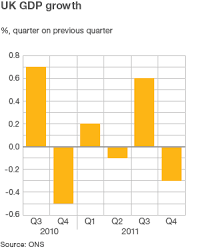
So back to the OECD, which predicted that in the first three months of 2012 the UK economy will have contracted by 0.1% - following a contraction of 0.3% in the last three months of 2011.

Leave aside that many close watchers of UK economic trends think the OECD has got it wrong anyway (especially after the economic boost of all the panic petrol buying), but even if the UK economy has contracted by 0.1%, what does that mean?

Well we know what it means technically: that the value of all the goods and services produced has contracted by 0.1% in the last three months. And if that is for a second consecutive quarter, as would be the case in the UK currently, then it would be a technical recession.

Somewhat illogically the economy is not in recession if it contracts by 2% in one quarter, grows by 0.1% the next and then contracts by 1% the one after. Yet two consectutive quarters of 0.1% contraction are a 'recession', even though the former case is worse.

So it's clear to me we should change our definition of recession to something that more accurately tells us the state of the economy: so how about a technical recession being redefined as contraction over an annual basis. In other words, if we look at the average of the last four quarters (or year, as most people know it).

But what does any of this mean to anyone personally or - to be less individualistic - to a community or to the economy?

Is growth that relevant? What does Mr Wilson or Ms Patel do when they hear the economy has contracted by 0.6%? A: About the same as they do when they hear the FTSE has dropped 1%. Fuck all, because it doesn't really much matter (and there's not much they can do about it).

What matters to people is their own living standards, the inequality in their community, the level of unemployment. And surely we (as fellow socialist readers of this blog) want an economy and economic measures that treat people as paramount.

So here's what's important: how does the change in your income relate to the change in inflation? That matters whether you're in waged work or receiving out of work benefits. It measures whether your living standards have risen or fallen.

Or what about the gap between rich and poor? Numerous researchers including Wilkinson & Pickett and Danny Dorling have shown the damaging effects of inequality on life chances through a variety of metrics.

And then there's unemployment - undoubtedly bad because of what it means for the individuals concerned, and also economically inefficient because it means we are paying for talent to be left idle (receiving benefits) instead of enabling that person to contribute to the economy (pay taxes).

So instead of measuring badly what matters less, why not prioritise measuring what matters most:
  • Living standards
  • Inequality
  • Unemployment

Because next month (on 25 April), despite the OECD's prediction, I suspect that the news will be reporting that the economy has returned to growth (probably only 0.1-0.4%) and Osborne will be welcoming it as a new dawn and an endorsement of austerity - only for the economy to contract in the second quarter.

This obsession with growth encourages politicians (as those from all parties did) to ignore rising inequality and do nothing about unsustainable debt-fuelled growth.

As Ann Pettifor said on Newsnight (watch online) (discussing the OECD prediction) the government should have used the budget "to spend on infrastructure, which would create jobs to create the income to pay back the debts".

That way, we'd reduce unemployment, increase living standards, reduce inequality and, also, generate stable economic growth.

The reality is that Osborne's austerity policies mean rising unemployment, falling living standards for most, and rising inequality. Bad for people and bad for the economy.

If we, as the left, want a new economy then we should be emphasising new ways of measuring its performance too.

Tuesday, 26 July 2011

GDP figures expose Osborne's economic ineptitude


GDP figures today show the economy grew by a pitiful 0.2% in Q2 of 2011, throwing the OBR's growth estimate way off course - meaning Osborne must now focus on growth (but more likely will announce more cuts to deal with an expanding deficit).

In advance of the formal announcement, commentators had been expecting GDP growth to be within -0.5% to 0.5%. This in itself tells a story. Low expectations reflect the failure of George Osborne's economic strategy - his cuts have suppressed growth, as well as causing the inevitable misery: pain without the gain.

All of this has been entirely foreseeable and predicted. Those on the left have rightly argued that unemployment is the main issue Osborne should be addressing, rather than his deficit obsession. Like my Nan used to tell me 'take care of the pennies and the pounds will look after themselves', a new maxim should be 'take care of unemployment and the deficit will take care of itself'.

Osborne's failure to create jobs and growth domestically is being compounded by the failures elsewhere in the world. The eurozone (always unviable IMO) is floundering as the reality of one monetary policy for such clearly different and divergent economies is made clear. Nevertheless there are some common truths for those countries most in crisis: the first being routine and endemic tax evasion and avoidance; the second being the deregulation of the finance sector; and the third, and least commented on, being an absence of manufacturing base in the economy.

This latter point is now being exacerbated by the growth of the BRIC countries (Brazil, Russia, India and China) particularly the latter. The effect on Europe and North America to the new reality of China as a major manufacturing economy (and the other three also catching up) is huge - and has the effect has been exacerbated in the US due to NAFTA, which had already decimated US manufacturing industry. In the UK, manufacturing has dropped by 9% since 2008 Q1.

With none of the three issues: tax justice, financial regulation and manufacturing policy at the heart of any western government's programme, the future economic prospects look bleak however today's GDP figures are spun.

Download the full ONS data and analysis


* Royal Wedding - a final word on the frippery ... in November 2010, the Telegraph reported that the Royal Wedding would boost the UK economy by as much as £620 million. When retail sales figures were published previously, and GDP figures today, the consensus switched to blaming the extra bank holiday for hitting the economy. The ONS today said "There were a number of special factors which may have affected economic activity in the second quarter, including the additional bank holiday for the royal wedding", but later says: "Sales in April may have been boosted by the royal wedding, before falling back in May". So the royal wedding as a special factor may have been a boost to the economy. Regardless, it's effect was minimal and Osborne's strategy is failing.


Update: and back to a serious point, good analysis of the GDP figures and reasons for UK's economic malaise by Unite General Secretary Len McCluskey on the Guardian website, "there is no plan for growth beyond an entirely dogmatic trust in the private sector. The possibilities of, for example, using the state's stake in major banks to drive investment are simply ignored."

Friday, 22 October 2010

Time to end the profit system

The Lib-Con Coalition government’s Spending Review is an attempt to rescue an already bankrupt economy. With £81bn cuts in public spending, it is the biggest and most sustained assault on the public sector since the creation of the welfare state sixty years ago.

But the reality is that despite the ruthless measures announced yesterday, the cuts will hardly make a dent on Britain’s budget deficit, which at £162 billion is the largest of the world’s major economies.

The plan is to bring government borrowing down by £149 billion in four years. This is a 19% per cent cut in real terms, as opposed to New Labour’s proposed 12 per cent. But can this gamble succeed? The very measures intended to reduce the deficit will deepen the crisis.

The one million people who will be thrown out of work and those made homeless will need some kind of support. And whilst blighting the lives of countless citizens, especially the most vulnerable, government spending will continue to rise by an additional £38 billion over the coming four years. As Chancellor Osborne announced: “total public expenditure – capital and current – over the coming years will be £702 billion next year, then £713 billion, £724 billion and £740 billion in 2014-15.”

An additional £7 billion cut brings the total cut in the welfare budget to £18 billion so far. The poorest ten per cent of the population stand to lose the most. It is a monstrous bludgeon expected to achieve just a £5 billion reduction in the £43 billion per year interest payments.

The measures include:

  • a 30% cut in funding for local authorities
  • a 74% cut in the budget for house-building combined with a trebling of rents for new tenants in social housing
  • insecure tenancy of council house dwellers
  • the minimum possible increase for the NHS, that will leave health care struggling to keep up with an aging population and scientific advance
    ending the universal right to Child benefits
  • a 3.4% real cut in education
  • cancellation of major infrastructure projects, like the renewal energy from the Severn Barrage
  • a 10% increase in rail fares
  • a £7 billion cut in the welfare budget
  • Culture Department to be cut by 42% with almost 30% cut for Arts Council
  • up to 30% cuts in budgets for government departments
  • 20% cut in funding for the police
  • rapid acceleration in the process of adding a year to the working life of a man and six to that of a woman before they can claim a state pension
  • huge and damaging reductions in the settlements for Scotland, Wales and Northern Ireland.

    There is certain to be much more pain as the contraction of the global capitalist economy tightens its grip. The attempt to reduce repayments to the money markets will be undermined by tax revenues falling faster as the recession turns to slump. The populist gesture of £2 billion to be raised from a permanent levy on banks will surely be passed on in the form of higher costs of borrowing.

    Cuts in administration of around 30% over four years will lead to a loss of an estimated 490,000 public sector jobs, 8% of the total. The effects of the overall programme confirms consultancy PriceWaterhouseCooper’s estimate of a further 500,000 jobs evaporating in the private sector as spending is reduced and contracts are cancelled.

    The Coalition has issued a sinister threat with its promise that it will always be better to be in work than on benefits. It means that they’re hard at work on schemes to reduce wages across the board. No doubt employers will be rubbing their hands at the prospect of new sources of cheap labour from the enlarged European Union and beyond.

    This is only the beginning. The Spending Review spells out that the capitalist state can no longer afford to fund any of the rights or life-support benefits won by unions in a century of struggle.

    The intention to reduce the wide and complex range of benefits needed by millions of people suffering the effects of three decades of profit-chasing globalisation to an all-encompassing single payment, and a time-limit on the Employment and Support Allowance reflects a profound contempt for the individuals whose needs have been assessed by cohorts of public sector workers. Capitalism in crisis wants to reduce millions of people to bottom-line cyphers of cost before trying to eliminate them altogether.

    Calls outside Downing Street for “French-style” strikes are a welcome move from the total inaction of the Trade Union Congress. But even industrial action needs a political purpose. The desperate gamblers in No10 and 11 are driven by a real economic crisis of the capitalist system itself.

    The solution to the debt mountain comes in the shape of action by People's Assemblies, formed locally throughout the country with a view to defending services, livelihoods, jobs, and homes. Eventually a government formed from a network of people's assemblies will need to take control of the financial sector, cancel the debts and turn it into a not-for-profit service.

    The global capitalist classes are watching to see the results of Osborne’s cruel experiment. It’s time to realise that we too must enter new territory.

    Gerry Gold
    Economics editor, 21 October 2010
    reposted from http://www.aworldtowin.net/

  • Wednesday, 2 September 2009

    Summer's greenshoots, autumnal rain ahead

    Forecasting the economy can be as unpredictable as forecasting the weather. Just ask Gordon Brown. In 2007 he told the City of London it was on the verge of "a new golden age".

    Statistics released over the summer revealed the UK economy shrank by 0.7% in the second quarter - far less than the 2.4% drop in the first quarter of the year. Throughout the summer too, the stock market (both here and in the US) steadily rose, and the housing market rose.

    However, there was bad news in the latest UK manufacturing figures and unemployment continues to rise - to nearly 2.5 million on the ILO measure.

    One comforting statistic over the summer was the decline in the personal debt mountain which was responsible for a massive rise in personal bankruptcies, insolvencies and repossessions over the last few years. Oh yes, and such irresponsible lending by the banks also led to their collapse - nearly dragging the entire economy with it.

    So how did the Bank of England and BBC react to people paying off their debts? With joy or just a prudent encouragement? No, the BBC's Hugh Pym stated "in theory, paying off some of the £1.4 trillion mountain of consumer debt is desirable. But a tendency for people to reduce debts rather than spending may not be helpful to an economy still in recession."

    Quite right Hugh, more debt for the proles, that's the solution! Sadly the BBC doesn't say it's unhelpful when workers' pay, benefit levels, or pensions are cut in a recession . . .

    Sunday, 7 June 2009

    The economy: its worse than you think


    With all the media attention focused on the infighting within New Labour, you'd be forgiven for missing the news that UK GDP fell further than initially thought in the first quarter of 2009.

    Although announced as the worst fall in GDP since 1979 at 1.9%, in fact is now estimated by the ONS to have been 2.2%, as the construction industry contracted more severely - 9%.

    Maybe, while removing the knives from his back (and passing them to Nick Brown to stab back), Gordon Brown has noticed this, and that's why he's appointed Alan Sugar - a man who's Amstrad company employed an imperial 85 people before collapsing into BSkyB, and who turned Tottenham from mid-table also rans into mid-table also rans in his time as chairman. This feature on his media ego trip (aka The Apprentice) I think raises questions about his merits.

    Alan also asked a female interviewee how she planned to look after her children if he gave her a job. Gordon obviously keen to combat the sexism slurs . . .