Showing posts with label business. Show all posts

Friday, 24 February 2012

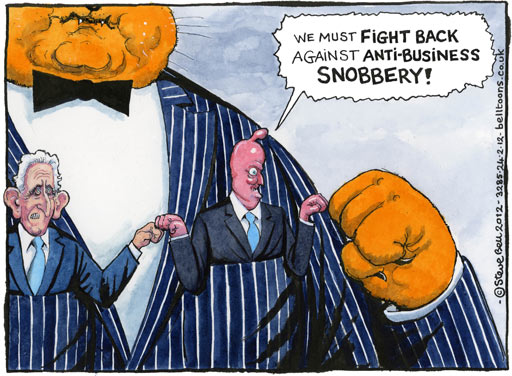
Cameron: Fighter for big business

So much for the Big Society. David Cameron came out swinging yesterday with uncharacteristic passion for big business, not the big society.


Having flirted with 'moral capitalism' (whatever that means), Cameron said he was "sick" of "the snobbery that says business has no inherent moral worth like the state does".

It's been a bad year for big business - not generally in the bottom line: profit margins are doing reasonably well - but, as I told the Morning Star:
"Big business has been rightly pilloried of late for dodging taxes, paying excessive bonuses, rampant profiteering, and now exploiting the unemployed through workfare.

"Cameron's speech is a reaction to the inevitable public distrust and growing anger with his government handing over our schools, welfare system and the NHS to big business.

"Activists should be proud that we have forced the government on the defensive - and keep up the pressure!"
By contrast, David Cameron called on "those of us who believe in markets, business and enterprise" to "fight this mood with all we've got."

Twitter and Facebook have proved effective at both naming and shaming abuses, and are in organising high street protests. Even the Daily Mail and Telegraph have published articles critical of mandatory forced labour.

Cameron's words mean we can expect a concerted onslaught from the governing parties and the old media - mostly reliant on corporate advertising or donations - to convince us that big corporations are rather benevolent institutions.
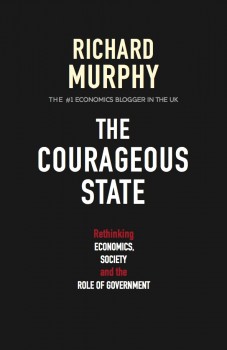
In Richard Murphy's The Courageous State there is a riposte to Mr Cameron: a 20-point charter setting out that "a good business":
  1. Makes clear who it is so people know who they are dealing with
  2. Makes clear who runs it
  3. Makes clear who owns it
  4. Makes clear the rules by which it is managed
  5. Puts its accounts on public record if it enjoys limited liability, and does so wherever it is incorporated whether required to by law or not
  6. Seeks to comply with all regulation that applies to it
  7. Seeks to pay the right amount of tax due on the profits it makes in the place where they are really earned and at the time they really arise
  8. Seeks to pay a living wage or more to all who work for it
  9. Recognises trade union rights
  10. Operates a fair pay policy so that the pay differential between the highest and lowest paid in the company cannot exceed an agreed ratio that should never exceed twenty
  11. Makes fair pension provision for all employees
  12. Does not discriminate between employers on the basis of race, nationality, national origin, gender, sexual orientation, age, disability, and similar such issues
  13. Does not abuse the environment
  14. Has a clear code of ethics that it publishes and is seen to uphold
  15. Is transparent in its dealings with customers
  16. Seeks at all times to minimise risk to those it deals with and takes all steps to ensure they know what those risks are
  17. Accepts responsibility for its failings and remedies them
  18. Works in partnership with its suppliers and does not abuse them
  19. Advertises responsibly
  20. Creates and supplies products meeting real human need

Don't expect Cameron to be writing this charter into corporate law any time soon.


Update: Great Steve Bell cartoon ton today's Guardian
Sunday, 31 July 2011

The Big Issue, Big Society and Social Enterprise: No solution

I read with interest Kit Withnail's blog about the Big Issue earlier this week - which he described as "one of the most foul and conservative institutions working in homelessness in the UK". Kit takes issue with the ethos, while making some very good points about attitudes towards homelessness and sleeping rough.

I was pleased and relieved to read it. Here's why: in 2002, as part of a research project on social enterprise, I interviewed one of the co-founders of the Big Issue in the North (legally separate from John Bird's London-based magazine). (The other co-founder was Ruth Turner, who latterly worked for Tony Blair in 10 Downing Street and then for his Faith Foundation. She was arrested and interviewed by police investigating the 'cash-for-peerages' scandal, but no charges were brought)

What struck me in the interview was that this was someone running a business - indeed it was constituted as a company. I was informed that, at the time, the Big Issue in the North had a £3 million annual turnover, it had 40 employees, it had a chief executive with a company car, it had nine years of trading history, sold 60,000 magazines per week and had a £200,000 profit margin (40% of which came from advertising revenue).

None of these 40 employees are the people from whom you might buy the magazine - the vendors. The business model is that the vendors (often people living on the streets) buy the magazines from the company at half the cover price, and then when sold they pocket the full cover price (i.e. if the cover price is £2 they buy copies for £1 and then sell for £2).*

What in effect this means is that a professional staff produces a magazine subsidised by the homeless vendors, who seemingly have no right to the minimum wage, and are not employed, so no health and safety protection, no paid leave, etc. Remember they're 'working not begging'- but they're working with no rights, at sub-poverty wage levels and are supporting a paid infrastructure of writers, printers, editors and admin staff. I have no hesitation in calling that exploitation. It calls itself "a business solution to a social problem". Except what does it solve - not homelessness (how could it - when it doesn't provide housing?).

The problem I have with the Big Issue is the same one I have with David Cameron (who is guest editing the next issue of the London Big Issue) and his Big Society. It's not a solution, it's a rather poor sticking plaster that moralises over the problem rather than addressing it. The cold reality is that charities and businesses cannot solve the severe social problems that capitalism causes. More than that, they neither have the power nor the intention to do so. So while politicians are destroying the welfare state (especially social security and council housing) more and more people are going to be subject to the whim of these business solutions, social enterprises or Big Society organisations.

It would be wrong to think this process began with the coming to power of the Tory-led coalition government. Labour created a social enterprise minister, and ministers promoted the concept, like Hazel Blears and Liam Byrne, who said shortly before leaving government, "In a climate of spending cuts and a need to reduce the budget deficit over the next few years, social enterprise has a huge role to play in delivering public services".

I don't deny that the Big Issue and other charities, social enterprises or social businesses can do some good and do help some people. But to pretend they are either 'the answer' or a solution is ludicrous. Unless that solution is to make more comfortably off people feel better about themselves. Then it is, as the CPGB once put it, no more than "a hypocritical belch of the well-fed bourgeoisie".

*By the way, unlike the man in the photo Big Issue vendors are instructed to stand to sell the magazine.

I leave you with the excellent 'Flag Day' by the Housemartins: